Facelina quadrilineata (Baba, 1930)
Description
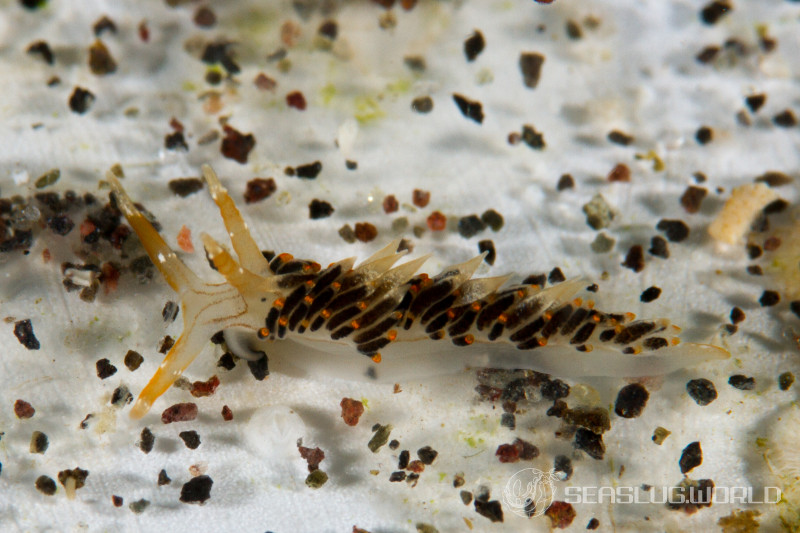
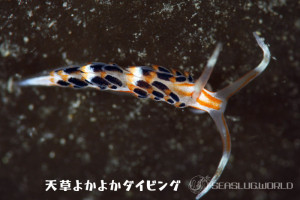
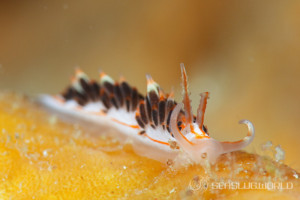
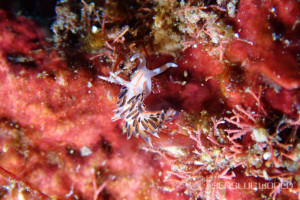
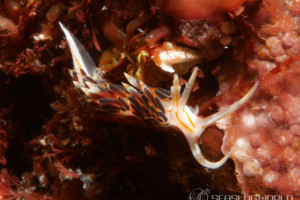
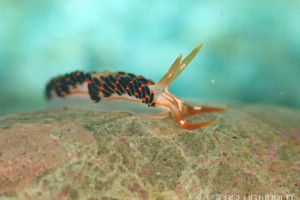
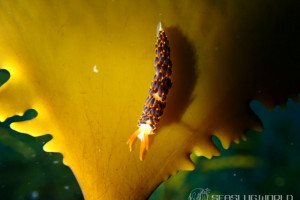
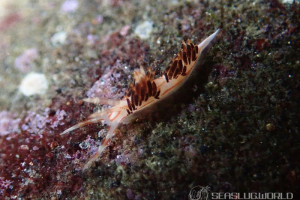
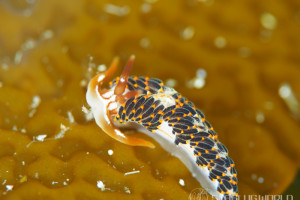
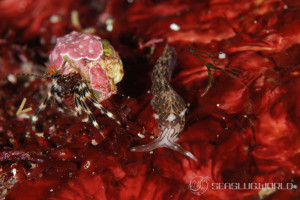
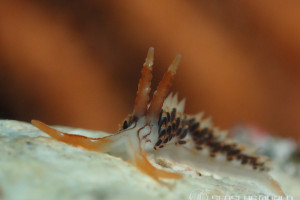
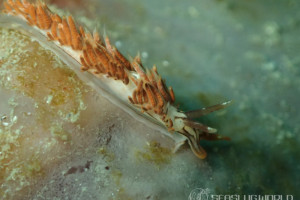
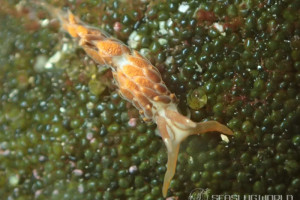
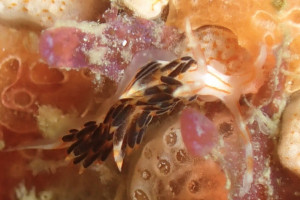
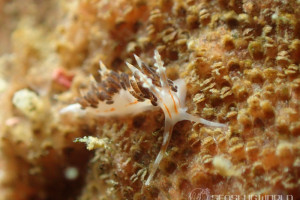
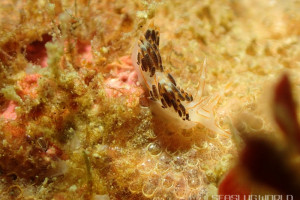
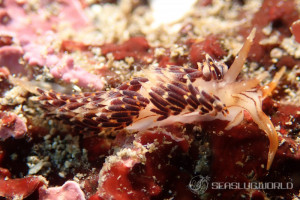
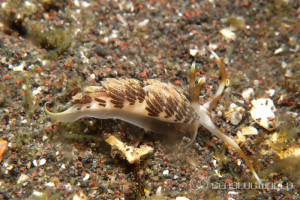
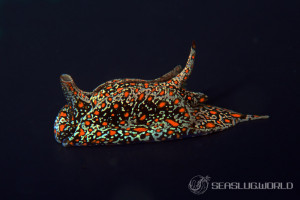
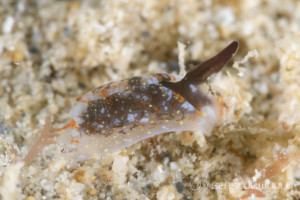
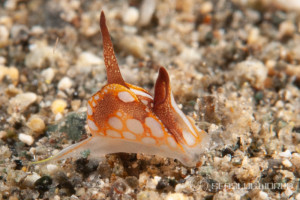
A small aeolid nudibranch, typically 10-20 mm in body length, reaching up to 23 mm.The ground colour of the body is translucent yellowish white, with the orange visceral organs visible through the skin. The most diagnostic feature is the set of four chocolate-brown longitudinal lines for which the species is named: two pairs run from the bases of the oral tentacles to the bases of the rhinophores on the head, and two further chocolate lines extend along each side of the body.
The rhinophores are smooth when fully extended, occasionally showing slight ring-like wrinkles when contracted. The oral tentacles are very slender and roughly equal in length to the rhinophores.
The cerata are fusiform and contain the digestive gland packed with chocolate-brown to black pigment granules, with orange-yellow or yellow tips. They are deciduous and reach at most about eight per row in the largest individuals.
Distribution
The type locality is Takanoshima Islet in Tateyama Bay, Chiba Prefecture, Japan. The species is widely distributed along the Japanese coast: on the Pacific side from Mutsu Bay, Onagawa Bay, Tateyama Bay, Sagami Bay, Shima and Osaka Bay; on the Sea of Japan side from Sado Island, Toyama Bay, Hekurajima, the western coast of the Noto Peninsula, and Tsuruga Bay.It is fairly common in the intertidal zone, where it is usually found beneath pebbles.
Etymology
From Latin quadri- (four) + lineata (lined), in reference to the four chocolate-brown longitudinal lines (two paired streaks on the head and two lines along each side of the body) figured in the original description (Baba, 1930). The Japanese name "Yotsusuji-minoumiushi" (literally "four-striped aeolid") was coined in the same paper for the same character.Remarks
Originally described as Hervia quadrilineata Baba, 1930 from two specimens collected at Takanoshima in Tateyama Bay. The species was subsequently reassigned by Baba to Cuthona (Hervia) quadrilineata (Baba, 1935; 1937), then made the type species of the new genus Facelinella Baba, 1949, and redescribed in detail as Facelinella quadrilineata by Baba 1965. Facelinella is currently treated as a synonym, and the species is placed in Facelina.Hirano & Ito 1998 demonstrated that what had been recognised as a single species in fact comprised a pair of cryptic species differing in penial structure, and described the form with an ejaculatory penis (in which the vas deferens passes through the penial papilla) as Facelina bilineata. In F. quadrilineata the vas deferens opens at the base of the penial papilla and the penis is non-ejaculatory.
References
- ヨツスヂミノウミウシ(新称), Baba, K. 1930c. Studies on Japanese nudibranchs (3). A. Phyllidiidae. B. Aeolididae. Venus 2(3): 117-122.
- ヨツスジミノウミウシ, Baba K. (1949). Opisthobranchia of Sagami Bay collected by His Majesty the Emperor of Japan (相模湾産後鰓類図譜). Iwanami Shoten, Tokyo. 4+2+194+7 pp., pls. 1-50.
- Facelinella quadrilineata (Baba) Yotsusuji-minoumiushi, Baba, K. 1957. A revised list of the species of Opisthobranchia from the northern part of Japan, with some additional descriptions. J. Fac. Sci., Hokkaido Univ.,ser. 6, Zool. 13(1-4):8-14.
- Facelinella quadrilineata (Baba) (= Hervia quadrilineata Baba, 1930), n. comb., Baba K. (1965). The anatomy of Facelinella quadrilineata (Baba) (Nudibranchia: Eolidoidea). Publications of the Seto Marine Biological Laboratory. 12(5): 409-414.
- Facelina quadrilineata comb. nov., Hirano Y.J. & Ito M. (1998). "Facelinella quadrilineata (Baba, 1930)", a pair of cryptic species of Facelina from Japan. Zoological Science. 15(5): 791-797.
- 高岡生物研究会. (2002). 日本海のウミウシ. 第2版.
- ヨツスジミノウミウシ, 中野理枝. (2004). 本州のウミウシ. ラトルズ.
A Kindle field guide by the site author
Kimoto N. (2026). Sea Slugs of Japan & the Indo-Pacific, 2nd Edition.
Kindle Edition
View on Amazon PR (Amazon Associates)Seasonality
Shooting Locations
Loading shooting locations...
Photos of Facelina quadrilineata
















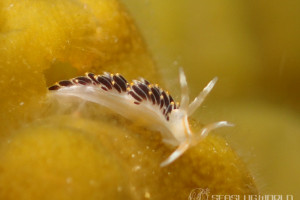
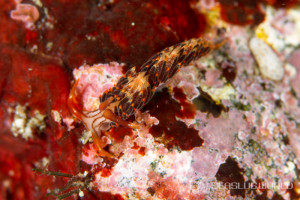

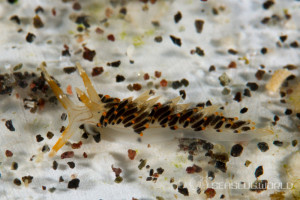
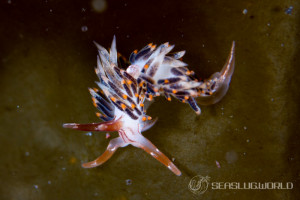
Same Genus Nudibranchs
Similar Colors Nudibranchs


Academic Database
Sea slug observation data is available in international marine biodiversity databases.