Odontoglaja guamensis Rudman, 1978
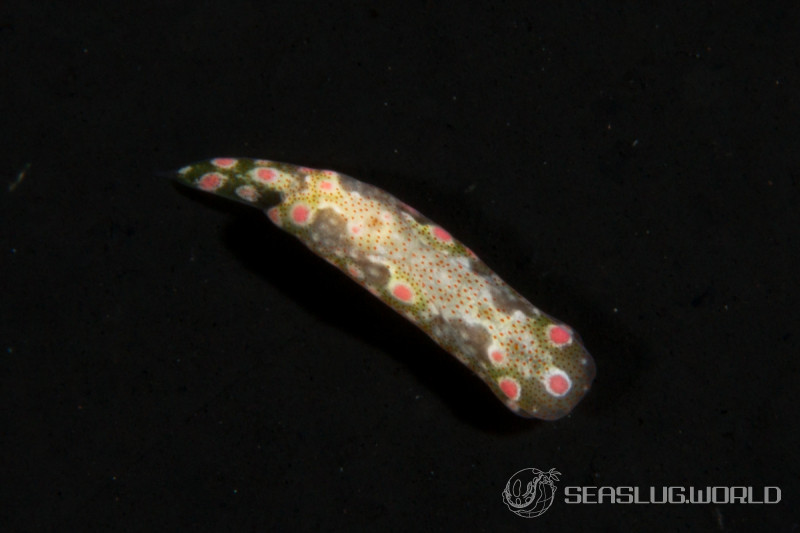
- Location
- Taketomi South, Ishigaki and Yaeyama, Okinawa, Japan
- Date
- 2017/02/14
- Length
- 4mm
- Depth
- 4.0m
- Water temperature
- 24.0℃
Description
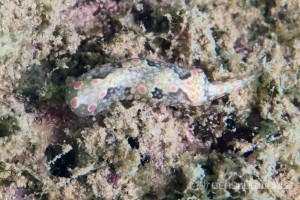
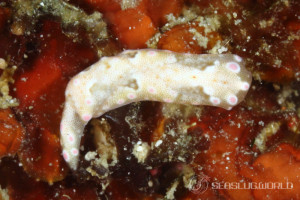
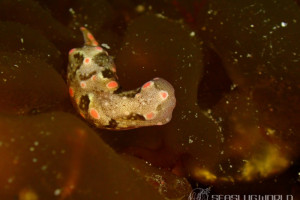
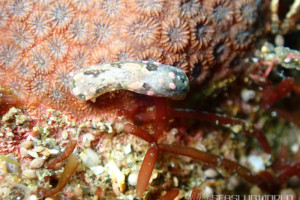
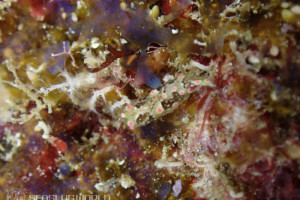
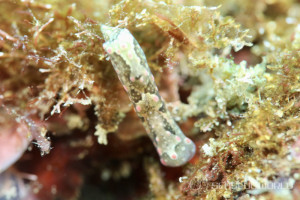
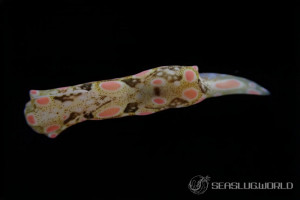
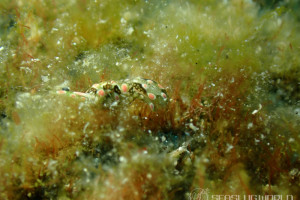
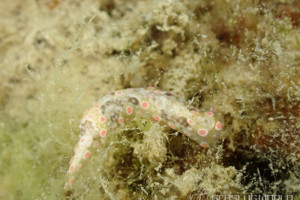
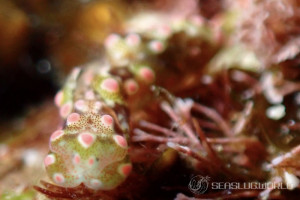
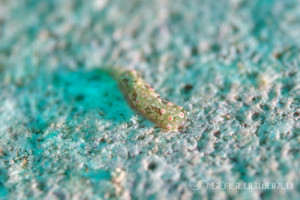
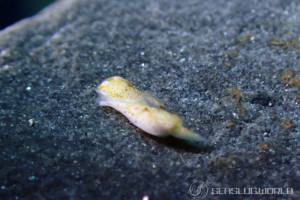
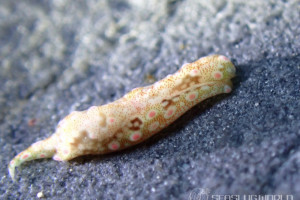
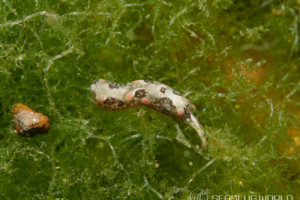
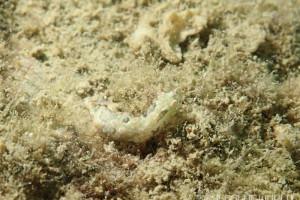
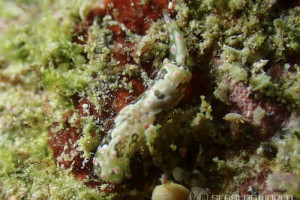
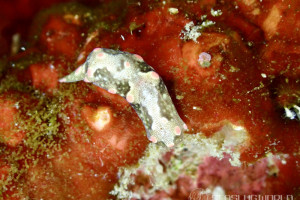
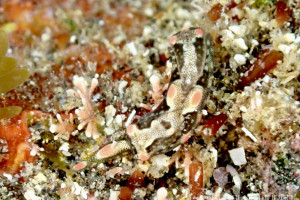
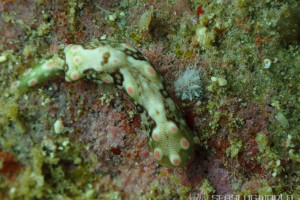
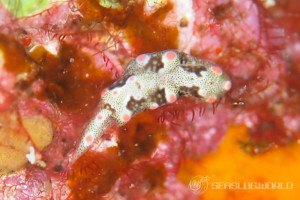
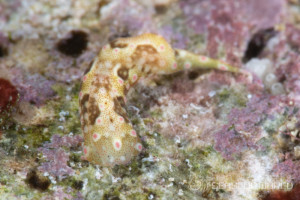
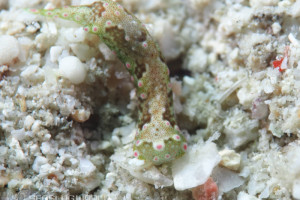
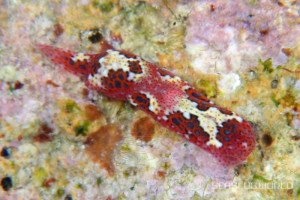
Body narrow and elongate, slightly broader anteriorly and at the posterior shield. Headshield triangular, narrowing posteriorly. Posterior shield rounded anteriorly, with a long tapering "tail" process extending posteriorly from its left side. The foot does not reach the rear of the posterior shield; the parapodia are largest mid-body and fold upward over the gap between the headshield and the posterior shield. The whole animal is covered with low pustules, most prominent on the posterior shield. Eyes visible, set close together at the anterior end of the headshield.Ground colour cream to pale green. Large pustules each bear a central pink spot ringed by a clear halo, giving the appearance of pink-centred targets; smaller pink-spotless pustules cluster at the rear of the headshield. The colour pattern is complex and almost bilaterally symmetrical, with two pairs of large irregular dark-brown patches on the headshield (one anterior, one elongate along the mid-rear sides), one pair where the parapodia fold over behind the headshield, one pair on the posterior shield, plus brown patches on the parapodia and at the base of the tail. Small pink dots are scattered over the dorsum and sides; the foot is pale green with small reddish-pink dots. The internal shell is heavily calcified, lying above the viscera in the posterior shield, with a long recurved triangular process extending posteriorly from the upper edge of the broad body whorl. Body length 8-11.5 mm; holotype 8.5 mm.
Distribution
Type locality is Bile Bay, south-western Guam, western Pacific (June 1972, collected by C. Carlson & P. J. Hoff). The original description rests on 65 specimens from Bile Bay collected between January 1971 and July 1972, mostly from a narrow boat channel into the bay (typically about 1 m depth, deepest record 7 m). Subsequent records extend to other localities in the western Pacific and Indian Ocean.Etymology
The original description does not give an explicit etymology paragraph for either the genus Odontoglaja or the species guamensis. The genus name combines Greek odonto- (tooth) with the stem of Aglaja, alluding to the genus being the only Aglajidae to retain a radula. The specific epithet guamensis is a place-name adjective for Guam, the type locality.Remarks
The genus Odontoglaja was erected for this species, which is unique among the Aglajidae in retaining a radula and a rudimentary gizzard. The radular teeth are philinid in shape but each bears a large secondary denticle at the tip — a unique combination. The reproductive system is monaulic and lacks the exogenous sperm sac and capsule gland present in other aglajids. Yet the species retains the sensory bristles flanking the mouth and a Yellow Gland opening into the reduced mantle cavity just above the anus, both characteristic of the Aglajidae, confirming familial placement despite the philinid-like gut. The internal shell most closely resembles that of Melanochlamys, while the long posterior-shield "tail" recalls Chelidonura and Aglaja.References
A Kindle field guide by the site author
Kimoto N. (2026). Sea Slugs of Japan & the Indo-Pacific, 2nd Edition.
Kindle Edition
View on Amazon PR (Amazon Associates)Seasonality
Shooting Locations
Loading shooting locations...
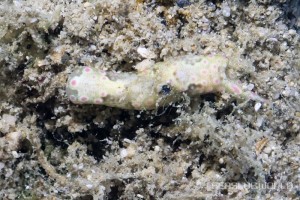
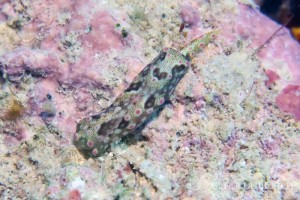
Photos of Odontoglaja guamensis




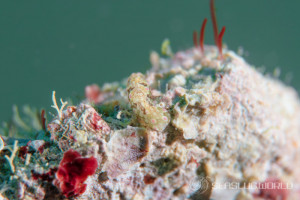
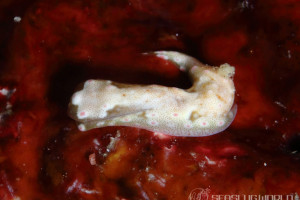
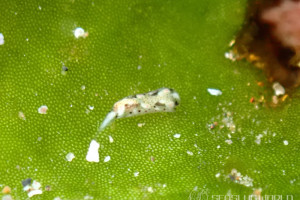

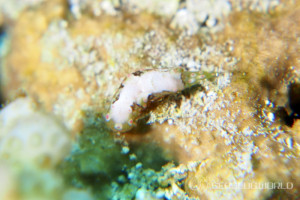


















Same Genus Nudibranchs
Similar Colors Nudibranchs
Academic Database
Sea slug observation data is available in international marine biodiversity databases.