Okenia nodosa (Montagu, 1808)
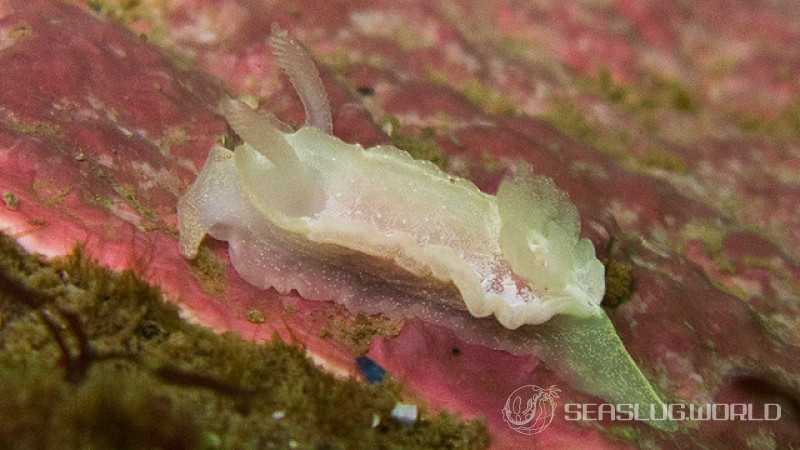
- Location
- Norway
- Date
- 2020/06/16
- Length
- ??mm
- Depth
- ??m
- Water temperature
- ??℃
Description
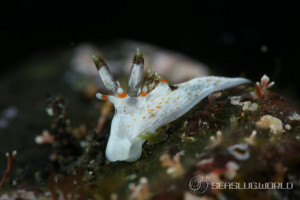
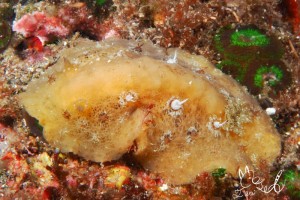
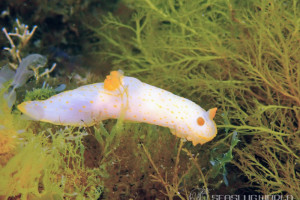
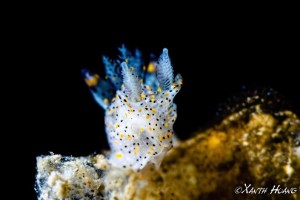
A medium-sized goniodoridid 20–30 mm in body length. The body is translucent white, with the mantle margin tinted yellow and undulating. A low longitudinal dorsal ridge runs along the midline, often yellow, and is flanked by small conical papillae. This ridge continues to the posterior tip of the foot, and the foot itself may also bear yellow pigmentation. The rhinophores are lamellate, sprinkled with opaque white spots. The oral tentacles are smooth, flattened, and project laterally from the sides of the head.Distribution
A cold-water species distributed along the European coasts of the eastern Atlantic, originally described from British material. Records include Ireland, the British Isles, Norway, Scandinavia, Denmark, France, Spain, the Faroe Islands, and the Mediterranean Sea.Etymology
The specific epithet nodosa is Latin for "knotty" or "having nodes", in reference to the low dorsal ridge and the small conical papillae surrounding the mantle margin.Remarks
The species is believed to feed on bryozoans.References
- Doris nodosa n. sp., Montagu G. (1808). Supplement to Testacea Britannica with Additional Plates. S. Woolmer, Exeter. iv + 183 pp., pls. 17-30.
- Goniodoris nodosa, Paz-Sedano S., Smirnoff D., Gosliner T.M. & Pola M. (2023). When a genus must become two: resurrection of Pelagella Gray, 1850 with the description of six new species. Journal of Molluscan Studies. 89(2): eyad008. https://doi.org/10.1093/mollus/eyad008
- Okenia nodosa (transferred from Goniodoris; Goniodoris synonymized with Okenia), Paz-Sedano S., Moles J., Smirnoff D., Gosliner T.M. & Pola M. (2024). A combined phylogenetic strategy illuminates the evolution of Goniodorididae nudibranchs (Mollusca, Gastropoda, Heterobranchia). Molecular Phylogenetics and Evolution. 192: 107990. https://doi.org/10.1016/j.ympev.2023.107990
A Kindle field guide by the site author
Kimoto N. (2026). Sea Slugs of Japan & the Indo-Pacific, 2nd Edition.
Kindle Edition
View on Amazon PR (Amazon Associates)Seasonality
Shooting Locations
Loading shooting locations...
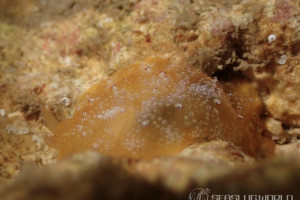
Photos of Okenia nodosa
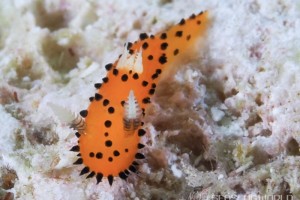
Same Genus Nudibranchs
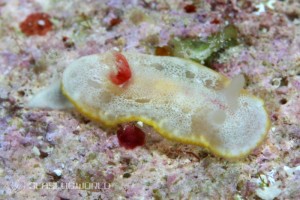
Similar Colors Nudibranchs
Academic Database
Sea slug observation data is available in international marine biodiversity databases.