Okenia babai Hamatani, 1961
Description
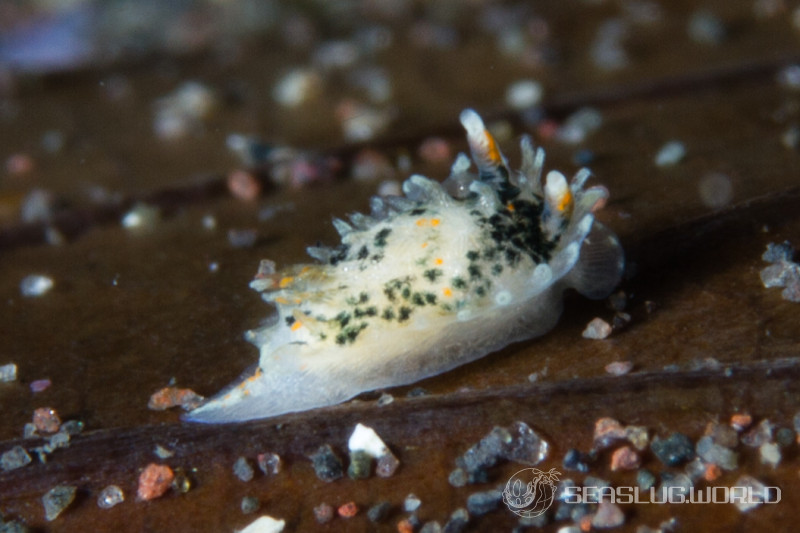
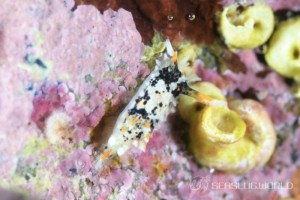
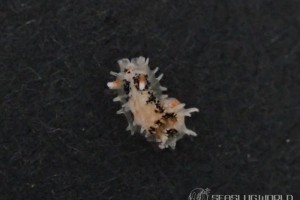
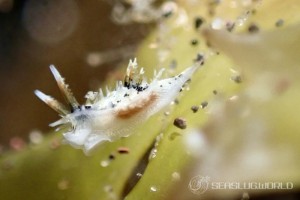
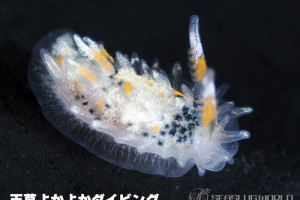
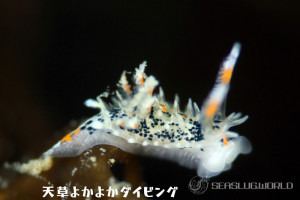
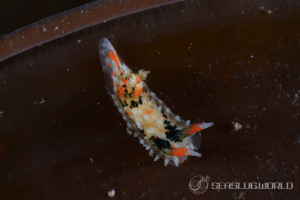
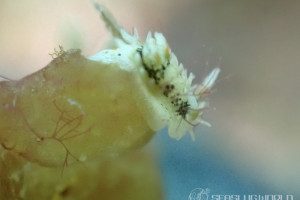
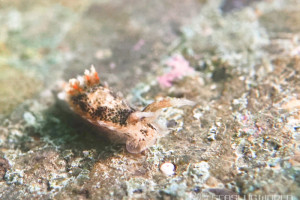
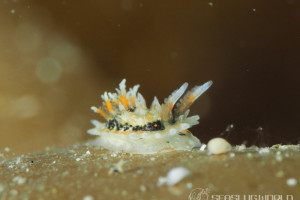
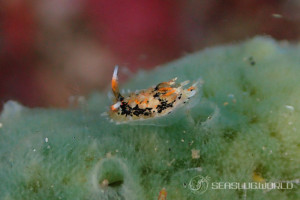
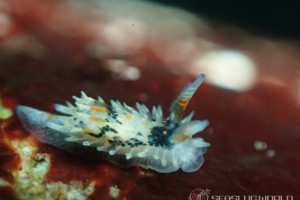
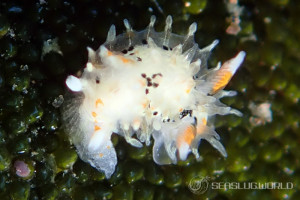
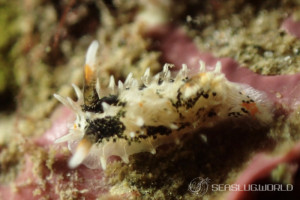
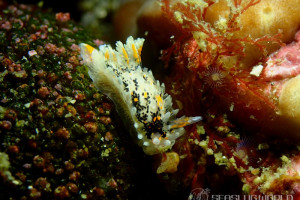
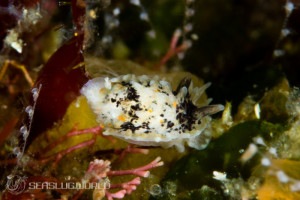
A small dorid, 3–5 mm long and 1–2 mm wide, limaciform with a clear mantle margin separating the back from the body sides. The mantle margin bears 9–11 claviform pointed papillae on each side; the first and the last on each side are bifid (the last with a swollen, robust main stem). The back carries 10–14 short pointed papillae, 3–4 of which tend to be arranged along the median line from the interspace of the rhinophores to the rear of the gills. The general integument and the papillae contain fine spicules. Rhinophores are large, cylindrical, perfoliate with 4–6 lamellae on the upper half, and non-retractile. The branchiae consist of 7 simply pinnate, non-retractile plumes arranged in a semicircle around the anus. Oral tentacles are broad and lobiform. The foot is narrower than the body, rounded at the antero-lateral corners, and ends in a short pointed tail.Coloration
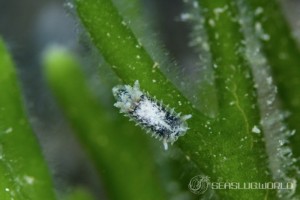
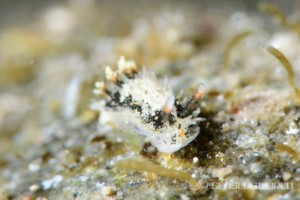
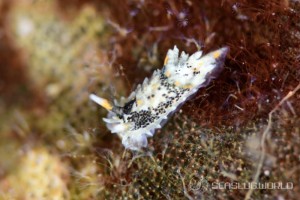
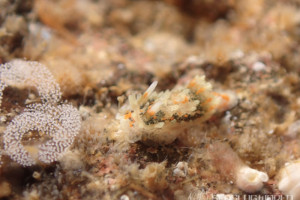
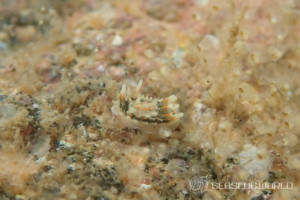
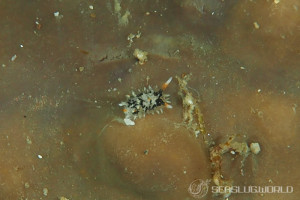
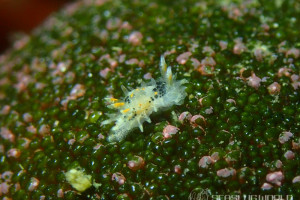
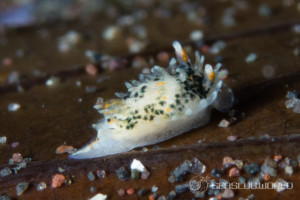
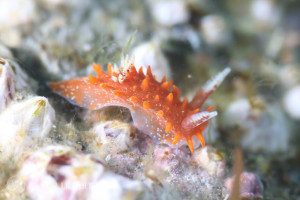
Ground colour slightly yellowish-white. A greenish band — varying from dark green to black between individuals — runs along the mantle margin on each side, widening anteriorly to cover the bases of the rhinophores and uniting posteriorly around the gills before continuing onto the tail. Patches of green and orange-red are scattered irregularly over the back, sides, tail, and gill rachises. Rhinophores are greenish below, colourless above, with an orange-red band in the middle. Most papillae are colourless, with only the last pallial papilla on each side sometimes tinged with yellow.Distribution
Type locality: rocky shore of Tannowa, Osaka Bay, Japan; 15 specimens collected on 30 July and 12 August 1961, with eggs also observed at the native habitat.Etymology
The original description (Hamatani, 1961) simply states: "The species is dedicated to Dr. Baba." The acknowledgement on the same paper credits Dr. Kikutaro Baba of Osaka Gakugei University for encouraging the study and allowing access to his reprint collection. This is the earliest species dedicated to Baba by Hamatani — predating Cyerce kikutarobabai Hamatani, 1976 (the 70th-birthday tribute) by 15 years.Remarks
In the family Goniodorididae, genus Okenia. Resembles Okenia echinata Baba, 1949 and O. opuntia Baba, 1960 in the densely papillate dorsum, but distinguished by the ground colour and dark-green marginal bands and the number of dorsal papillae.References
- Okenia (Okenia) babai Hamatani n. sp., Hamatani I. (1961). Preliminary account of a new species of Okenia from Osaka Bay, Japan (Nudibranchia-Goniodorididae). Publications of the Seto Marine Biological Laboratory. 9(2): 363-365.
- 高岡生物研究会. (2002). 日本海のウミウシ. 第2版.
- 倉持卓司, 倉持敦子 & 増倉加津雄. (2009). 相模湾から採集されたイバラウミウシ属(軟体動物門: 裸鰓目: ネコジタウミウシ科). 神奈川自然誌資料. 30: 37-40. https://doi.org/10.32225/nkpmnh.2009.30_37
A Kindle field guide by the site author

Kimoto N. (2026). Sea Slugs of Japan & the Indo-Pacific, 2nd Edition.
Kindle Edition
View on Amazon PR (Amazon Associates)Seasonality
Shooting Locations
Loading shooting locations...
Photos of Okenia babai
















Same Genus Nudibranchs
Similar Colors Nudibranchs
Academic Database
Sea slug observation data is available in international marine biodiversity databases.