Pelagella castanea (Alder & Hancock, 1845)
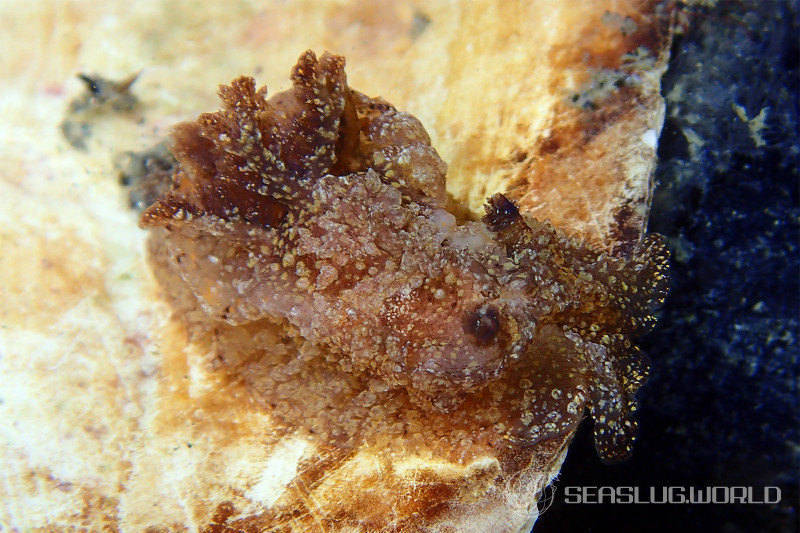
- Location
- Arai Benten Beach, Hamanako, Shizuoka, Japan
- Date
- 2022/04/09
- Length
- 15mm
- Depth
- 7.0m
- Water temperature
- 15.0℃
Description
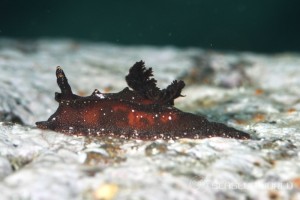
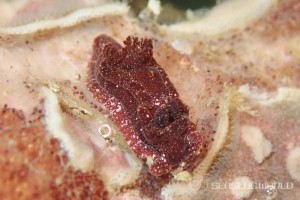
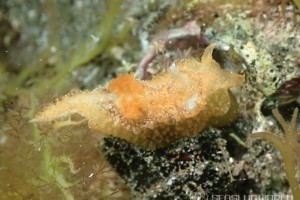
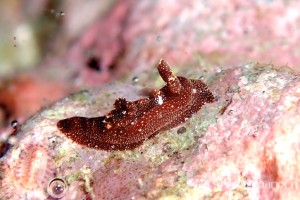
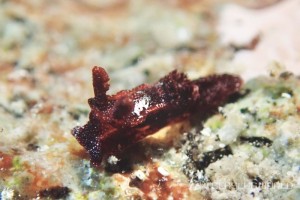
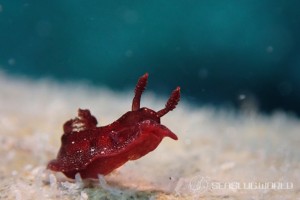
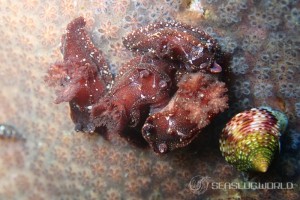
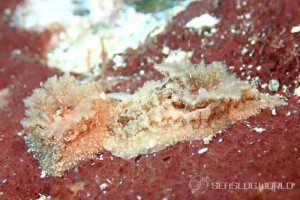
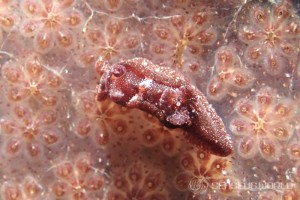
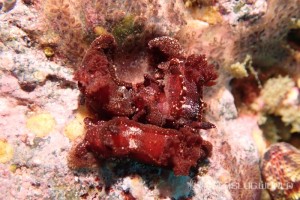
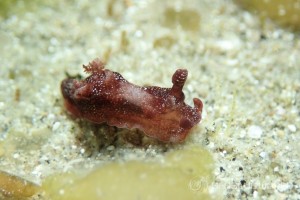
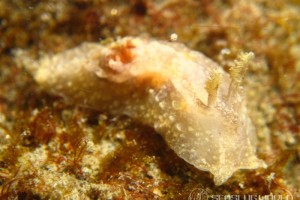
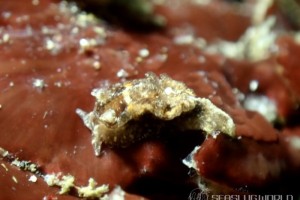
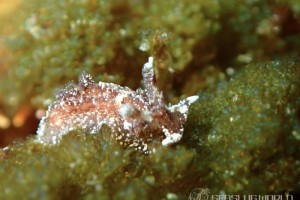
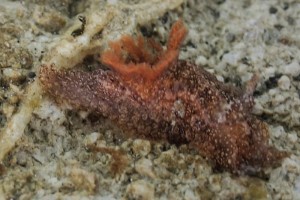
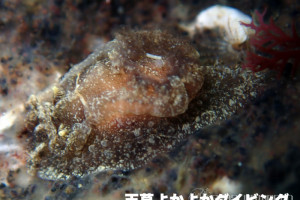
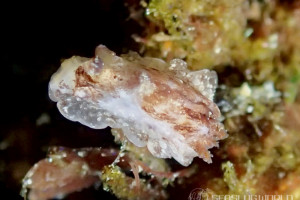
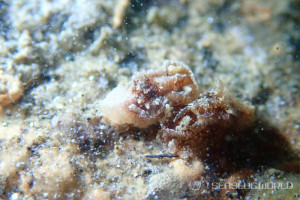
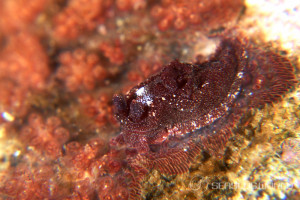
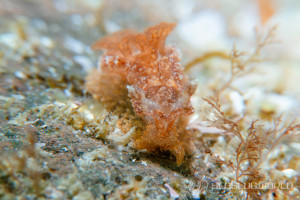
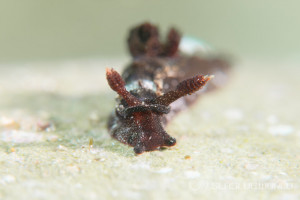
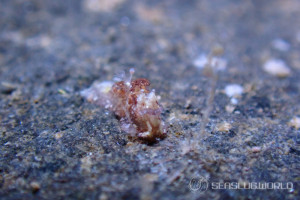
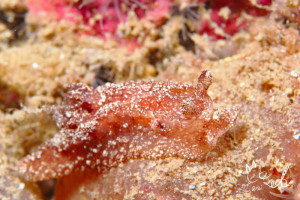
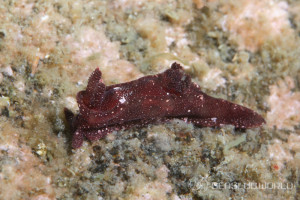
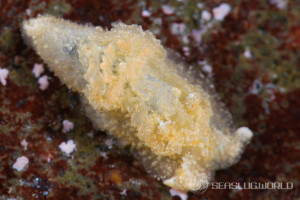
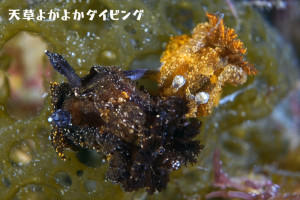
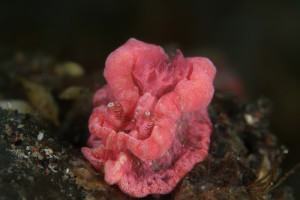
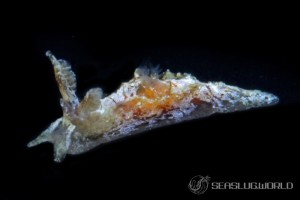
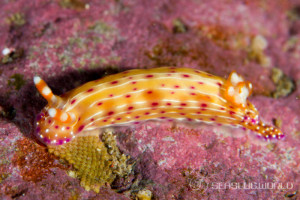
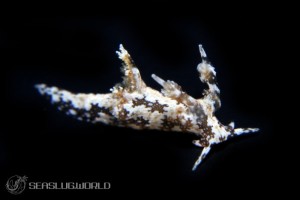
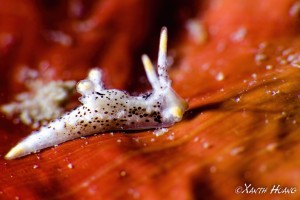
Body dark to reddish brown, sometimes pale greyish brown in Atlantic and Mediterranean specimens.The surface bears white spots and fine white lines, and the mantle edge forms a clearly raised, sharply defined rim with marginal tubercles.
Rhinophores are brownish with white lines and bear seven to nine lamellae.
The gill consists of about eight tripinnate branches arranged in a star shape around the anus.
Maximum recorded length is around 40 mm, making it one of the larger members of the family.
Distribution
The type locality is the coast of Devonshire, England.The species is widespread in the northeastern Atlantic (the United Kingdom, Ireland, Norway, the Netherlands, Sweden, and northern Spain) and the Mediterranean Sea (Strait of Gibraltar, France, and Italy).
Records from the Indo-Pacific and Japan have been attributed to this species, but their conspecificity with European Pelagella castanea still requires molecular verification.
Etymology
The specific epithet is derived from Latin castanea, meaning chestnut-coloured.Remarks
The species was placed in Goniodoris for over a century, but Paz-Sedano et al. 2023 resurrected the genus Pelagella Gray, 1850 on the basis of molecular phylogenetic analyses and re-established this species as its type species.The northeastern Atlantic and Mediterranean populations were shown to form a single monophyletic clade.
Doris pareti Vérany, 1846 and Goniodoris brunnea Macnae, 1958 are treated as junior synonyms.
In Japan the vernacular name was first introduced in Uchida et al. 1927 as "nekoshita-umiushi" and in Baba 1930 as "nekoshita-umiushi"; the modern form "nekojita-umiushi" is now standard.
References
- ねこしたうみうし(新稱), 内田清之助ほか. (1927). 日本動物圖鑑. 北隆館.
- ネコシタウミウシ(平瀬), Baba, K. 1930a. Studies on Japanese nudibranchs (2). A. Polyceridae. B. Okadaia, n.g. (preliminary report). Venus 2(2).
- ネコジタウミウシ, 生物學御研究所編. (1955). 相模湾産後鰓類図譜〈補遺〉. 岩波書店.
- ネコジタウミウシ, 鈴木敬宇. (2000). ウミウシガイドブック〈2〉. TBSブリタニカ.
- 高岡生物研究会. (2002). 日本海のウミウシ. 第2版.
- ネコジタウミウシ, 中野理枝. (2004). 本州のウミウシ. ラトルズ.
- Paz-Sedano S., Smirnoff D., Gosliner T.M. & Pola M. (2023). When a genus must become two: resurrection of Pelagella Gray, 1850 with the description of six new species. Journal of Molluscan Studies. 89(2): eyad008. https://doi.org/10.1093/mollus/eyad008
- Paz-Sedano S., Moles J., Smirnoff D., Gosliner T.M. & Pola M. (2024). A combined phylogenetic strategy illuminates the evolution of Goniodorididae nudibranchs (Mollusca, Gastropoda, Heterobranchia). Molecular Phylogenetics and Evolution. 192: 107990. https://doi.org/10.1016/j.ympev.2023.107990
A Kindle field guide by the site author
Kimoto N. (2026). Sea Slugs of Japan & the Indo-Pacific, 2nd Edition.
Kindle Edition
View on Amazon PR (Amazon Associates)Seasonality
Shooting Locations
Loading shooting locations...
Photos of Pelagella castanea
Tag:













Same Genus Nudibranchs
Similar Colors Nudibranchs

Academic Database
Sea slug observation data is available in international marine biodiversity databases.