Pleurobranchella nicobarica Thiele, 1925
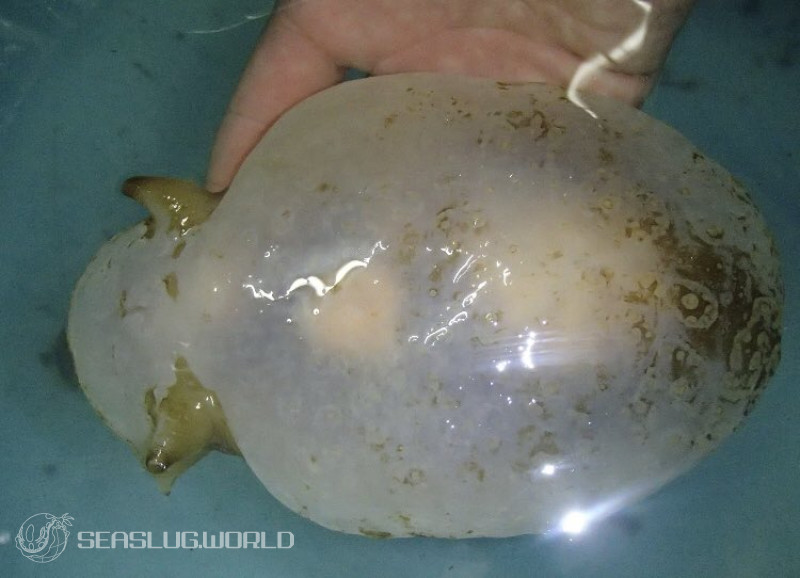
- Location
- Japan
- Date
- 2019/04/23
- Length
- ??mm
- Depth
- ??m
- Water temperature
- ??℃
Description
A large notaspidean reaching about 9–13 cm in body length when alive, occasionally up to 15 cm. The body is oval, gelatinous, soft and translucent in life, with internal organs visible through the body wall; it becomes rather tough and opaque after fixation. Body color is white to dark grayish, sometimes with orange to dark purplish tones on the sole, gill, and surrounding areas.The mantle is very large, extending well beyond the lateral and posterior margins of the foot, and no shell is present. The anterior portion of the mantle fuses above the head into a broad oral veil, on each side of which a short rhinophore arises. The gill lies along the middle of the right side beneath the mantle margin, with a tuberculate rachis and about 40 pairs of alternating lamellae. The penis is spiral, with sparsely distributed hook-shaped papillae pointing toward the base on its convex side.
In Suruga Bay it is taken as bycatch in the deep-water trawl fishery for the Japanese giant spider crab Macrocheira kaempferi at depths of 200–400 m, where local fishermen call it "kurage" (jellyfish). Stomach contents include unidentifiable invertebrate fragments and fish scales, suggesting a carnivorous or scavenging habit.
Distribution
Type locality: southwest of Great Nicobar (Nicobar Islands, eastern Indian Ocean), 296 m depth. Recorded throughout the Indo-West Pacific deep sea (200–400 m), including South Africa, the Gulf of Aden, southern China (south of Hainan Island), the southwestern Philippines, and New South Wales, Australia. The Japanese record by Inoue & Okutani 1987 from Suruga Bay, off the western coast of the Izu Peninsula, central Honshu (200–400 m), represented the northernmost record at the time.Etymology
The specific epithet nicobarica refers to the Nicobar Islands, the type locality, meaning "of the Nicobar Islands."Remarks
Thiele 1925 originally proposed Pleurobranchella as a subgenus of Euselenops Pilsbry, 1896. The taxon was later raised to generic rank by Er. Marcus & Ev. Marcus 1970, Willan 1977, and Ev. Marcus & Gosliner 1984. Diagnostic characters of the genus include a radula composed solely of unicuspid lateral teeth, a very large mantle, and hook-shaped papillae on the convex side of the penis.Pleurobranchoides gilchristi O'Donoghue, 1929 (described from South Africa) and Gigantonotum album Lin & Tchang, 1965 (described from Hainan Island) are regarded as junior synonyms of this species. The Japanese vernacular name "kanten-umifukuro" ("agar-jelly sea hare") was newly proposed by Inoue & Okutani 1987 in reference to the gelatinous, semi-transparent body.
References
A Kindle field guide by the site author
Kimoto N. (2026). Sea Slugs of Japan & the Indo-Pacific, 2nd Edition.
Kindle Edition
View on Amazon PR (Amazon Associates)Seasonality
Shooting Locations
Loading shooting locations...
Photos of Pleurobranchella nicobarica
Similar Colors Nudibranchs

Academic Database
Sea slug observation data is available in international marine biodiversity databases.