Trapania vitta Gosliner & Fahey, 2008
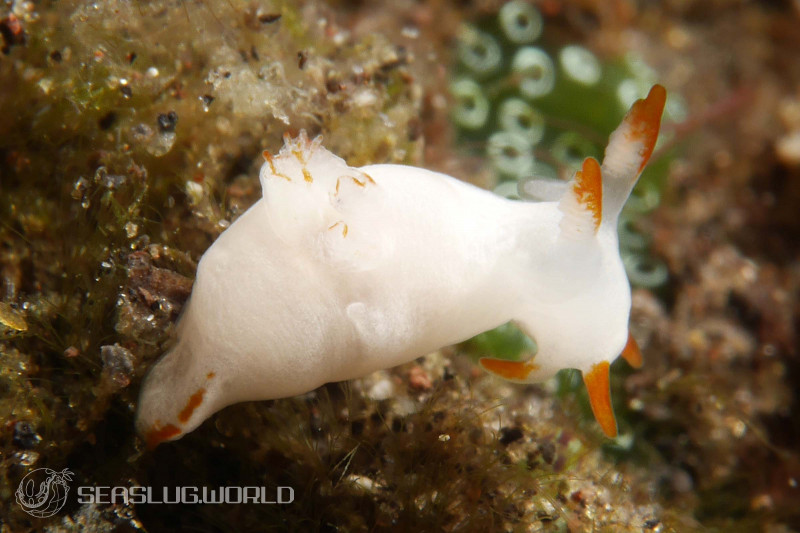
- Location
- USAT Liberty Shipwreck, Tulamben, Pulau Bali, Indonesia
- Date
- 2016/09/25
- Length
- 8mm
- Depth
- 23.0m
- Water temperature
- 28.0℃
Description
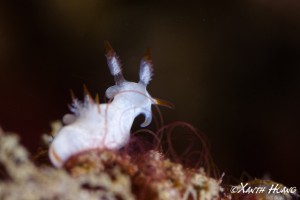
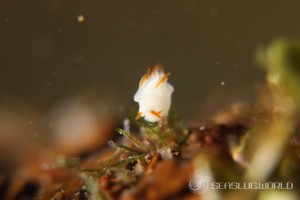
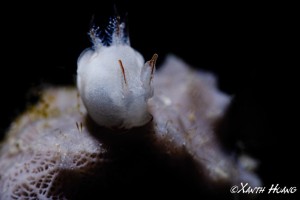
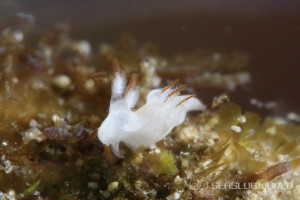
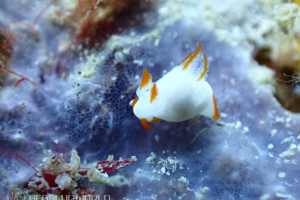
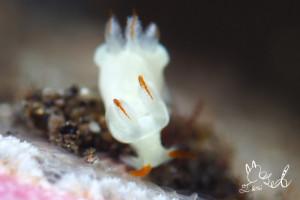
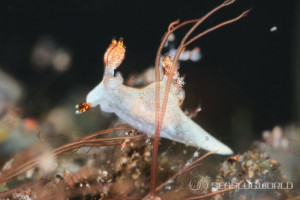
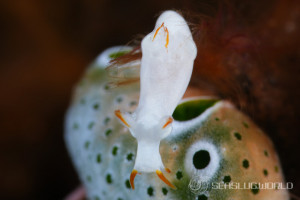
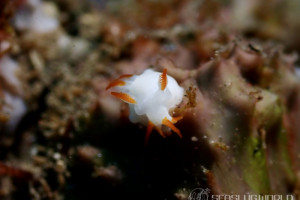
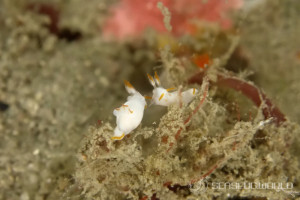
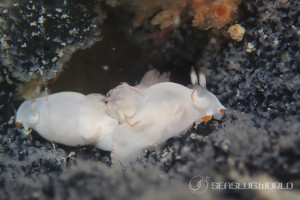
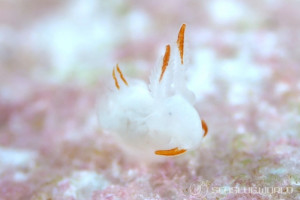
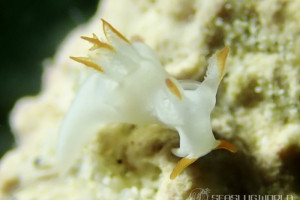
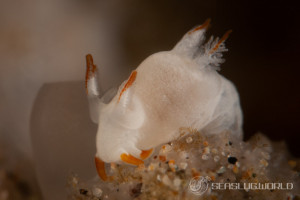
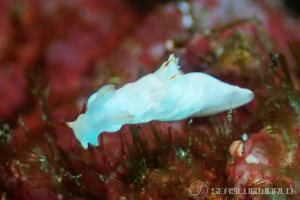
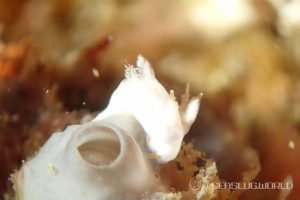
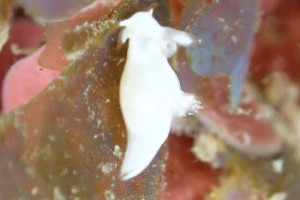
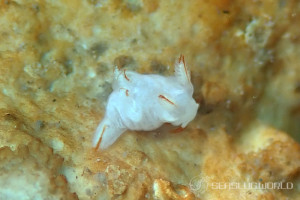
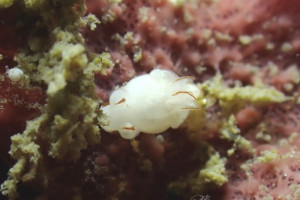
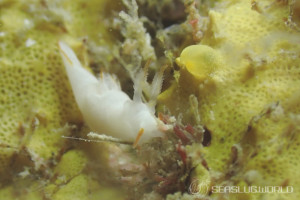
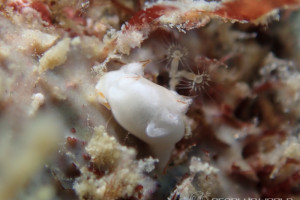
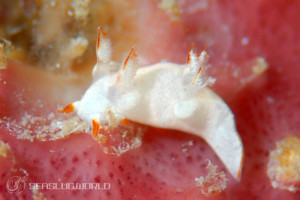
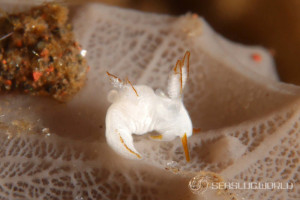
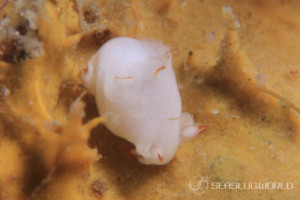
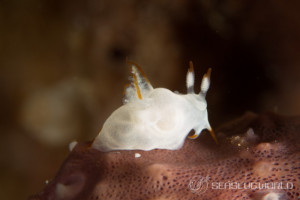
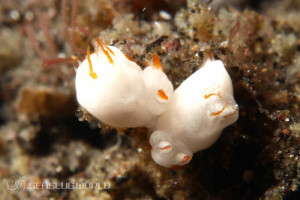
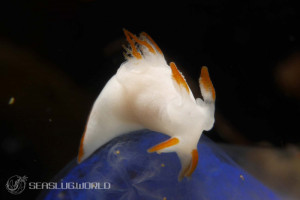
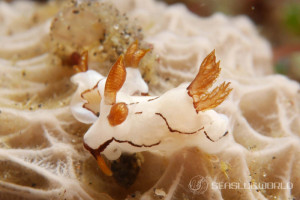
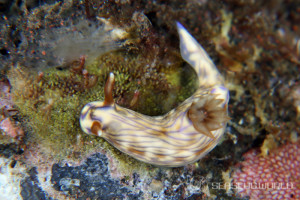
Body 2–5 mm long, elongate and convex, lacking a notal margin. Widest at the branchial region. The head is rounded anteriorly and the anterior foot margin extends into elongate tentacles. Oral tentacles are relatively short, stout with rounded apices. Rhinophores are short and stout with 6–7 lamellae; stalk and club are similar in thickness. Extra-rhinophoral appendages are relatively short, thin and have a curved apex. Extra-branchial appendages are curved and about the same size as the extra-rhinophoral appendages. Gill of three bipinnate branches.The body is entirely white. Anterior foot tentacles, extra-rhinophoral and extra-branchial appendages are white. Oral tentacles are reddish-brown or orange. Rhinophores are white with a reddish-brown or orange line on the upper anterior side of the club. Gill leaves are also white with the same reddish-brown or orange lines on the rachis. The posterior tip of the foot has blue-grey pigment with an occasional orange pigment spot.
Distribution
Indonesia (type locality: Amed, Bali), Papua New Guinea, the Philippines and Kerama Islands, Japan.Etymology
Verbatim from the original description (Gosliner & Fahey, 2008, p.79):The specific name vitta is from the Latin word meaning 'ribbon' or 'band' to describe the bands of orange or reddish brown colouration on the rhinophores and gill leaves.
Remarks
Described as one of 16 new Indo-Pacific Trapania species in Gosliner, T.M. & Fahey, S.J. 2008 Zoological Journal of the Linnean Society 152: 53-111. Records by Koehler (Philippine Sea-Slugs), Bolland (Okislugs) and Coleman 2001 (p.52) under the name Trapania aurata are referred here as misidentifications of this species (p.78). The radula closely resembles T. aurata Rudman, 1987 from Hong Kong, "but the outermost denticle of T. aurata is longer with a base that extends the entire width of the tooth" (p.80).References
- Trapania aurata (Coleman 2001, misid.), Coleman N. (2001). 1001 Nudibranchs: Catalogue of Indo-Pacific Sea Slugs. Neville Coleman's Underwater Geographic Pty Ltd, Springwood, Australia. 144 pp.
- Trapania vitta sp. nov., Gosliner T.M. & Fahey S.J. (2008). Systematics of Trapania (Mollusca: Nudibranchia: Goniodorididae) with descriptions of 16 new species. Systematics and Biodiversity. 6(1): 53-98. https://doi.org/10.1017/s1477200007002587
- Trapania vitta, Terrence Gosliner, Ángel Valdés and David Behrens. (2015). Nudibranch and Sea Slug Identification Indo-Pacific. New World Pubns Inc.
- アカスジツガルウミウシ(新称), 中野理枝. (2018). 日本のウミウシ. 文一総合出版.
- Paz-Sedano S., Moles J., Smirnoff D., Gosliner T.M. & Pola M. (2024). A combined phylogenetic strategy illuminates the evolution of Goniodorididae nudibranchs (Mollusca, Gastropoda, Heterobranchia). Molecular Phylogenetics and Evolution. 192: 107990. https://doi.org/10.1016/j.ympev.2023.107990
Featured in this book

Terrence Gosliner, Ángel Valdés and David Behrens. (2018). Nudibranch and Sea Slug Identification Indo-Pacific 2nd Edition. New World Pubns Inc.
New World Publications
This species, Trapania vitta, is included in the book.
View on Amazon PR (Amazon Associates)Seasonality
Shooting Locations
Loading shooting locations...
Photos of Trapania vitta
Tag:





















Same Genus Nudibranchs
Similar Colors Nudibranchs
Academic Database
Sea slug observation data is available in international marine biodiversity databases.