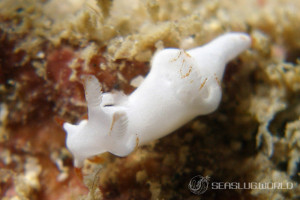
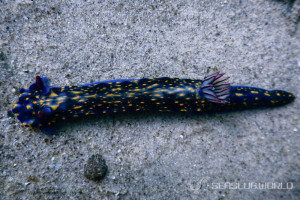
Trapania aurata Rudman, 1987
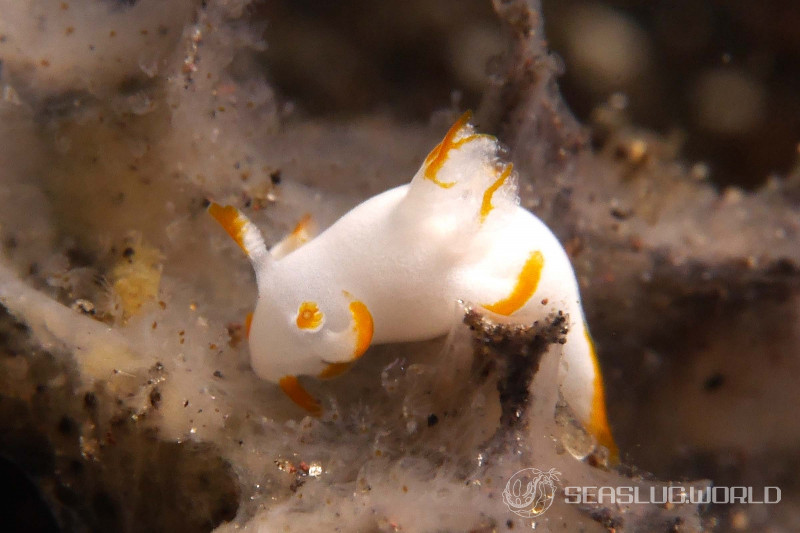
- Location
- Tulamben, Pulau Bali, Indonesia
- Date
- 2016/11/20
- Length
- 5mm
- Depth
- 23.0m
- Water temperature
- 28.0℃
Description
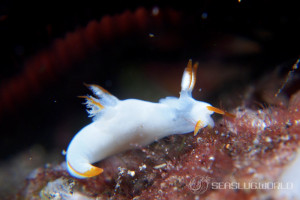
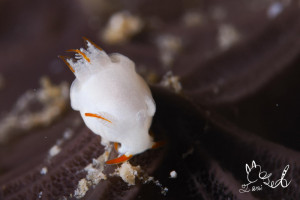
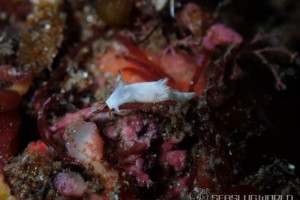
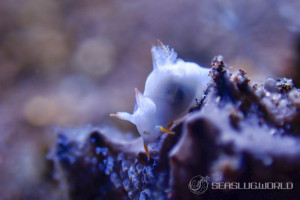
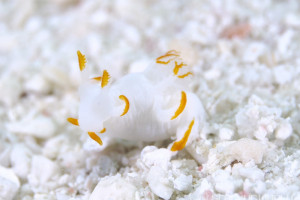
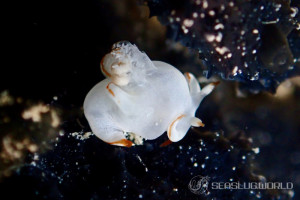
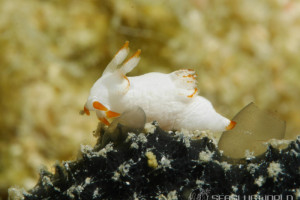
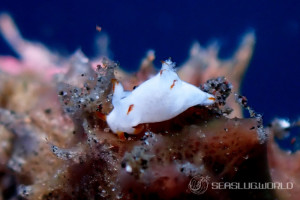
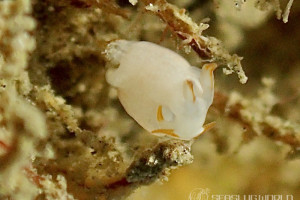
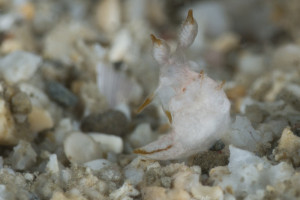
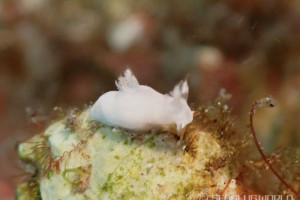
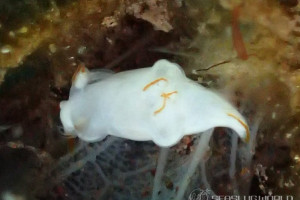
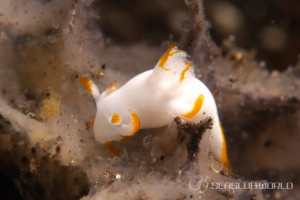
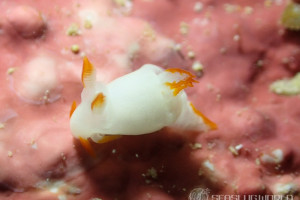
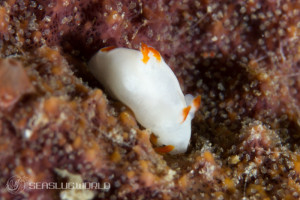
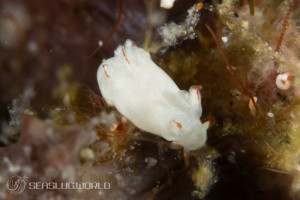
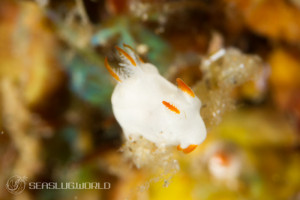
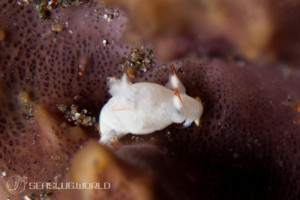
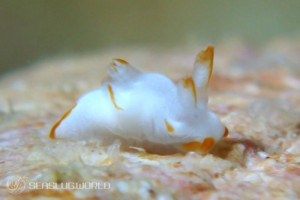
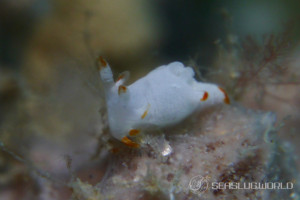
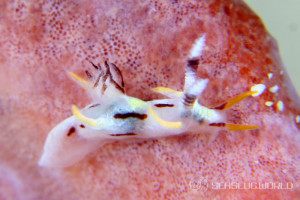
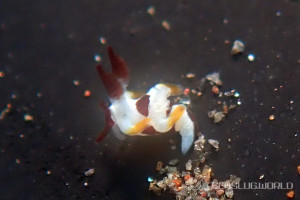
Body opaque white with bright golden (yellow-orange) markings on the appendages and body. Oral tentacles yellow-orange with translucent white tips; a yellow-orange band joins them across the front of the head. Rhinophore stalks white, clubs yellow-orange. The lateral processes (the genus-defining flanking projections of Trapania) bear a broad yellow-orange band along the outer edge that wraps onto the dorsal side near the tip. The antero-dorsal face of each anterior tentacular foot corner is yellow-orange, a thin yellow-orange band runs along the foot edge, and the posterior tip of the foot is yellow-orange and extends forward as a streak along the dorsal midline. Holotype 6 mm preserved.Distribution
Type locality is South Ninepin, Hong Kong (14 m depth, July 1983). Recorded from Hong Kong, New Caledonia, and Japan. A photograph from Port Hedland, Western Australia (Coleman, 1982) of a similar but more orange specimen suggests possibly wider Indo-West Pacific distribution.Etymology
The specific epithet aurata is Latin for golden, referring to the golden markings on the body and appendages (verbatim from the original description).Remarks
Resembles Trapania rudmani and Trapania tartanella in basic colour scheme (white with yellow markings) but is distinguished by (1) an opaque white ground colour (translucent white in Trapania rudmani), (2) broad golden bands running along all four lateral processes (Trapania rudmani has only a thin yellow line along the dorsal edge of each process), and (3) entirely yellow rhinophores, oral tentacles, and anterior foot corners. Like other members of the genus, it occurs on mixed sponge/bryozoan/hydroid colonies and is presumed to feed on entoprocts living on these substrata.References
- Trapania aurata, Terrence Gosliner, Ángel Valdés and David Behrens. (2015). Nudibranch and Sea Slug Identification Indo-Pacific. New World Pubns Inc.
- キンスジツガルウミウシ(新称), 中野理枝. (2018). 日本のウミウシ. 文一総合出版.
- Smirnoff D.S., Donohoo S.A. & Gosliner T.M. (2022). Extra-branchial processes manifest extra diversity: systematics of the genus Trapania (Nudibranchia: Goniodorididae) and nine new species descriptions. Zoological Journal of the Linnean Society. 196(1): 270-313. https://doi.org/10.1093/zoolinnean/zlac009
- Paz-Sedano S., Moles J., Smirnoff D., Gosliner T.M. & Pola M. (2024). A combined phylogenetic strategy illuminates the evolution of Goniodorididae nudibranchs (Mollusca, Gastropoda, Heterobranchia). Molecular Phylogenetics and Evolution. 192: 107990. https://doi.org/10.1016/j.ympev.2023.107990
Featured in this book
Terrence Gosliner, Ángel Valdés and David Behrens. (2018). Nudibranch and Sea Slug Identification Indo-Pacific 2nd Edition. New World Pubns Inc.
New World Publications
This species, Trapania aurata, is included in the book.
View on Amazon PR (Amazon Associates)Seasonality
Shooting Locations
Loading shooting locations...
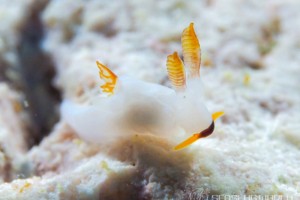
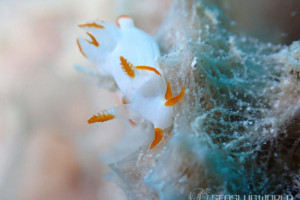
Photos of Trapania aurata

















Same Genus Nudibranchs
Similar Colors Nudibranchs

Academic Database
Sea slug observation data is available in international marine biodiversity databases.