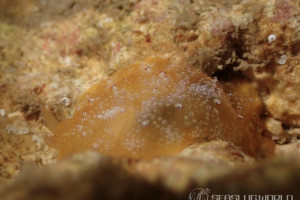
Trapania brunnea Rudman, 1987
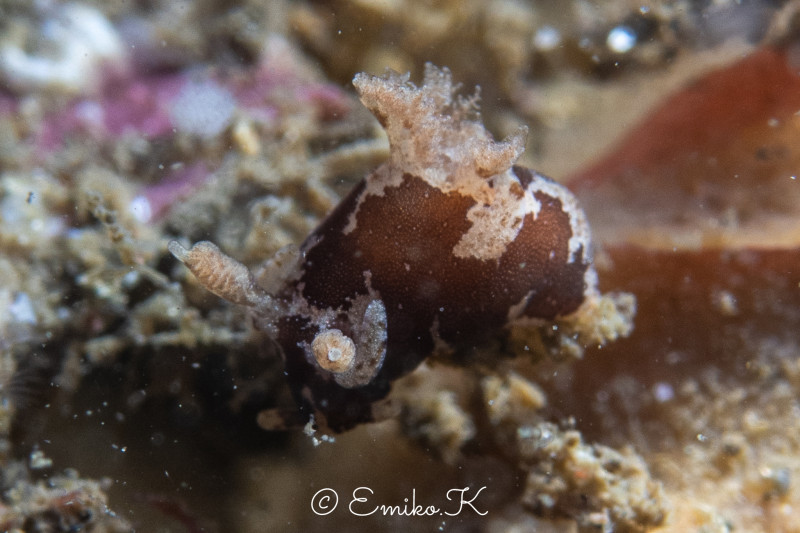
- Location
- Chowder Bay, New South Wales, Australia
- Date
- 2021/04/21
- Length
- 5mm
- Depth
- 8.0m
- Water temperature
- 20.0℃
Description
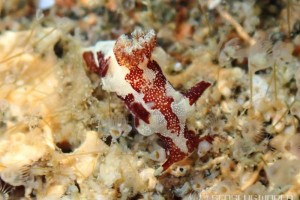
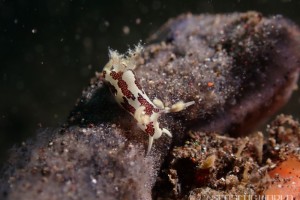
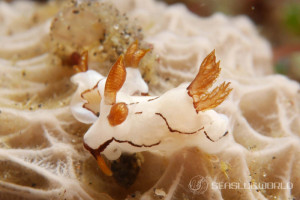
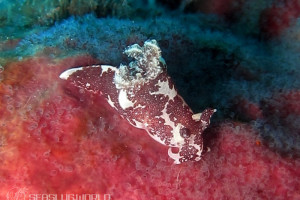
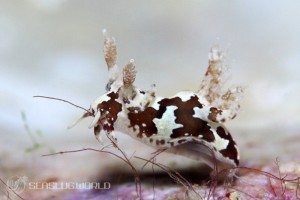
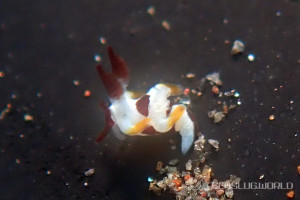
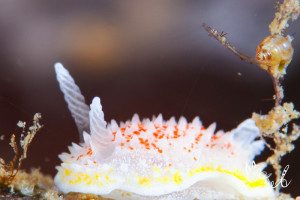
Body dark brown with sparsely scattered small white spots and densely scattered microscopic white or iridescent specks. Regularly placed white patches occur on the dorsum: a midline streak/triangular patch on the head; an elongate white patch at each rhinophore base running anteriorly and posteriorly (sometimes joined between the rhinophores into an "H" shape); a midline patch between the rhinophores and gills; a patch midway between the gills and the posterior tip of the foot. The foot tip is white with an irregular white border. Anterior tentacular foot corners white-tipped, and the upper third of the oral tentacles is white. The four lateral processes are white with a median dark brown longitudinal band. Rhinophore stalks translucent with white spots and specks; clubs translucent brown with white tips. Gill bases white; gill axes translucent brown with reddish-brown speckling; lamellae translucent. Reaches 17 mm in body length alive.Distribution
Type locality is Clovelly, Sydney, New South Wales, Australia (5-10 m depth, October 1978). A south-eastern Australian temperate species recorded from NSW (Sydney region, Lord Howe Island), Victoria (Westernport Bay), Tasmania (Hobart), and South Australia (Kangaroo Island, Yorke Peninsula). Subsequent records also from Japanese coasts south of central Honshu.Etymology
The specific epithet brunnea is the feminine form of Latin brunneus (brown), referring to the dark brown body colour (verbatim from the original description).Remarks
Distinct in colour from any other described Trapania. Superficially resembles the sympatric Trapania benni (described in the same paper), but Trapania benni has a reddish-brown ground colour with many small yellow or white specks and larger yellow spots inside the white patches. Like other members of the genus, this species is associated with mixed sponge/bryozoan/hydroid colonies and is presumed to feed on the entoprocts that grow on them.References
- Trapania Pruvot-Fol, 1931 (genus), Pruvot-Fol A. (1931). Notes de systematique sur les Opisthobranches. Bulletin du Muséum National d'Histoire Naturelle, Paris. (2)3(3): 308-316.
- Trapania brunnea Rudman, 1987, Fahey S.J. (2004). A new species of Trapania (Nudibranchia: Goniodorididae) from Western Australia with comparisons to other Indo-West Pacific Trapania. Zootaxa. 514: 1-12.
- Trapania brunnea (compared), Hermosillo A. & Valdés Á. (2004). Two new species of dorid nudibranchs (Mollusca, Opisthobranchia) from Bahía de Banderas and La Paz, Mexico. Proceedings of the California Academy of Sciences, Series 4. 55(28): 550-560.
- Paz-Sedano S., Moles J., Smirnoff D., Gosliner T.M. & Pola M. (2024). A combined phylogenetic strategy illuminates the evolution of Goniodorididae nudibranchs (Mollusca, Gastropoda, Heterobranchia). Molecular Phylogenetics and Evolution. 192: 107990. https://doi.org/10.1016/j.ympev.2023.107990
A Kindle field guide by the site author
Kimoto N. (2026). Sea Slugs of Japan & the Indo-Pacific, 2nd Edition.
Kindle Edition
View on Amazon PR (Amazon Associates)Seasonality
Shooting Locations
Loading shooting locations...
Photos of Trapania brunnea

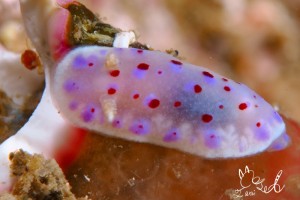
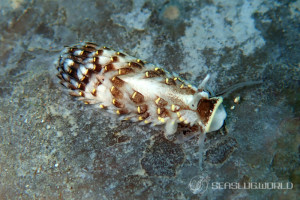
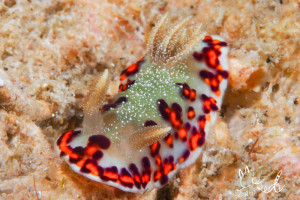
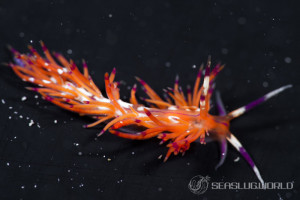
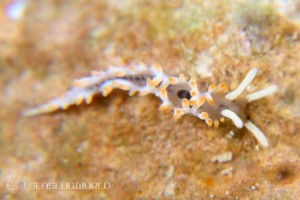
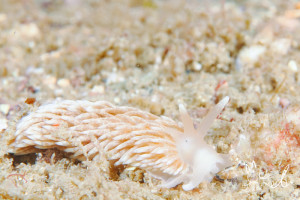
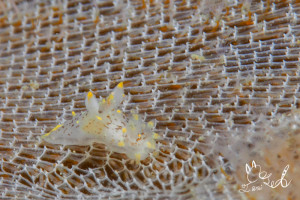
Same Genus Nudibranchs
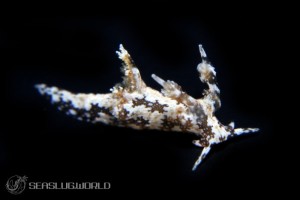
Similar Colors Nudibranchs

Academic Database
Sea slug observation data is available in international marine biodiversity databases.