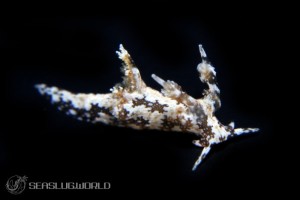
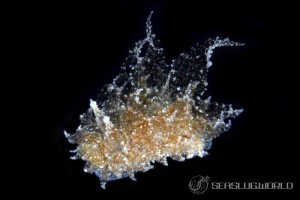
Runcina fijiensis T. E. Thompson & Brodie, 1988
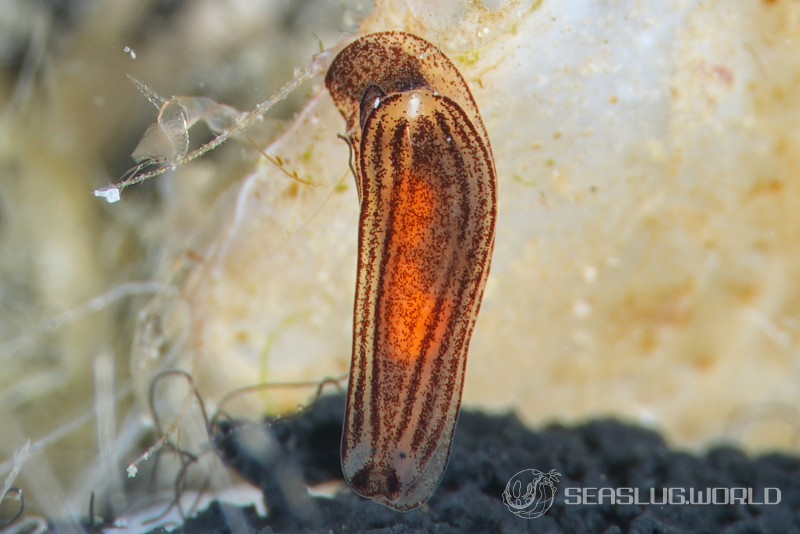
- Location
- Soft Coral, Kenting, Taiwan
- Date
- 2026/05/30
- Length
- 3mm
- Depth
- 12.0m
- Water temperature
- 27.0℃
Description
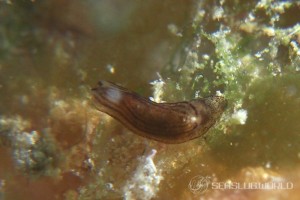
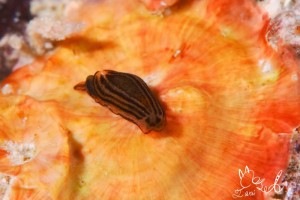
A small runcinid, 2-3 mm in length. The body ground colour is pale yellow, marked with a striking pattern of longitudinal black stripes on the dorsal surface of both the mantle and the foot. The anterior ends of these black stripes are clearly separated but unite smoothly toward the rear of the body. There is a noticeable median emargination at the front edge, and a longitudinal crest runs along the posterior margin of the mantle. The ventral surfaces of the foot and mantle are uniformly pale yellow, without stripes. Black gills protrude from beneath the mantle rim on the posterior right side; at least two are visible externally.Distribution
The type locality is Makaluva Island, off the southeastern coast of Viti Levu, Fiji. The species was described from specimens that emerged from mixed intertidal algal material collected on the reef platform.Etymology
The specific epithet fijiensis is a Latin locality adjective meaning "from Fiji", in reference to the type locality.Remarks
The genus Runcina contains small opisthobranchs distributed in shallow marine habitats worldwide; all members are specialised herbivores feeding on macrophytic algae, with well-developed gizzard plates. Another runcinid, Runcina marshae Burn, 1966, has been described from the same Fijian island; that species differs in being a dull orange in life, possessing a vestigial internal shell, and bearing serrated bosses on the gizzard plates — features all absent in R. fijiensis.A Kindle field guide by the site author
Kimoto N. (2026). Sea Slugs of Japan & the Indo-Pacific, 2nd Edition.
Kindle Edition
View on Amazon PR (Amazon Associates)Seasonality
Shooting Locations
Loading shooting locations...
Photos of Runcina fijiensis




Same Genus Nudibranchs

Similar Colors Nudibranchs
Color:
Brown
Academic Database
Sea slug observation data is available in international marine biodiversity databases.