Enjoying Nudibranchs to the Fullest — Interview with Atsushi Ono, Part 2
This is the continuation of our interview with Atsushi Ono. This time, we dive into what makes nudibranchs so fascinating.
Were nudibranchs once a boring subject?!
—— When did you first see a nudibranch?
It was back when I was working at Izu Ocean Park. Mr. Masuda used to tell us, "You guys had better shoot invertebrates too," so I reluctantly photographed things like the yamato-umiushi (Homoiodoris japonica). Those photos are actually used in the new field guide.
But at that time there were still plenty of fish species unrecorded in Japan, so I preferred finding fish. Invertebrates just didn't grab me. Research hadn't progressed very far either — many nudibranchs didn't even have names. Field guides would just list them as "one species of sea slug."
—— So they weren't even supporting cast — more like background extras. When did nudibranchs become something special for you?
It was a little while after I moved to Zamami, about twenty years ago. Thanks to underwater photography becoming more accessible, nudibranch booms would flare up here and there — but they'd fizzle out just as quickly. That kept happening.
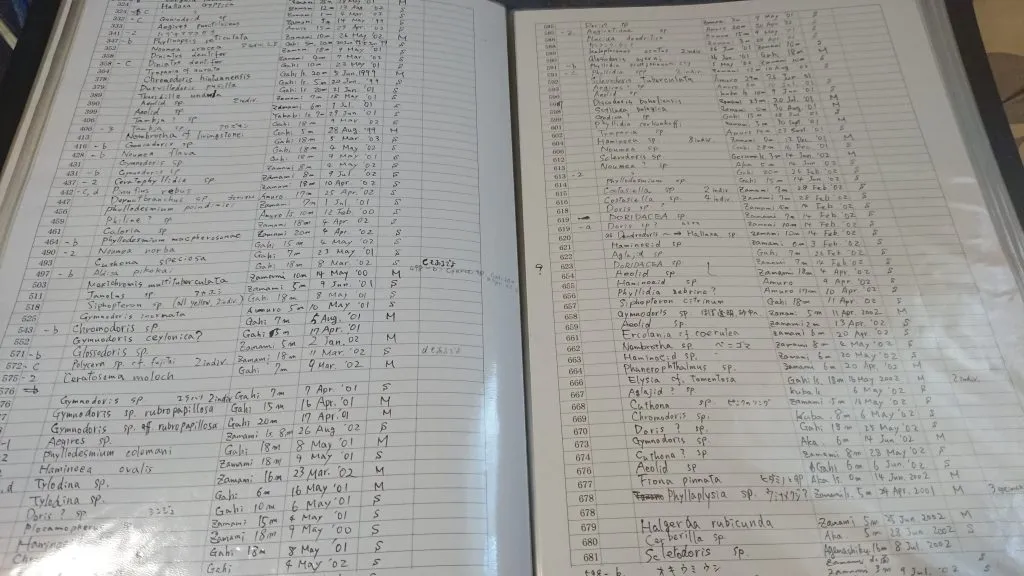
I started by trying to figure out how many species there were around Zamami, but after a year I had barely reached seventy. Around that time, a longtime guest of mine came and asked me to guide a nudibranch dive. Through plenty of trial and error, I gradually mastered how to spot them. Incidentally, that same guest has contributed many photos to *New Edition: Sea Slugs*.
Then I put up a website featuring lots of nudibranch photos, and it happened to catch the eye of an editor at TBS Britannica. That's how *Nudibranch Guidebook: From the Seas of Okinawa and the Kerama Islands* (1999) came about.
Around the same time, Helmut Debelius published *Nudibranchs and Sea Snails: Indo-Pacific Field Guide* (1996), and that was a real spark for me. Nudibranchs that even Japanese researchers couldn't identify were being sorted out overseas, one after another. That's when I thought, let's make a book.
—— So you started from Okinawa.
In Okinawa, there was Professor Robert F. Bolland — Bob — from the University of Maryland's program at Kadena Air Base, who was researching nudibranchs. He kept sending specimens to Terrence M. Gosliner at the California Academy of Sciences. That's why research on southern species was actually more advanced here than on mainland Japan.
Terrence M. Gosliner — the leading authority on nudibranchs. Both SEASLUG.WORLD and *New Edition: Sea Slugs* are built on the foundation of his *Nudibranch & Sea Slug Identification — Indo-Pacific*.
When I was working on *Nudibranch Guidebook*, Bob had already spent more than twenty years sending Okinawan nudibranchs to research institutions in the U.S. and contributing to their classification. You simply can't talk about Okinawan nudibranchs without him. He also has photos of nudibranchs that no one else has, so producing a Japanese nudibranch field guide without his help would have been impossible. I once went to visit him, and I could really feel how differently they view natural history as a discipline compared to us in Japan. By the way, he retired in 2013 and now lives in Utah, away from Okinawa.
—— Was it fun making a nudibranch book?
Yes, it was. I prefer figuring out the pieces whose place you don't yet know, or deciding where they fit based on new information, rather than just slotting pieces into obvious spots.
Because nudibranch research is still young, there's this feeling of almost-but-not-quite understanding something — and then slowly inferring more from what is known. That's what makes it so interesting.
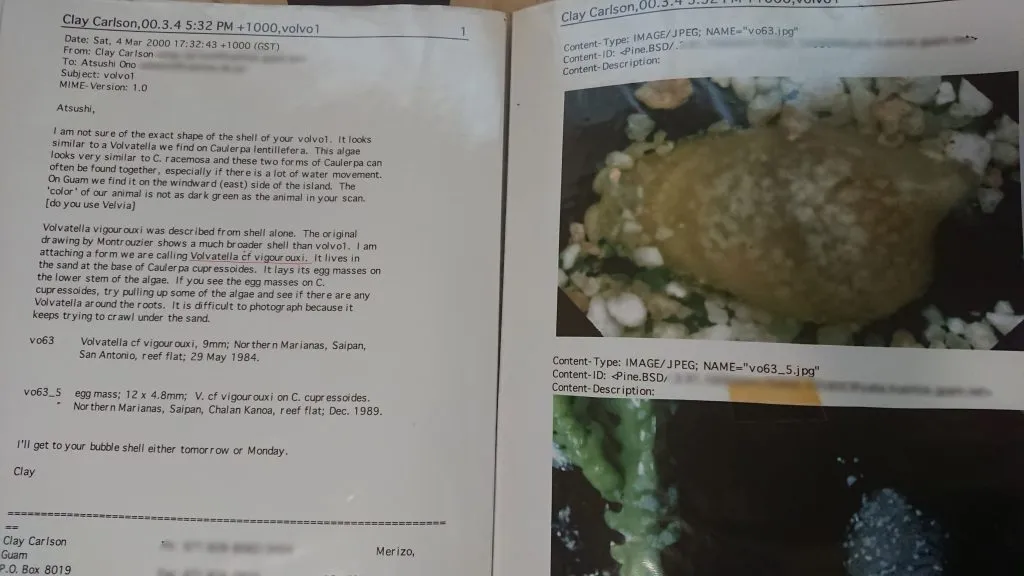
—— You also touched on the state of research in the afterword of the new book. Did you feel any sense of mission about it?
None at all. I can only hope that good researchers will come along in the future. I'd love for someone to take on the aeolid nudibranchs — at the level of describing new species. Mainland Japan still has so many aeolids that aren't understood. Many whose genus or even family is uncertain. Some you can't even infer from the many samples collected across the warm Indo-Pacific.
—— So it's still a very uncertain world. Your author bio says you "prefer thinking about evolution over ecology." Is that what you meant?
That's a different matter. When you use a field guide to grasp how things stand today and then start digging into the past, it opens up into a three-dimensional view. Finding the key morphological features, feeding habits, or breeding behaviors along the way is the fun part — that's what I was getting at in the afterword. You combine it with molecular phylogenetic analysis.
There's Haeckel's idea that ontogeny recapitulates phylogeny. It's been refuted, of course, but my feeling is — don't dismiss it entirely. There are parallels not just in morphological evolution, but in ecology too. Even when species diverge evolutionarily, juveniles can still retain the feeding habits of the ancestral species, for example. Feeding habits especially show this clearly. But no one's published on it, have they? I think it's fascinating. Maybe people just haven't noticed. Divers have been watching! (laughs)
—— So you trace the path of evolution backwards from the present. It sounds endless, but there's real romance in it.
Not just watching and photographing — more ways to enjoy nudibranchs
—— By the way, I recently ran a survey of divers I'm connected with on Twitter, and the most common reason they love nudibranchs was "the joy of finding them." Could you tell us about a nudibranch you were especially happy to find?
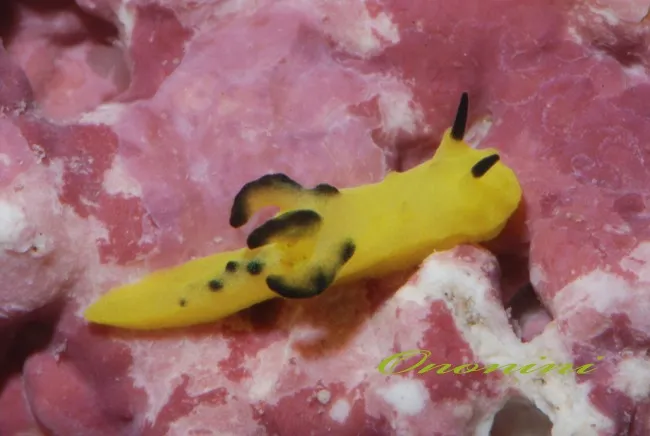
I've had "Yes!" moments dozens of times — too many to remember them all — but I was really thrilled when I found a perfect specimen of the tachi-aoi umiushi (Bornella anguilla). It's a rare one — maybe just one individual turns up per year. I'd seen a few before, but always with damage to the appendages in front of the gills.
Another one was when I was flipping through a thick Australian book on mollusks and came across a nudibranch that lives on blue coral. It's an Indian Ocean species, so I went looking for it around Zamami right away — and I found one. "Ha, they're here too!" Its Japanese name is manjū-umiushi (Phyllidia varicosa).
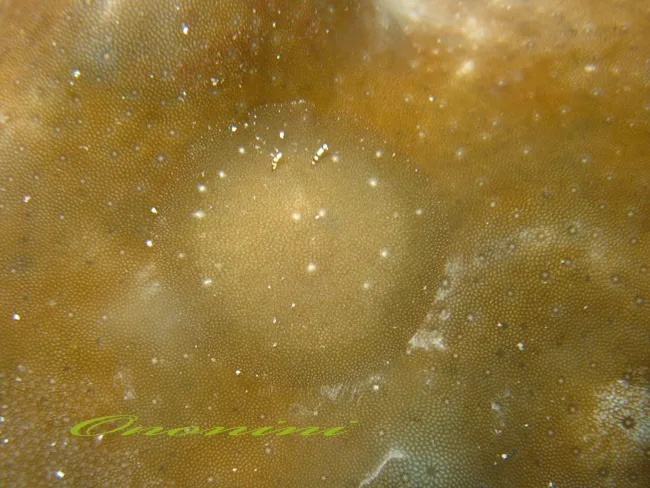
Both the tachi-aoi umiushi and the manjū-umiushi appear in the new field guide, *New Edition: Sea Slugs*.
—— I see. Speaking of the difficulty of finding them, the smaller they are, the harder they are to spot. What's the smallest nudibranch you've ever seen?
About 1.5 mm, I think.
—— 1.5 mm!
My eyesight and cataracts make it tough these days, though. The guests are far better at it than I am. Sometimes they find something so tiny it takes me by surprise (laughs). Even when someone points right at a small one, I can't see it — yet the person who found it somehow can. That's when I reach for my loupe.
—— Using a loupe is a great move. If you had to name a nudibranch you'd like divers and enthusiasts to take on as a challenge, what would it be?
First, I'd want people to check my field guide to see what's become of the species that were once lumped together as "sentenro-umiushi" (Hypselodoris placida), pay attention to the differences, and try sorting through their own photos. These are common species.
Once you've leveled up a bit, try the Gymnodoris group (kinuhada-no-nakama). There are SO many of them, so there's real fun in telling them apart — but it's tough! (laughs)
—— Spotting those differences is hard work! Are there any points to keep in mind when photographing them for identification with a field guide?
As long as the key features are captured, you'll be fine. First, secure the angle you personally like, and then grab the key parts as throwaway shots. The field guide tells you which features are the keys. For example, if gill shape is the key, don't just shoot from the side — make sure you also get a shot from directly above.
—— Finally, on the subject of nudibranchs, could you tell us about the fascination that emerges when you've observed many different species?
The existence of cryptic species is one of the fascinations. At first you assume it's just variation, but as you observe many individuals you start to feel a gap between them and the main population's coloration. In other words, they don't connect. You start thinking they might be separate species.
Of course, cryptic species can exist in any group of organisms. Just as manta rays and wrasses of the genus Pseudolabrus were split into two species, anyone can enjoy the thought that something looks similar but might actually be a different species! And since serious research on nudibranchs themselves has only just begun, lots of unknowns keep turning up — which is great fun. When you realize something isn't in any field guide, it's "Yes!" all over again.
Continue to the next page: behind the scenes of *New Edition: Sea Slugs*
Enjoyed this post? You can tip the author directly —
Tip this post