Asteronotus hepaticus (Abraham, 1877)
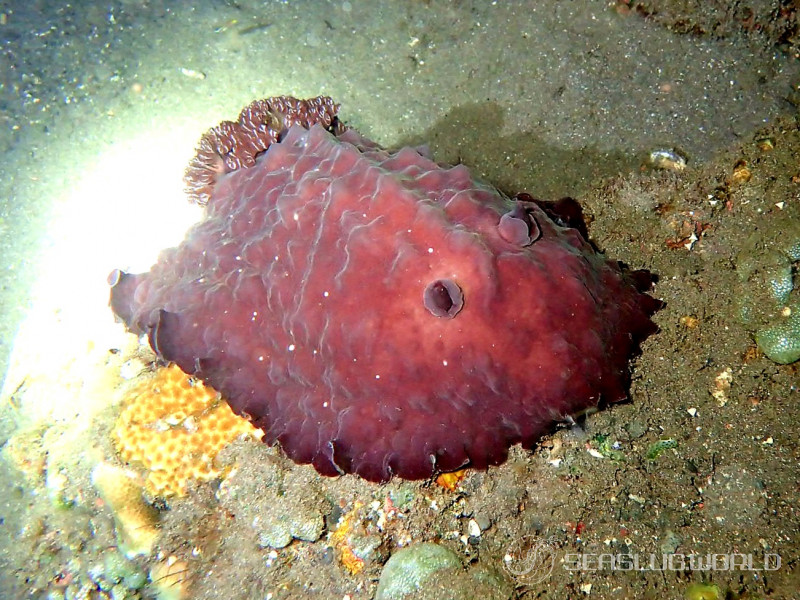
- Location
- Jemeluk beach, Amed, Pulau Bali, Indonesia
- Date
- 2024/05/03
- Length
- 200mm
- Depth
- 3.0m
- Water temperature
- 30.0℃
Description
A large dorid nudibranch reaching about 20 cm in length. The body is oval-oblong and somewhat flattened, with a thick fleshy mantle that extends all the way round and an irregularly sub-crenate, slightly undulating margin. The dorsal surface feels smooth to the touch but, on close inspection, is densely covered with small, rounded, granular tubercles. The rhinophores are clavate and retract into wide cavities with finely denticulate margins. The six tripinnate gills retract into a cavity with a six-lobed rim. The oral tentacles are short, flat, and subconic. The foot is broadest in the middle, about a third of the mantle width. The background colour is reddish-brown to deep liver-brown — the basis for the species name.Distribution
Originally described from material labelled "Pacific Ocean". Subsequently recorded broadly across the tropical western Pacific, including Vanuatu, Indonesia, the Solomon Islands, Papua New Guinea, and Japan (Okinawa and elsewhere).Etymology
The specific epithet hepaticus is Latin for "of the liver", referring to the liver-coloured (deep reddish-brown) body of the species.Remarks
A member of the family Discodorididae, feeding primarily on sponges. Externally distinguishable from Asteronotus cespitosus by differences in body colour and tubercle shape.References
- Doris hepatica n. sp., Abraham P.S. (1877). Revision of the Anthobranchiate Nudibranchiate Mollusca, with descriptions or notices of forty-one hitherto undescribed species. Proceedings of the Zoological Society of London, 1877: 196-269, pls. xxvii-xxx.
- セダカコバンウミウシ(新称), 中野理枝. (2019). 日本のウミウシ. 第二版. 文一総合出版.
Featured in this book

中野理枝. (2019). 日本のウミウシ. 第二版. 文一総合出版.
文一総合出版
This species, Asteronotus hepaticus, is included in the book.
View on Amazon PR (Amazon Associates)Seasonality
Shooting Locations
Loading shooting locations...
Photos of Asteronotus hepaticus

Same Genus Nudibranchs
Similar Colors Nudibranchs

Academic Database
Sea slug observation data is available in international marine biodiversity databases.