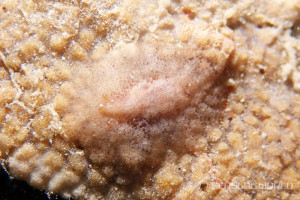
Asteronotus spongicolus Gosliner & Á. Valdés, 2002
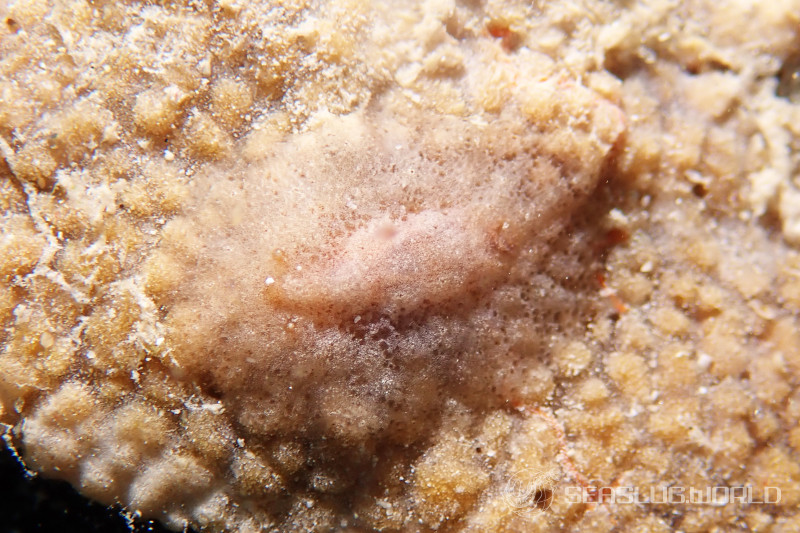
- Location
- Romblon Island, Philippines
- Date
- 2018/03/06
- Length
- 6mm
- Depth
- 10.0m
- Water temperature
- 27.0℃
Description
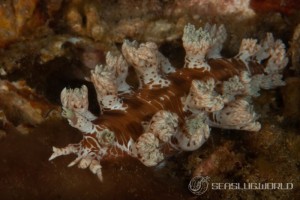
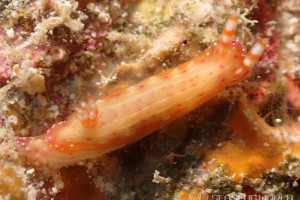
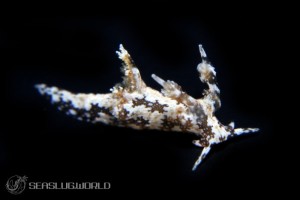
A small dorid nudibranch reaching 10–25 mm in body length. The body is elongate and ovoid, somewhat flattened. The notum is smooth or bears only very low ridges and tubercles; conspicuous warty processes are absent. Body colour ranges from yellowish-green to yellow-brown to brown, marked with scattered small white and dark spots, providing strong crypsis on the surface of its host sponge. The rhinophores are perfoliate with about 10 lamellae each. There are five to six tripinnate gill leaves, and a single, elongate, digitiform oral tentacle on each side of the mouth.Distribution
Type locality: Lizard Island, North Queensland, Australia (patch reef, 3 m depth). The original description (Gosliner & Valdés 2002) also reported the species from three localities in coastal Tanzania (Zanzibar, the Dar es Salaam region, and the Mtwara region). The species is therefore expected to occur broadly across the Indo-West Pacific wherever its host sponge is present.Etymology
From Latin spongia (sponge) + -cola (dweller), meaning "sponge-dweller", in reference to the species' habit of living on the underside of its host sponge.Remarks
The species feeds on sponges, particularly Carteriospongia, and is typically found at 1–3 m depth on the undersides of these host sponges. It is externally very similar to its congener Asteronotus mimeticus, and the two species cannot be reliably separated by live colour or general outline alone — distinction relies on anatomical characters (radula and reproductive system).References
- Asteronotus spongicolus sp. nov., Gosliner T.M. & Valdés Á. (2002). Sponging off of Porifera: new species of cryptic dorid nudibranchs (Mollusca, Nudibranchia) from the tropical Indo-Pacific. Proceedings of the California Academy of Sciences, ser. 4, 53(5): 51-61.
- Asteronotus spongicolus, Terrence Gosliner, Ángel Valdés and David Behrens. (2015). Nudibranch and Sea Slug Identification Indo-Pacific. New World Pubns Inc.
Featured in this book
Terrence Gosliner, Ángel Valdés and David Behrens. (2018). Nudibranch and Sea Slug Identification Indo-Pacific 2nd Edition. New World Pubns Inc.
New World Publications
This species, Asteronotus spongicolus, is included in the book.
View on Amazon PR (Amazon Associates)Seasonality
Shooting Locations
Loading shooting locations...
Photos of Asteronotus spongicolus
Tag:


Same Genus Nudibranchs
Similar Colors Nudibranchs

Color:
Brown
Academic Database
Sea slug observation data is available in international marine biodiversity databases.