Ceratodoris mellita (Rudman, 2004)
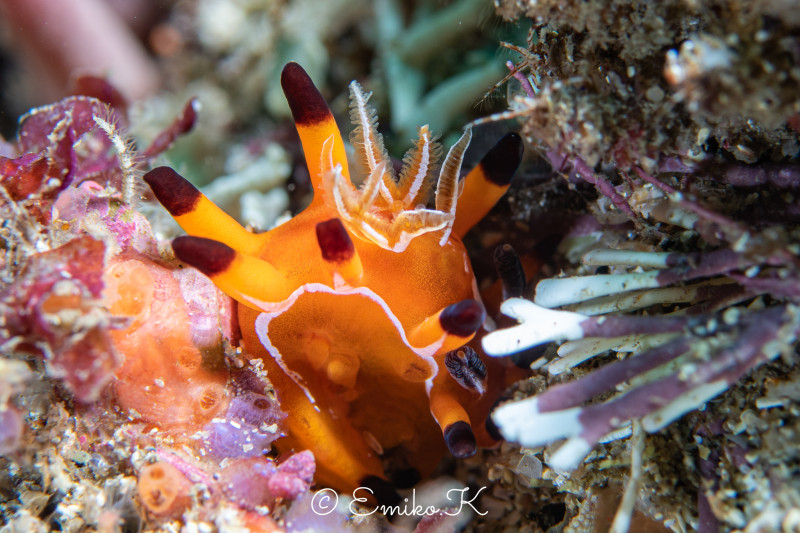
- Location
- The Steps, Kurnell, New South Wales, Australia
- Date
- 2020/06/11
- Length
- 20mm
- Depth
- 15.0m
- Water temperature
- 17.0℃
Description
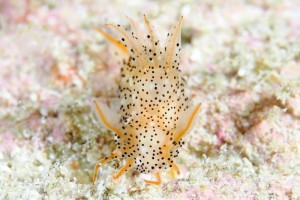
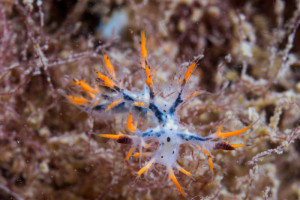
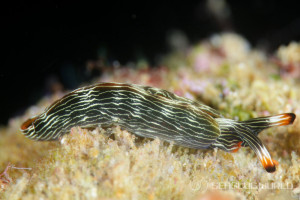
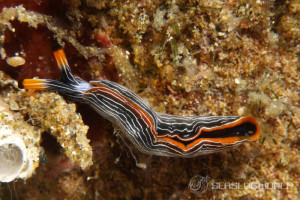
Body elongately ovate, relatively high and lacking a distinct mantle edge, although the position is indicated by five large lateral papillae per side, with the middle three particularly long — about twice the body width. The papillae are cylindrical, broadening before tapering to a pointed tip, and are quite motile (held horizontally, vertically, or folded over the body). A single mediodorsal papilla sits just anterior to the gills, similar in shape and length to the lateral papillae. Gills long and simple, in three clusters: an anterior cluster of two gills with a common base in the midline just anterior to the anal papilla, and two posterior clusters (each of 2 or 3 gills with a common base) on each side of the anus. Rhinophores similar in shape and length to the dorsal papillae; the upper half is elongate and bears lamellae. Body ground colour orange (golden orange-yellow); mantle papillae and oral tentacles tipped with black, with a black spot on the posterior tip of the foot. An opaque white line runs down the dorsal midline from between the rhinophores to the base of the mediodorsal papilla, extending about halfway up the anterior face of that papilla. A lateral white line runs along each side and around the anterior end of the body, with a branch extending up the ventral (outer) face of each papilla to just below the black tip. Rhinophores with translucent orange stalk and black club, a white line up the posterior midline; gills translucent orange with opaque white edging. Radular formula 30(+1) × 1.1.0.1.1. Holotype 18 mm long alive; largest paratype 19 mm preserved.Distribution
Type locality: Split Solitary Island, off Coffs Harbour, New South Wales, Australia. Originally known only from eastern Australian waters; records include Coffs Harbour, Fish Rock Cave (South West Rocks), and Montague Island in southern NSW.Etymology
The specific epithet mellita is Latin for "honeyed", in reference to the golden orange-yellow colour of the animal.Remarks
Originally described in Okenia, the species was later transferred to the resurrected genus Ceratodoris. The colour pattern (orange with white lines and black-tipped papillae) is unique in the genus and readily distinguishes the species from all congeners. The well-developed cuticular band of recurved rodlets around the buccal bulb, together with the heavy radular teeth, suggests that the species feeds on a calcified bryozoan, though feeding has not been observed in the field.References
A Kindle field guide by the site author
Kimoto N. (2026). Sea Slugs of Japan & the Indo-Pacific, 2nd Edition.
Kindle Edition
View on Amazon PR (Amazon Associates)Seasonality
Shooting Locations
Loading shooting locations...
Photos of Ceratodoris mellita

Same Genus Nudibranchs
Similar Colors Nudibranchs

Academic Database
Sea slug observation data is available in international marine biodiversity databases.