Ceratodoris nakanoae (Paz-Sedano & Pola, 2021)
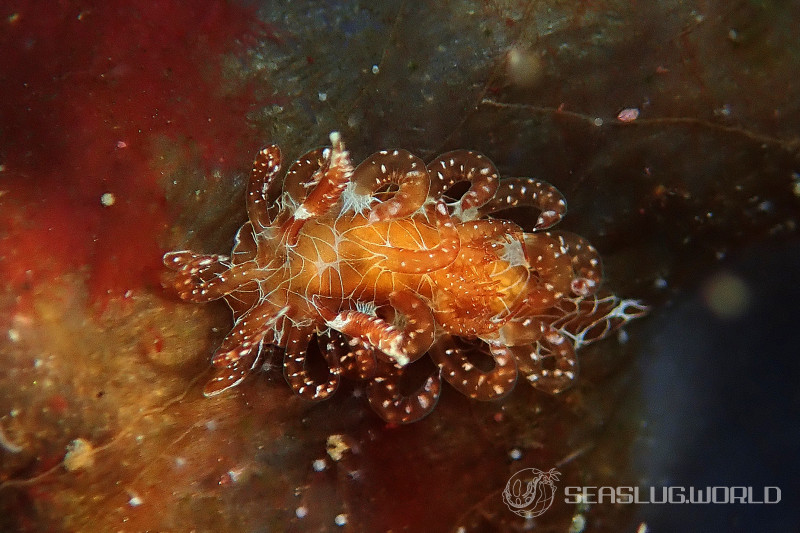
- Location
- Ushitsuki Rock, Kumomi, Shizuoka, Japan
- Date
- 2018/12/03
- Length
- 10mm
- Depth
- 12.0m
- Water temperature
- 20.0℃
Description
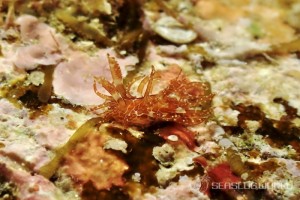
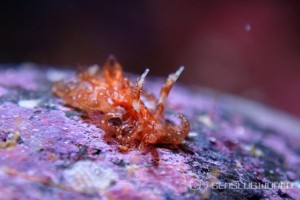
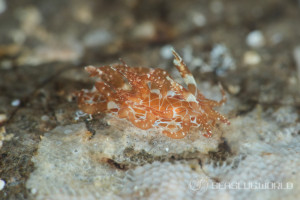
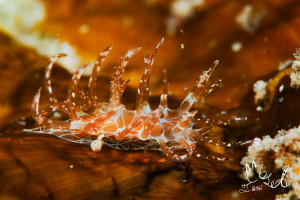
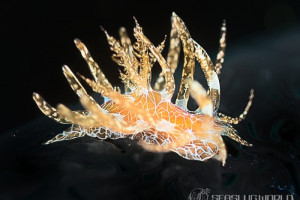
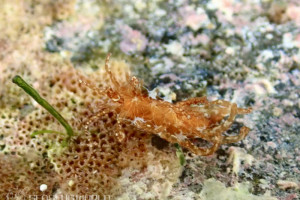
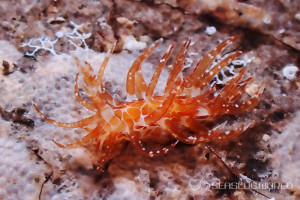
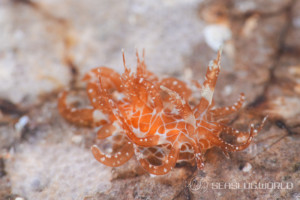
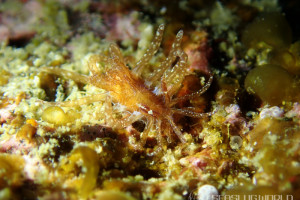
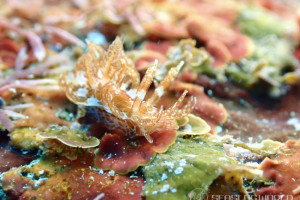
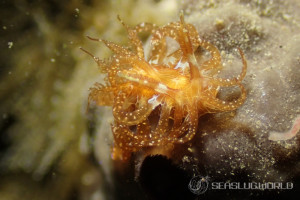
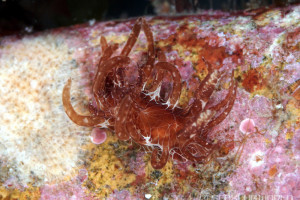
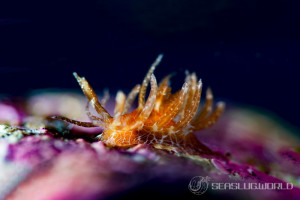
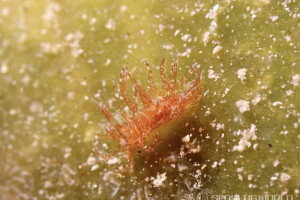
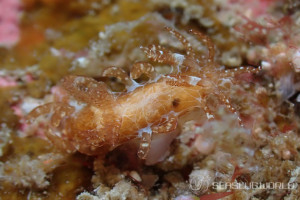
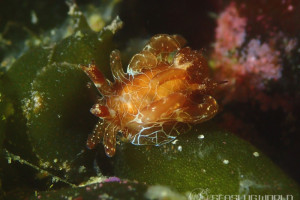
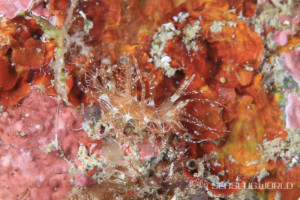
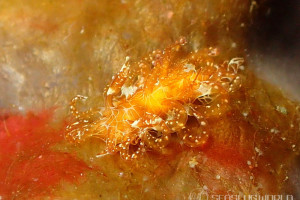
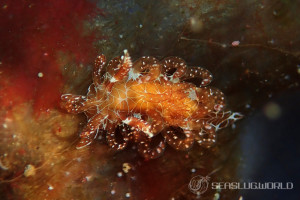
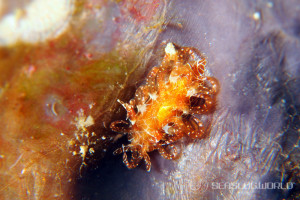
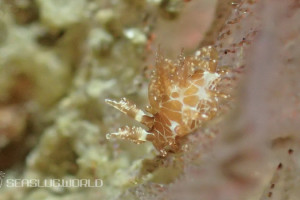
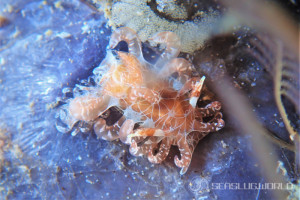
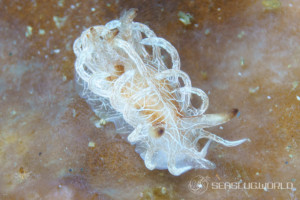
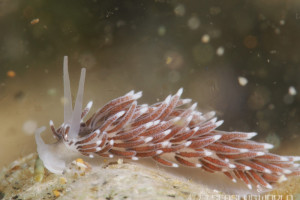
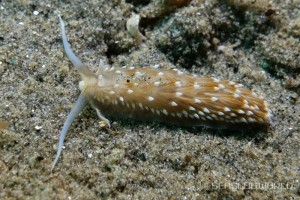
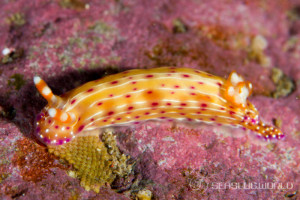
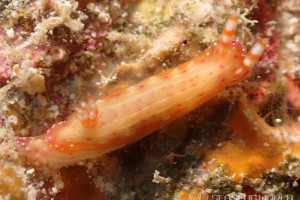
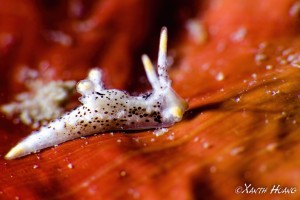
A small dorid nudibranch reaching about 8 mm in length, with a light brown-orangish body covered by a dense network of fine white lines on the dorsum, sides and foot. The mantle edge bears eight elongate, backward-curved papillae on each side — two adjacent to the rhinophores, four between the rhinophores and gills, and two behind the gills — together with a single mid-dorsal papilla. The two posteriormost papillae share a common stalk. Rhinophores are non-retractile, long and slender, each bearing about 20 lamellae concentrated in the middle portion. Six tripinnate gill branches form a semicircle around the anus. Oral tentacles are elongate, one on each side of the mouth. Papillae, rhinophores and gill branches are translucent brown speckled with white spots, with white patches at the base of the papillae and gill lamellae.Distribution
Type locality: Issai, Kochi Prefecture, Japan (13 m depth). The original description (Paz-Sedano & Pola 2021) referred to this species specimens previously figured as Okenia sp. from the Marquesas Islands (Gosliner et al. 2015, 2018) and from the Pacific coast of Japan between Kanagawa and Kochi (Debelius & Kuiter 2007, Nakano 2018).Etymology
Named in honour of Rie Nakano, "who has contributed greatly to the study of the nudibranchs of Japan" (Paz-Sedano & Pola 2021).Remarks
Several Indo-Pacific congeners share the reticulate dorsal pattern of fine pale lines, but background colour separates them clearly: Okenia pellucida is translucent white with brown lines, Okenia purpureolineata is translucent purple with darker purple lines, and Okenia vena is translucent white with brown lines. Ceratodoris nakanoae is uniquely light brown-orangish with white lines. The present species also bears only a single mid-dorsal papilla, whereas O. pellucida, O. purpureolineata, and O. vena have 4–7, 7, and 5–7 respectively.References
- Okenia sp. 1, Helmut Debelius, Rudie H. Kuiter. (2007). Nudibranchs of the World.
- Okenia sp. 3, Terrence Gosliner, Ángel Valdés and David Behrens. (2015). Nudibranch and Sea Slug Identification Indo-Pacific. New World Pubns Inc.
- アミメイバラウミウシ(新称), 中野理枝. (2018). 日本のウミウシ. 文一総合出版.
- Okenia sp. 5, Terrence Gosliner, Ángel Valdés and David Behrens. (2018). Nudibranch and Sea Slug Identification Indo-Pacific 2nd Edition. New World Pubns Inc.
- Okenia nakanoae Paz-Sedano & Pola, sp. nov., Paz-Sedano S., Wilson N.G., Carmona L., Gosliner T.M. & Pola M. (2021). An ocean yet to be discovered: increasing systematic knowledge of Indo-Pacific Okenia Menke, 1830 (Nudibranchia : Goniodorididae). Invertebrate Systematics. 35(7): 797-825. https://doi.org/10.1071/is20088
- Ceratodoris nakanoae comb. nov., Paz-Sedano S., Moles J., Smirnoff D., Gosliner T.M. & Pola M. (2024). A combined phylogenetic strategy illuminates the evolution of Goniodorididae nudibranchs (Mollusca, Gastropoda, Heterobranchia). Molecular Phylogenetics and Evolution. 192: 107990. https://doi.org/10.1016/j.ympev.2023.107990
Featured in this book
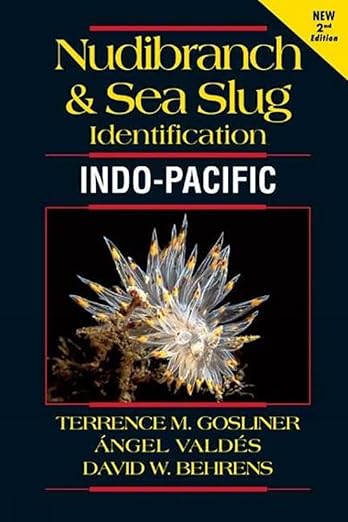
Terrence Gosliner, Ángel Valdés and David Behrens. (2018). Nudibranch and Sea Slug Identification Indo-Pacific 2nd Edition. New World Pubns Inc.
New World Publications
This species, Ceratodoris nakanoae, is included in the book.
View on Amazon PR (Amazon Associates)Seasonality
Shooting Locations
Loading shooting locations...
Photos of Ceratodoris nakanoae

















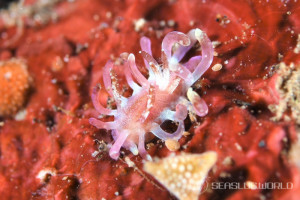
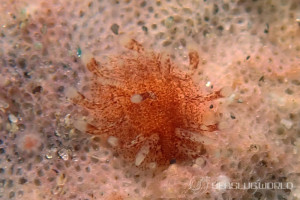
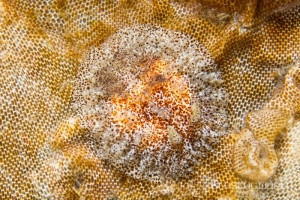
Same Genus Nudibranchs
Similar Colors Nudibranchs

Academic Database
Sea slug observation data is available in international marine biodiversity databases.