Ceratodoris kendi (Gosliner, 2004)
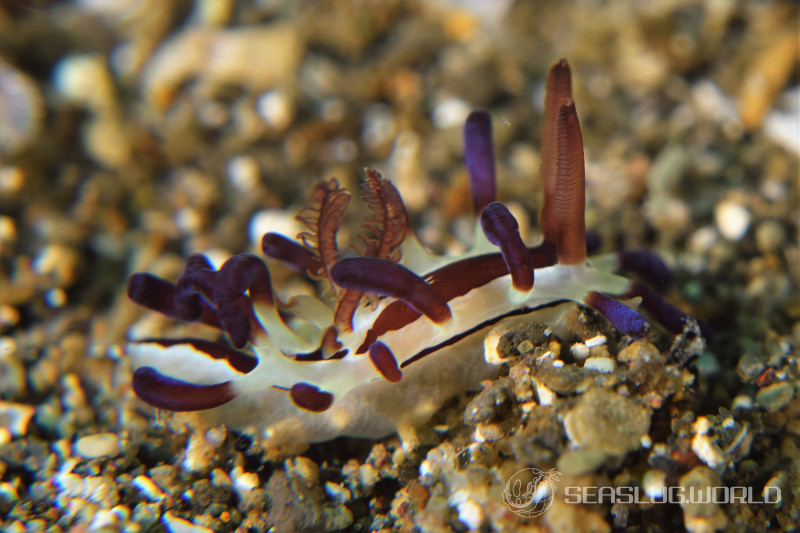
- Location
- Anilao, Philippines
- Date
- 2016/04/30
- Length
- 25mm
- Depth
- 18.0m
- Water temperature
- 27.0℃
Description
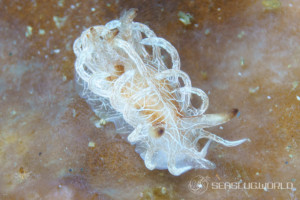
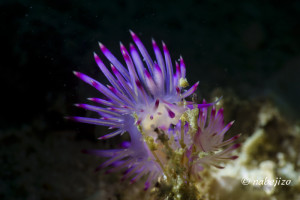
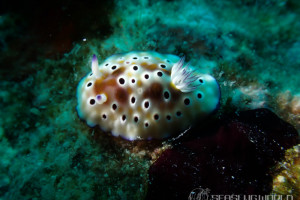
The body is wide and dorso-ventrally flattened, with a well-developed, distinct notal border. The general body color is translucent yellowish white, with a broad mid-dorsal band of maroon pigment running from anterior to the rhinophores to the posterior end of the foot. The band divides around the mid-dorsal papillae and rejoins posterior to the gills. The rhinophores and gill bear maroon pigment with opaque white markings along their lengths. The medial and marginal papillae are maroon basally and purple distally. A maroon lateral line runs along each side of the body between the notum and the foot. There are eight pairs of elongate notal papillae along the body sides and a single mid-dorsal papilla anterior to the gill. The gill consists of three unipinnate branches that are bifid or trifid at the base. The rhinophores are elongate with 31 congested lamellae. Living animals reach 30 mm; preserved specimens 15-25 mm.Distribution
The type locality is Bethlehem, Caban Island, Batangas Province, Luzon, Philippines (10 m depth). Known from Luzon (Philippines) and Sulawesi (Indonesia).Etymology
Verbatim from the original description (Gosliner, 2004, p.135):The specific epithet kendi is the Filipino word for candy, in reference to its appearance to a sweet confection.
Remarks
Originally described as Okenia kendi in Gosliner, T.M. 2004 Proceedings of the California Academy of Sciences 55(5): 125-161; subsequently transferred to Ceratodoris. Found on the underside of the large brown leafy sponge Phyllospongia lamellosa at 5-15 m depth, where it feeds on encrusting bryozoans.References
- Okenia kendi Gosliner, sp. nov., Gosliner T. M. (2004). Phylogenetic Systematics of Okenia, Sakishmaia, Hopkinsiella and Hopkinsia (Nudibranchia: Goniodorididae) with descriptions of new species from the tropical Indo-Pacific". Proceedings of the California Academy of Sciences 55(5): 125-161.
- Okenia kendi, Terrence Gosliner, Ángel Valdés and David Behrens. (2018). Nudibranch and Sea Slug Identification Indo-Pacific 2nd Edition. New World Pubns Inc.
- Paz-Sedano S., Moles J., Smirnoff D., Gosliner T.M. & Pola M. (2024). A combined phylogenetic strategy illuminates the evolution of Goniodorididae nudibranchs (Mollusca, Gastropoda, Heterobranchia). Molecular Phylogenetics and Evolution. 192: 107990. https://doi.org/10.1016/j.ympev.2023.107990
Featured in this book
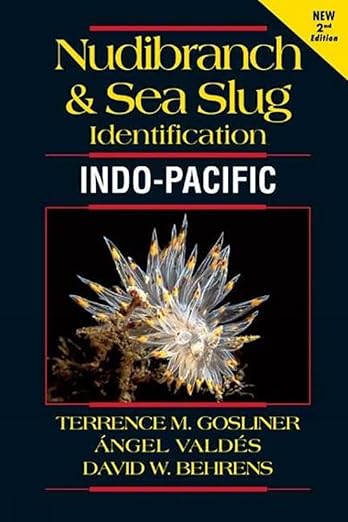
Terrence Gosliner, Ángel Valdés and David Behrens. (2018). Nudibranch and Sea Slug Identification Indo-Pacific 2nd Edition. New World Pubns Inc.
New World Publications
This species, Ceratodoris kendi, is included in the book.
View on Amazon PR (Amazon Associates)Seasonality
Shooting Locations
Loading shooting locations...
Photos of Ceratodoris kendi

Same Genus Nudibranchs
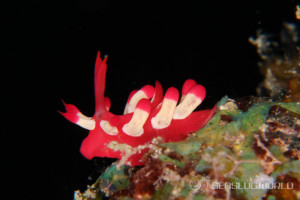
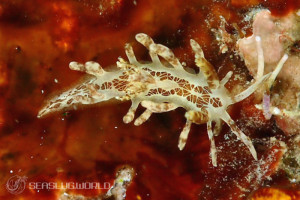
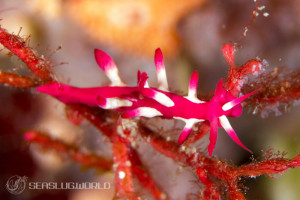
Similar Colors Nudibranchs
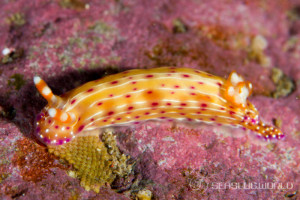

Academic Database
Sea slug observation data is available in international marine biodiversity databases.