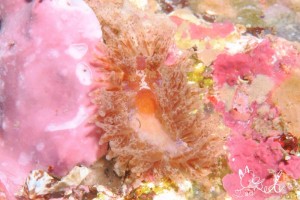
Ceratodoris atkinsonorum (Rudman, 2007)
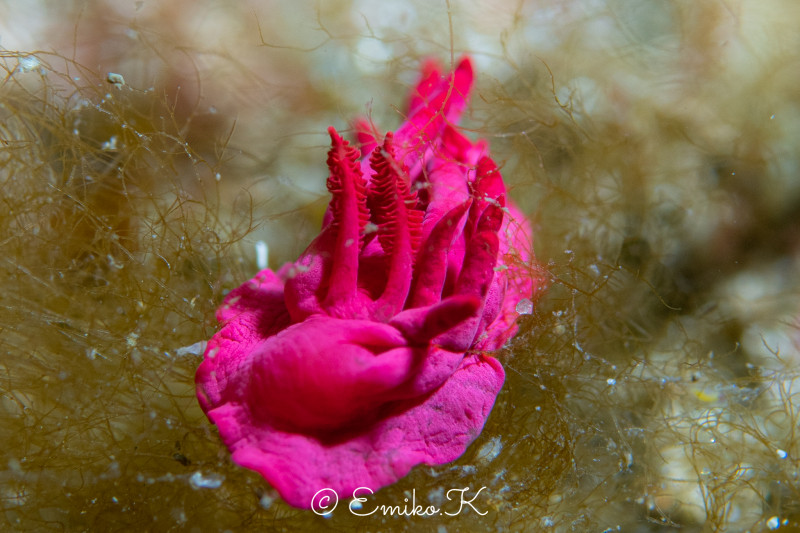
- Location
- The Steps, Kurnell, New South Wales, Australia
- Date
- 2020/06/23
- Length
- 10mm
- Depth
- 15.0m
- Water temperature
- 17.0℃
Description
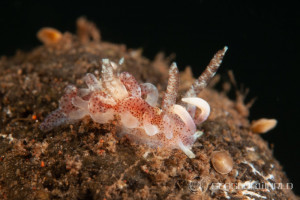
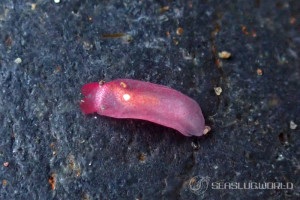
Body elongate with a relatively low profile; mantle ridge absent but position indicated by up to seven large mantle papillae on each side. The anteriormost papilla on each side sits just in front of the adjacent rhinophore and points anteriorly, similar in size and shape to the others. Other lateral papillae point outward and somewhat upward, approximately one and a half times the body width long, some with bluntly rounded and others with pointed tips. Two dorsal mantle papillae are usually present in the midline, one in front of and one behind the gills. Gills usually five (sometimes lacking the two smaller posterior gills), each inserted separately, simple, with a broad rounded outside edge. Rhinophores long and tapering; the club has up to 14 lamellae and occupies the upper four-fifths. From above, head indistinguishable from foot; no oral tentacles; ventrally a distinct V-shaped groove differentiates the anterior edge of the foot from the head, and the anterior corners of the foot are extended into triangular processes.Body bright pink except for the tips of the mantle processes, gills and rhinophores, which are a deeper redder shade of the same colour. Holotype 13-15 mm alive; paratypes 5-10 mm alive.
Distribution
Type locality: The Pipeline, west side of Nelson Bay, Port Stephens, New South Wales, Australia, on Pleurotoichus clathratus, 11 m. Also recorded from Bare Island, Botany Bay, NSW (6-15 m); subsequent records suggest a possible extension to New Zealand.Etymology
The species is named after Leanne and David Atkinson in recognition of their long-running observations on opisthobranch biology in New South Wales and their many contributions to the Sea Slug Forum. The plural genitive ending -orum reflects dedication to two persons.Remarks
Originally described in Okenia. Ceratodoris was subsequently resurrected, and the species is now placed there. It is one of three pink Okenia-group species in Australia known to feed on the bryozoan Pleurotoichus clathratus, often co-occurring on the same colony with Ceratodoris hallucigenia and Okenia stellata. C. hallucigenia differs in its more elongate, higher body profile and the distinct and separate oral veil, and O. stellata has red lines as part of its colour pattern — both absent in C. atkinsonorum.References
A Kindle field guide by the site author
Kimoto N. (2026). Sea Slugs of Japan & the Indo-Pacific, 2nd Edition.
Kindle Edition
View on Amazon PR (Amazon Associates)Seasonality
Shooting Locations
Loading shooting locations...
Photos of Ceratodoris atkinsonorum

Same Genus Nudibranchs
Similar Colors Nudibranchs

Academic Database
Sea slug observation data is available in international marine biodiversity databases.