Ceratodoris hallucigenia (Rudman, 2004)
Ceratodoris hallucigenia
No field photograph submitted for this species yet
Have you photographed this species?Description
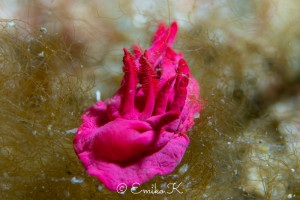
Body very elongate with a high cylindrical profile and no distinct mantle ridge. Four pairs of large lateral mantle papillae: the anteriormost pair is about half the width and length of the others, points forward and tapers to a point, while the other three pairs project outward and upward, about twice the body width long, with bluntly rounded tips. The papillae are relatively rigid and less motile than the long papillae of many other species in the group. A single mid-dorsal papilla sits just in front of the gills. Gills usually five, in an arch around the anal papilla (sometimes only three with a fused base); simple, with a broad smooth band up the outside edge. Rhinophores long and tapering, with up to 16 lamellae on the upper two-thirds. The head is highly distinctive, with a wide bilobed "oral veil" at least twice the width of the body. Body uniformly bright pink, with the gills, rhinophores and tips of the mantle processes a deeper redder shade. Up to 18 mm long alive.Distribution
Type locality: Blue Pools, Heron Island, Queensland, Australia, 40-50 ft. Recorded from northern Australia (Western Australia - Kimberley, Exmouth Gulf; Northern Territory), Queensland, and central New South Wales (North Solitary Is. and Mutton Bird Is. near Coffs Harbour; Halifax Park, Port Stephens).Etymology
The species is named for its likeness to the Burgess Shale Cambrian fossil Hallucigenia sparsa, whose reconstructed dorsal armament closely resembles the row of long rigid papillae along the back of this sea slug.Remarks
Originally described in Okenia. Ceratodoris was subsequently resurrected to accommodate "Okenia"-group species with frontal and dorsal processes but without lateral processes, and the species is now placed there. It is regularly found together with O. stellata on the bryozoan Pleurotoichus clathratus. Ceratodoris atkinsonorum differs in having a lower body profile and lacks the wide bilobed oral veil.References
- Okenia hallucigenia, Terrence Gosliner, Ángel Valdés and David Behrens. (2018). Nudibranch and Sea Slug Identification Indo-Pacific 2nd Edition. New World Pubns Inc.
- Paz-Sedano S., Moles J., Smirnoff D., Gosliner T.M. & Pola M. (2024). A combined phylogenetic strategy illuminates the evolution of Goniodorididae nudibranchs (Mollusca, Gastropoda, Heterobranchia). Molecular Phylogenetics and Evolution. 192: 107990. https://doi.org/10.1016/j.ympev.2023.107990
Featured in this book
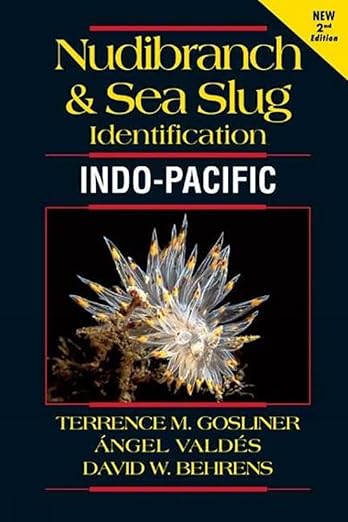
Terrence Gosliner, Ángel Valdés and David Behrens. (2018). Nudibranch and Sea Slug Identification Indo-Pacific 2nd Edition. New World Pubns Inc.
New World Publications
This species, Ceratodoris hallucigenia, is included in the book.
View on Amazon PR (Amazon Associates)Seasonality
Shooting Locations
Loading shooting locations...
Photos of Ceratodoris hallucigenia
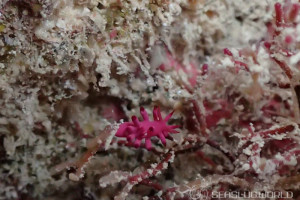

Same Genus Nudibranchs
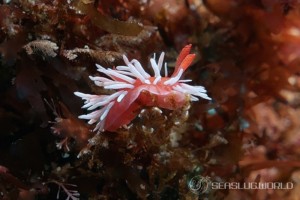
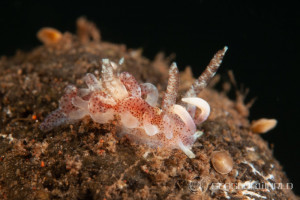
Similar Colors Nudibranchs

Academic Database
Sea slug observation data is available in international marine biodiversity databases.