Diaulula odonoghuei (Steinberg, 1963)
Description
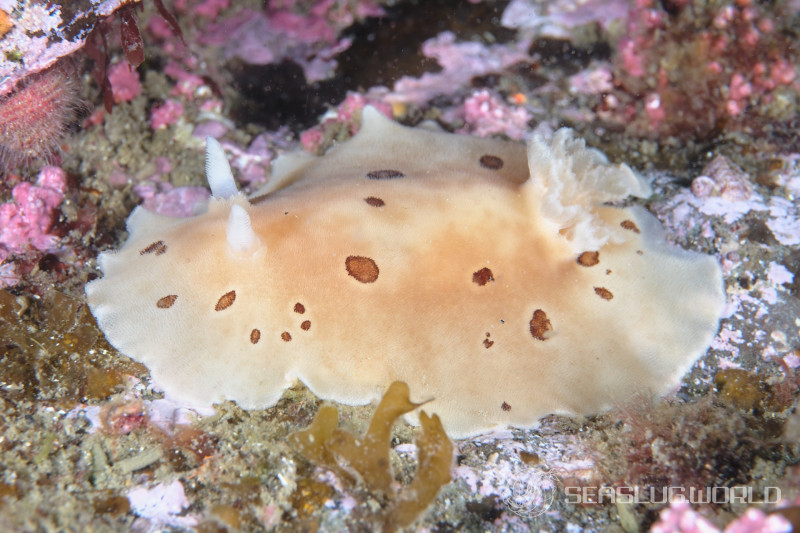
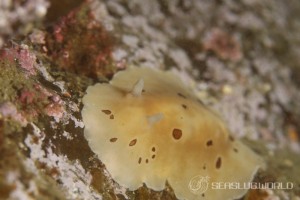
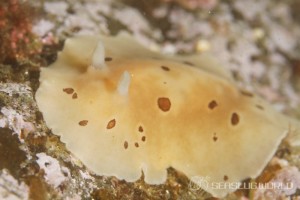
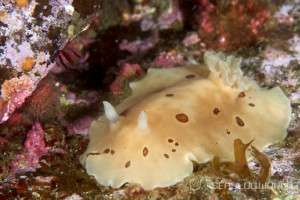
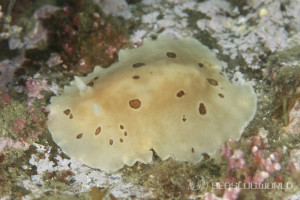
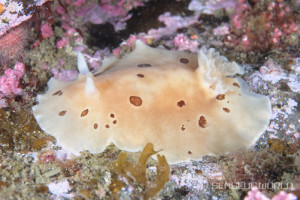
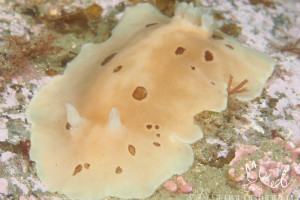
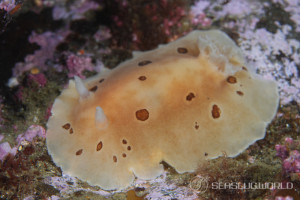
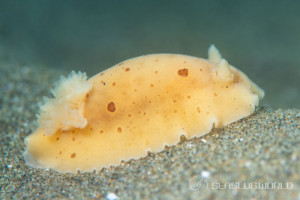
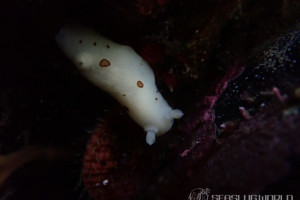
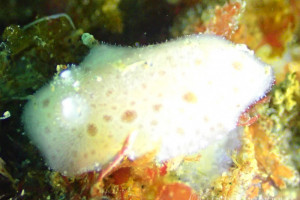
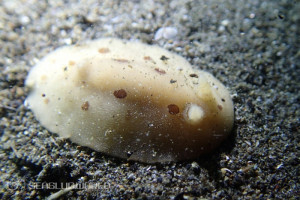
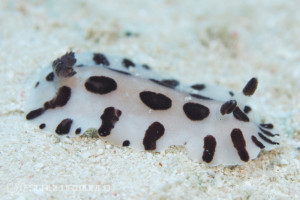
Ground colour grey-white to pale yellowish-brown, the dorsum scattered with chocolate-brown spots that may be ring-shaped or solid and vary considerably in size. A diagnostic feature is that these spots extend onto the mantle margin. The dorsum is finely villous, giving a velvety texture. Rhinophores and gills are pale yellow to off-white; the branchial plume comprises around six tri- to quadripinnate leaves. This is one of the larger species of Diaulula, reaching about 100 mm in length.Distribution
North Pacific. The neotype was collected at Gig Harbor, Washington, USA. The species has an amphi-Pacific range extending from Korea and northern Japan (south to Onagawa) through Hokkaido, the Aleutian Islands and the Pacific coast of North America southwards to Bodega Bay in northern California, predominantly in cold-water regions.Etymology
The specific epithet odonoghuei honours Charles Henry O'Donoghue, the British-born Canadian zoologist who studied the nudibranch fauna of the Vancouver Island region in the 1920s. O'Donoghue had originally described populations belonging to this species as Doris echinata O'Donoghue, 1922, but that name was a junior homonym and unavailable; Steinberg 1963 later proposed Doris odonoghuei as a replacement name dedicated to him.Remarks
This species was long confused with the broadly North-Pacific Diaulula sandiegensis (J. G. Cooper, 1863), and Japanese animals were treated under the latter name. Hallas, Simison & Gosliner 2017, combining molecular phylogenetics with morphology, recognised two species: a "spotted" form with spots reaching the mantle margin (D. odonoghuei) and a "ringed" form lacking marginal spots (D. sandiegensis). Northwest-Pacific populations previously called the ezo leopard dorid are referable to D. odonoghuei. The species feeds on sponges. the 1957 study recorded it as D. sandiegensis from northern Japan (Akkeshi, Muroran, Shirikishinai, Asamushi and Onagawa), proposing the Japanese name "Ezo-kasuriumiushi".References
- Diaulula sandiegensis (Cooper) Ezo-kasuriumiushi (n. n.), Baba, K. 1957. A revised list of the species of Opisthobranchia from the northern part of Japan, with some additional descriptions. J. Fac. Sci., Hokkaido Univ.,ser. 6, Zool. 13(1-4):8-14.
- Doris odonoghuei nom. nov., Steinberg J.E. (1963). Notes on the opisthobranchs of the west coast of North America - III. Further nomenclatorial changes in the order Nudibranchia. The Veliger. 6(2): 63-67.
- エゾカスリウミウシ, 中野理枝. (2004). 本州のウミウシ. ラトルズ.
- Cooke S., Hanson D., Hirano Y., Ornelas-Gatdula E., Gosliner T.M., Chernyshev A.Y. & Valdés A. (2014) Cryptic diversity of Melanochlamys sea slugs (Gastropoda, Aglajidae) in the North Pacific. Zoologica Scripta 43: 351-369.
- Diaulula boreopacifica, Martynov A.V., Sanamyan N.P. & Korshunova T.A. (2015). Review of the opisthobranch mollusc fauna of Russian Far Eastern seas: Pleurobranchomorpha, Doridida and Nudibranchia. Bulletin of Kamchatka State Technical University, 34, 62-87. https://doi.org/10.17217/2079-0333-2015-34-62-87
- Diaulula odonoghuei (Steinberg, 1963), Hallas J.M., Simison W.B. & Gosliner T.M. (2017). Changing spots: pseudocryptic speciation in the North Pacific dorid nudibranch Diaulula sandiegensis (Cooper, 1863) (Gastropoda: Heterobranchia). Journal of Molluscan Studies. 83(1): 1-15. https://doi.org/10.1093/mollus/eyw037
- エゾカスリウミウシ, 中野理枝. (2018). 日本のウミウシ. 文一総合出版.
- Diaulula odonoghuei, 柏尾翔 & 山崎友資. (2021). 北海道積丹半島沿岸のウミウシ. ちりぼたん. 51(1): 1-20.
Featured in this book

中野理枝. (2019). 日本のウミウシ. 第二版. 文一総合出版.
文一総合出版
This species, Diaulula odonoghuei, is included in the book.
View on Amazon PR (Amazon Associates)Seasonality
Shooting Locations
Loading shooting locations...
Photos of Diaulula odonoghuei











Same Genus Nudibranchs
Similar Colors Nudibranchs

Academic Database
Sea slug observation data is available in international marine biodiversity databases.