Doto cervicenigra Ortea & Bouchet, 1989
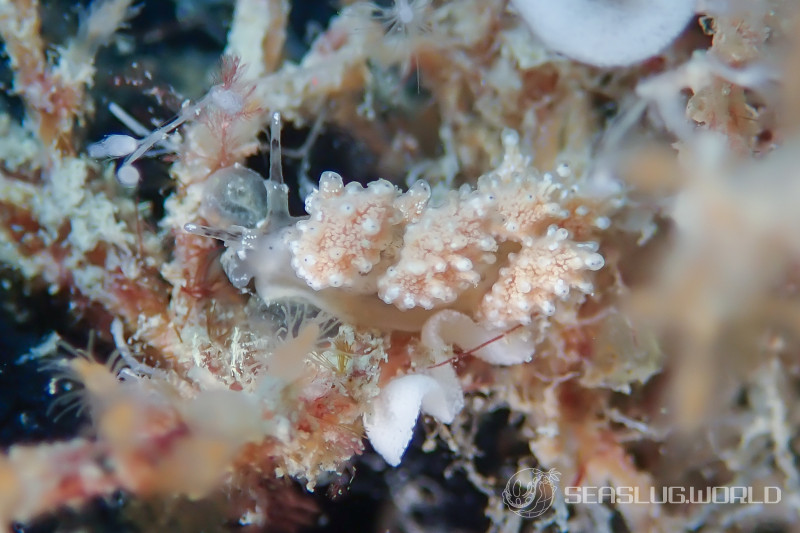
- Location
- Banya, Amami Oshima, Kagoshima, Japan
- Date
- 2023/12/05
- Length
- ??mm
- Depth
- 1.0m
- Water temperature
- 22.0℃
Description
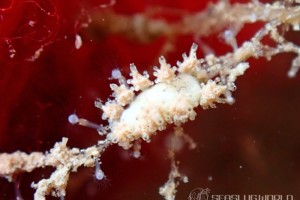
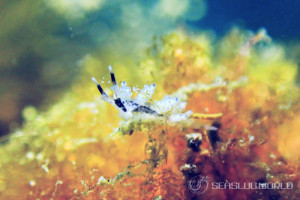
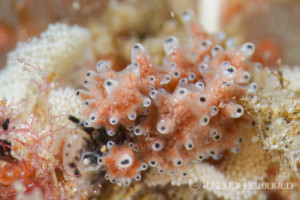
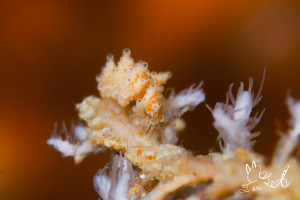
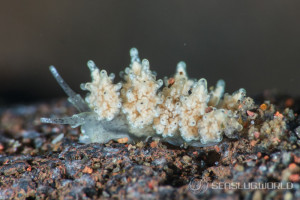
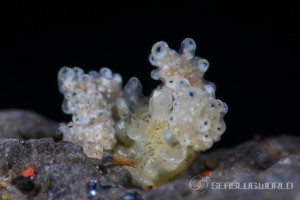
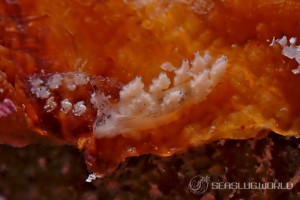
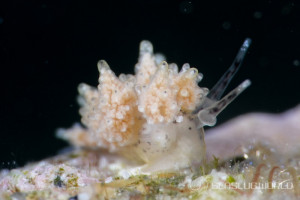
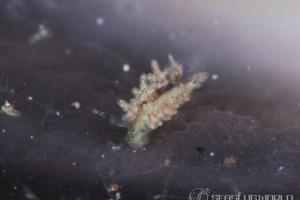
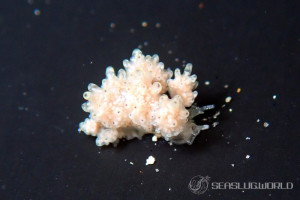
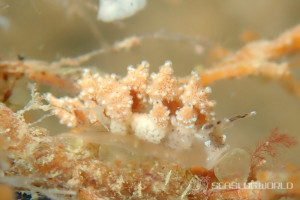
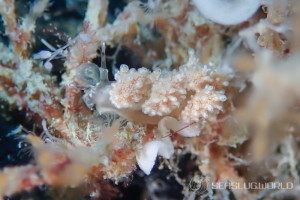
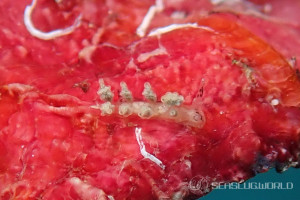
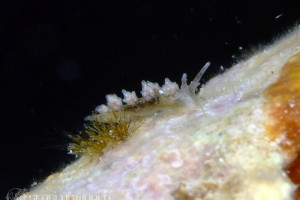
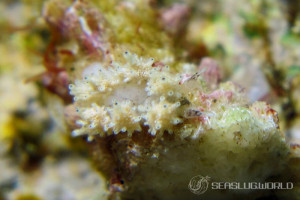
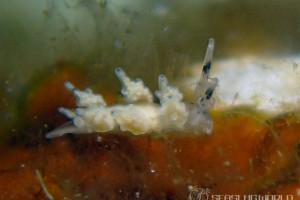
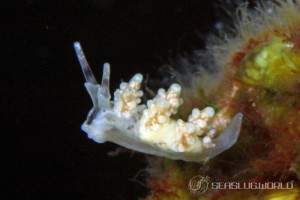
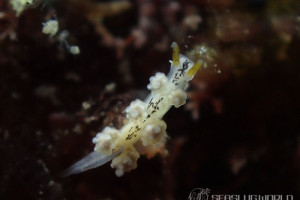
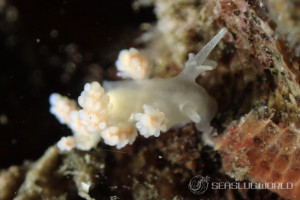
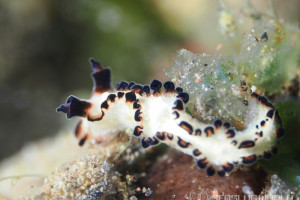
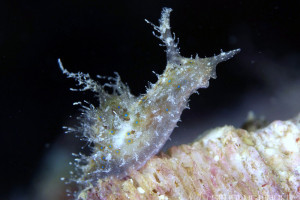
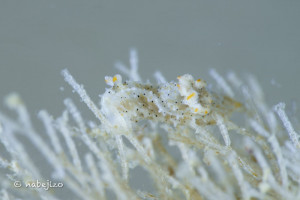
A small species reaching 5–7 mm in length. Body translucent white. The head bears numerous irregular black markings that extend backwards between the rhinophores—the most reliable diagnostic character. Rhinophores are long, black with white tips; the rhinophore sheath is short, thin, and symmetrical. There are 5–6 pairs of dorsolateral cerata, each bearing 2–3 crowns of nearly spherical tubercles. The apical tubercle of each ceras has a dark violet-black subcutaneous spot surrounded by opaque white pigment. A black longitudinal line runs along the dorsal midline, with scattered black spots on the body sides.Distribution
Type locality: La Revellata near Calvi, Corsica, France. Confirmed from the western Mediterranean, including France (Corsica, Marseille area, Thau Basin), Italy (Sicily, Sardinia), and Spain (Catalonia, Mallorca). DNA barcode data from BOLD Systems (BIN: AFY8172) has confirmed that Japanese (Okinawa) specimens are conspecific with Mediterranean populations, suggesting a broader distribution than previously recognized.Etymology
From Latin cervix (neck, head) + nigra (black), referring to the dark markings on the cephalic region.Remarks
A member of the family Dotidae. This species feeds exclusively on hydroids, with Obelia sp., Sertularella mediterranea, and Campanularia sp. recorded as prey. Unlike most nudibranchs, it does not ingest polyps whole but instead perforates the perisarc with fine radular teeth and sucks the coenosarc fluid. Larvae are planktotrophic, enabling long-distance dispersal. Phylogenetic analysis by Vazquez-Alcaide et al. 2025 placed this species in a well-supported clade with D. fluctifraga from the Canary Islands. The two are morphologically nearly indistinguishable but confirmed as separate species by molecular data, differing in distribution (Mediterranean vs. Atlantic) and prey (Obelia/Campanularia vs. Pennaria disticha).References
- オキナワシロマツカサウミウシ(仮称), 小野篤司. (1999). ウミウシガイドブック. TBSブリタニカ.
A Kindle field guide by the site author
Kimoto N. (2026). Sea Slugs of Japan & the Indo-Pacific, 2nd Edition.
Kindle Edition
View on Amazon PR (Amazon Associates)Seasonality
Shooting Locations
Loading shooting locations...
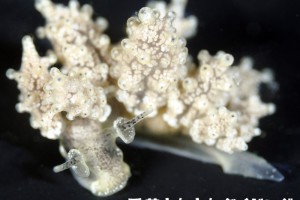
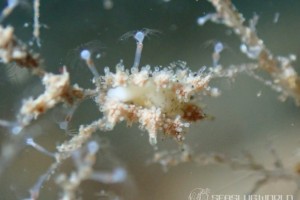
Photos of Doto cervicenigra












Same Genus Nudibranchs


Similar Colors Nudibranchs
Academic Database
Sea slug observation data is available in international marine biodiversity databases.