Felimare agassizii (Bergh, 1894)
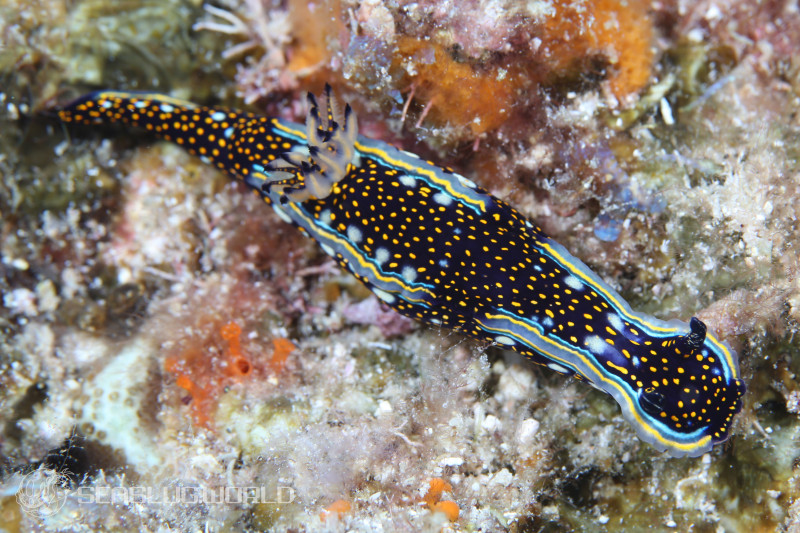
- Location
- Mexico
- Date
- 2013/09/28
- Length
- 30mm
- Depth
- 7.0m
- Water temperature
- 28.0℃
Description
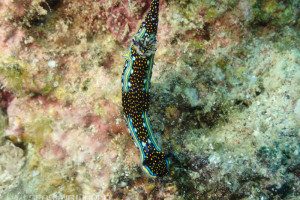
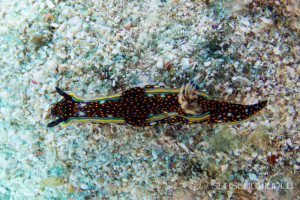
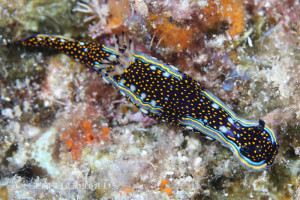
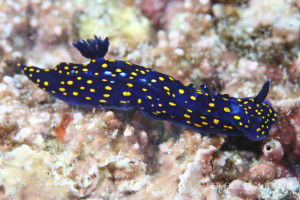
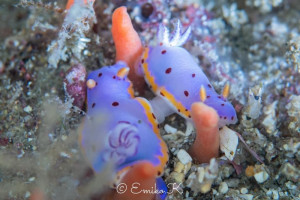
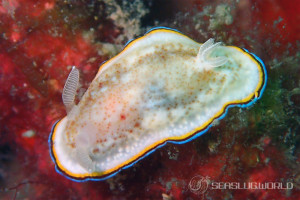
A small to medium-sized chromodorid reaching about 38 mm in body length. The ground colour in life is dark brown to reddish-brown, with yellow round spots scattered all over the dorsum; some individuals also show somewhat larger blue spots set among the yellow ones. The mantle margin bears, from outside in, a yellow band and a pale blue band, both interrupted at the front, sides and rear. The rhinophores are black, and the gill is cream-coloured with darkened tips. Bergh's alcohol-preserved type, 12 mm long, 5 mm high and 5 mm wide, was uniformly blue, with numerous small oval white points scattered over the dorsum and sides; the points were especially dense around the rhinophore openings and the round branchial slit. The lateral parts of the dorsum were olive-green and bore a discontinuous (anteriorly and posteriorly interrupted) whitish longitudinal band, with two narrow continuous white lines running along the mantle margin itself. A narrow olive-green band ran along the upper body sides immediately below the mantle margin, with a discontinuous white line beneath it. The foot sole was greenish-yellow, the rhinophore club blue with zigzag anterior and posterior edges, and the gill leaves strongly yellow with blue tips. The gill consists of 7 leaves of nearly equal size, with sharp white inner margins sometimes accompanied by a fine blue band. The type was collected with Tridachia diomedea (= Elysia diomedea) in the Gulf of Panama.Distribution
Eastern tropical Pacific. Type locality: Gulf of Panama, based on a single specimen taken during dredging by the U. S. Fish Commission Steamer Albatross in 1891 under the direction of Alexander Agassiz. The species is recorded from Costa Rica, Panama, Mexico and the Galápagos Islands.Etymology
Named in honour of Alexander Agassiz (1835–1910), the Swiss-American marine zoologist and director of the Museum of Comparative Zoology at Harvard who organised and led the Albatross dredging expedition. Bergh wrote the epithet with a capital initial ("Agassizii") in the original description.Remarks
Originally placed by Bergh in Chromodoris, the species was subsequently moved to Glossodoris and then to Hypselodoris, and is now placed in Felimare on the basis of a molecular phylogeny of the Chromodorididae; the parentheses in the author citation reflect this series of generic transfers.References
- Chromodoris Agassizii Bgh. n. sp., Bergh R. (1894). Reports on the dredging operations off the West Coast of Central America to the Galapagos, to the West Coast of Mexico, and in the Gulf of California, in charge of Alexander Agassiz, carried on by the U. S. Fish Commission Steamer "Albatross", during 1891. XIII. Die Opisthobranchien. Bulletin of the Museum of Comparative Zoology at Harvard College. 25(10): 125-235, pls. I-XII.
- Hypselodoris agassizii (Bergh, 1894), Gosliner T.M. & Johnson R.F. (1999). Phylogeny of Hypselodoris (Nudibranchia: Chromodorididae) with a review of the monophyletic clade of Indo-Pacific species, including descriptions of twelve new species. Zoological Journal of the Linnean Society. 125: 1-114. https://doi.org/10.1111/j.1096-3642.1999.tb00585.x
- Felimare agassizii, Johnson R.F. & Gosliner T.M. (2012). Traditional taxonomic groupings mask evolutionary history: a molecular phylogeny and new classification of the chromodorid nudibranchs. PLoS ONE 7(4): e33479.
- Felimare agassizii, Behrens D.W., Hermosillo A., Fletcher K. & Jensen G.C. (2022). Nudibranchs & Sea Slugs of the Eastern Pacific. Molamarine.
Featured in this book
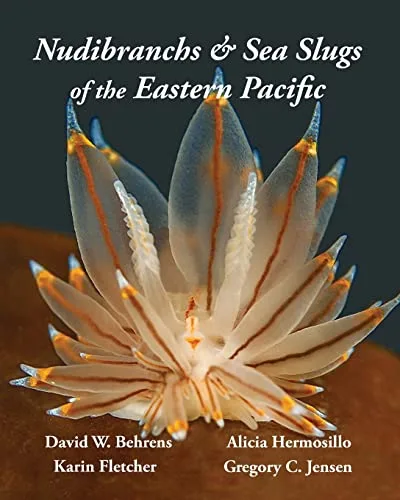
Behrens D.W., Hermosillo A., Fletcher K. & Jensen G.C. (2022). Nudibranchs & Sea Slugs of the Eastern Pacific. Molamarine.
Molamarine
This species, Felimare agassizii, is included in the book.
View on Amazon PR (Amazon Associates)Seasonality
Shooting Locations
Loading shooting locations...
Photos of Felimare agassizii



Same Genus Nudibranchs
Similar Colors Nudibranchs


Academic Database
Sea slug observation data is available in international marine biodiversity databases.