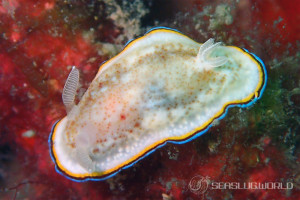
Felimare bilineata (Pruvot-Fol, 1953)
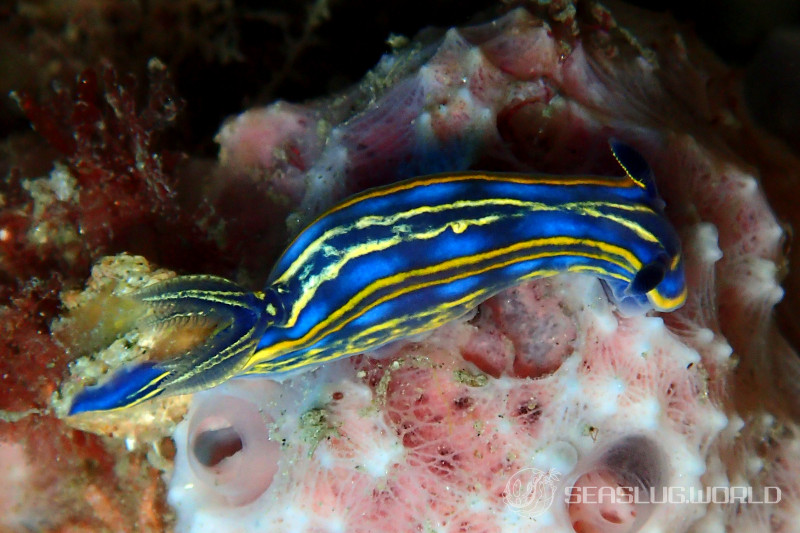
- Location
- La Herradura, Granada, Spain
- Date
- 2017/08/13
- Length
- 30mm
- Depth
- 15.0m
- Water temperature
- 23.0℃
Description
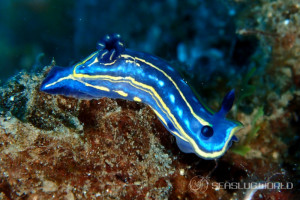
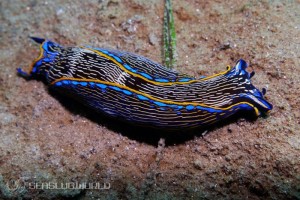
A small chromodorid with a bright blue body bordered by a fine yellow to orange marginal line. The dorsum bears two longitudinal yellow to orange lines that run close together and lacks the conspicuous mid-dorsal pale line otherwise characteristic of related Mediterranean and East-Atlantic blue Glossodoris species.The rhinophores and gills are blue, edged with yellow. A crescent-shaped yellow arc lies in front of the rhinophores, and a yellow ring surrounds the base of the gills. A yellow mid-dorsal line and a lateral yellow line on each side run along the tail. Juveniles are pale blue and darken with growth.
Distribution
Northeast Atlantic from Morocco to Senegal, and the Mediterranean Sea. The type locality is Témara on the Atlantic coast of Morocco, where Pruvot-Fol described the species from three specimens collected by H. Gantès on 27 July, 25 and 26 August 1949.Etymology
From Latin bi- ("two") + lineatus ("lined"), referring to the two longitudinal yellow lines on the dorsum.Remarks
Three subspecies are recognised: the nominotypical F. b. bilineata, F. b. senegalensis and F. b. viridis (all Ortea, Valdés & García-Gómez, 1996).Original description (verbatim, Pruvot-Fol 1953: 72-73)
Glossodoris bilineata n. sp. — Pl. I, fig. 7, 8, 9 ; Témara, n° 89, H. Gantès leg.« À cette espèce, je rapporte trois individus récoltés à Témara : 27 juillet 1949, 25 et 26 août 1949. C'est encore un Glossodoris de la famille bleue, apparentée à G. gracilis ; en alcool, elle ne s'en distingue guère, mais deux aquarelles accompagnant les envois montrent un dessin bien nettement distinct de celui de l'espèce méditerranéenne. D'un bleu pâle chez le jeune, beaucoup plus foncé chez l'adulte, elle est bordée de jaune et porte sur le dos deux lignes jaunes, assez rapprochées et pas de ligne médiane. Devant les rhinophores, une ligne courbe forme un croissant, et il y a un cercle autour des branchies. Rhinophores bleus, branchies bleues (avec lignes jaunes ?). Une ligne jaune médiane sur la queue et une sur le flanc. Il n'y a pas de lignes blanches entre les jaunes, comme chez gracilis. L'aspect est donc assez différent. […] L'armature buccale en entonnoir, plissée, est formée de bâtonnets ou granules très petits et noyés dans la masse. »
References
- Glossodoris bilineata n. sp., Pruvot-Fol A. (1953). Étude de quelques opisthobranches de la côte atlantique du Maroc et du Sénégal. Travaux de l'Institut Scientifique Chérifien. 5: 1-105, pls 1-4.
- Hypselodoris bilineata (Pruvot-Fol, 1953), Gosliner T.M. & Johnson R.F. (1999). Phylogeny of Hypselodoris (Nudibranchia: Chromodorididae) with a review of the monophyletic clade of Indo-Pacific species, including descriptions of twelve new species. Zoological Journal of the Linnean Society. 125: 1-114. https://doi.org/10.1111/j.1096-3642.1999.tb00585.x
- Felimare bilineata, Johnson R.F. & Gosliner T.M. (2012). Traditional taxonomic groupings mask evolutionary history: a molecular phylogeny and new classification of the chromodorid nudibranchs. PLoS ONE 7(4): e33479.
A Kindle field guide by the site author

Kimoto N. (2026). Sea Slugs of Japan & the Indo-Pacific, 2nd Edition.
Kindle Edition
View on Amazon PR (Amazon Associates)Seasonality
Shooting Locations
Loading shooting locations...
Photos of Felimare bilineata

Same Genus Nudibranchs
Similar Colors Nudibranchs
Academic Database
Sea slug observation data is available in international marine biodiversity databases.