Leostyletus misakiensis (Baba, 1960)
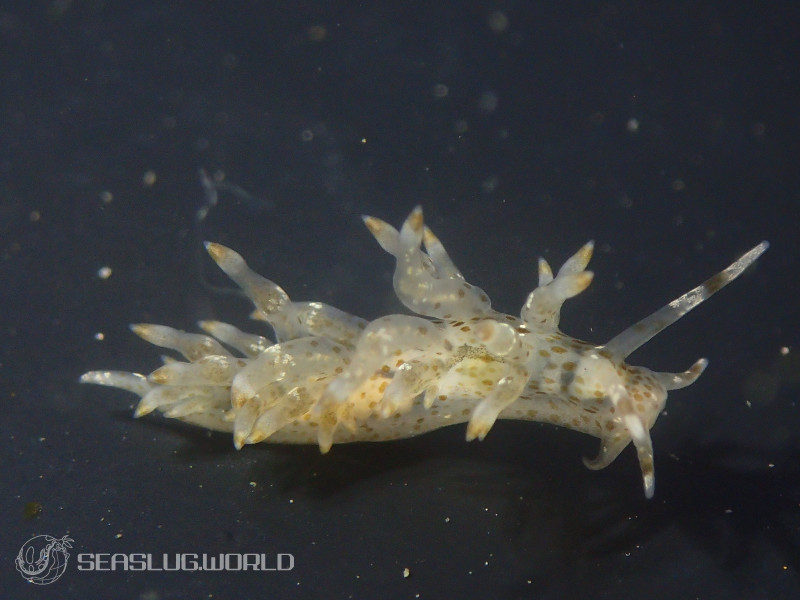
- Location
- Kajinohama, Jogashima, Kanagawa, Japan
- Date
- 2019/04/23
- Length
- 8mm
- Depth
- 2.0m
- Water temperature
- 16.0℃
Description
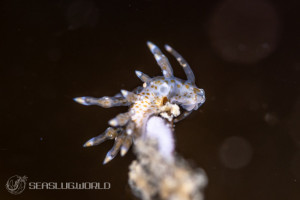
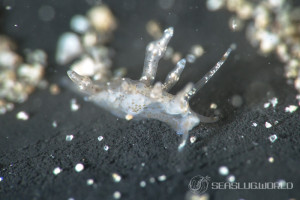
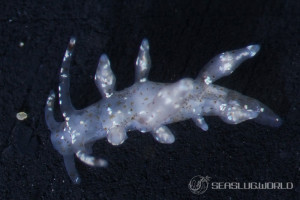
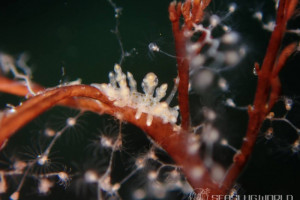
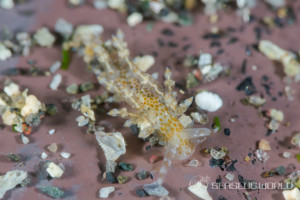
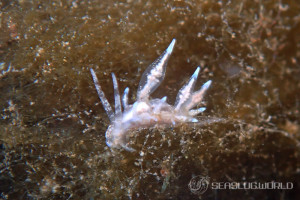
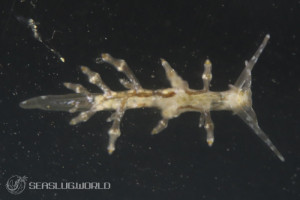
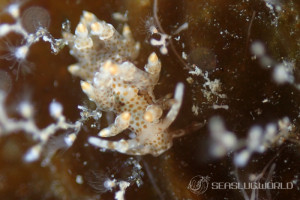
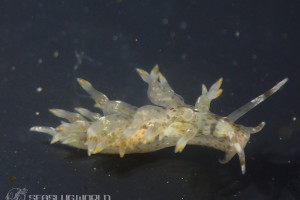
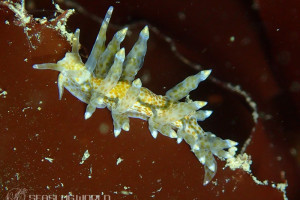
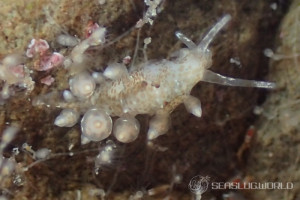
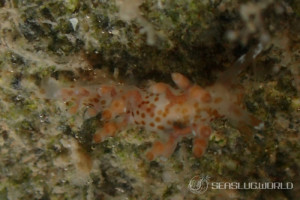
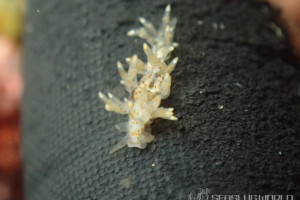
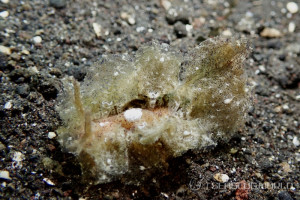
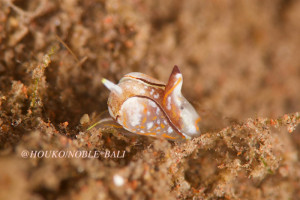
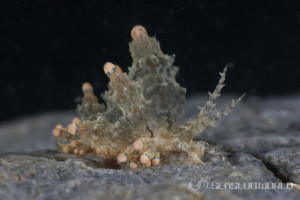
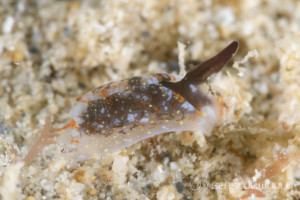
A small aeolid 3-5 mm in length. Rhinophores simple; foot corners produced as short horns. Cerata long fusiform, arranged in 6 oblique rows on each side: about 4 in the first, 5 in the second, 4 in the third, 3 in the fourth, 2-1 in the following rows. The foremost two rows (the right and left livers) lie rather close together and are separated from the posterior liver rows. Anus just in front of the inner corner of the right post-anal row. General ground colour yellowish white, scattered everywhere with chocolate-brown spots on the body, cephalic tentacles, rhinophores, and gills; the sole is colourless. Each ceras bears a yellow subapical ring and a bluish-green liver vein. A particularly diagnostic feature is that the liver vein within each ceras develops a large boss in the middle of its length, with the ceratal integument elevated above the boss.Distribution
Type locality: Misaki, Sagami Bay, Japan. Subsequently recorded from Mukaishima, Inland Sea of Seto, in some abundance from Sargassum.Etymology
The specific epithet misakiensis is "from Misaki" (place name + Latin adjectival suffix -ensis), referring to the type locality.Remarks
The original combination was Eubranchus misakiensis; the species has subsequently been placed in the genus Leostyletus.References
- Misaki-hime-minoumiushi (n. n.), Baba K. (1960). TWO NEW SPECIES OF THE GENUS EUBRANCHUS FROM JAPAN (NUDIBRANCHIA-EOLIDACEA). Publications of the Seto Marine Biological Laboratory. 8(2): 299-302. https://doi.org/10.5134/174650
- Martynov A.V. (1998). Opisthobranch mollusks (Gastropoda: Opisthobranchia) of the family Eubranchidae: Taxonomy and two new species from the Sea of Japan [in Russian]. Zoologicheskii Zhurnal. 77(7): 763-777.
- ミサキヒメミノウミウシ, 鈴木敬宇. (2000). ウミウシガイドブック〈2〉. TBSブリタニカ.
- 高岡生物研究会. (2002). 日本海のウミウシ. 第2版.
- ミサキヒメミノウミウシ, 中野理枝. (2004). 本州のウミウシ. ラトルズ.
- ミサキヒメミノウミウシ, 小野篤司 & 加藤昌一. (2009). ウミウシ. 誠文堂新光社.
- Eubranchus misakiensis, Chichvarkhin A. (2016). Shallow water sea slugs (Gastropoda: Heterobranchia) from the northwestern coast of the Sea of Japan, north of Peter the Great Bay, Russia. PeerJ. 4: e2774. https://doi.org/10.7717/peerj.2774
A Kindle field guide by the site author
Kimoto N. (2026). Sea Slugs of Japan & the Indo-Pacific, 2nd Edition.
Kindle Edition
View on Amazon PR (Amazon Associates)Seasonality
Shooting Locations
Loading shooting locations...
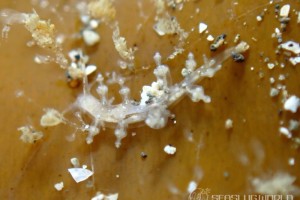
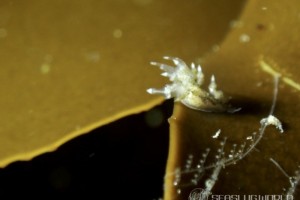
Photos of Leostyletus misakiensis






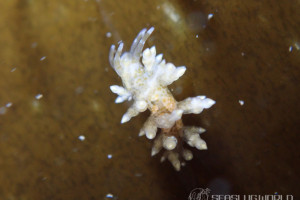

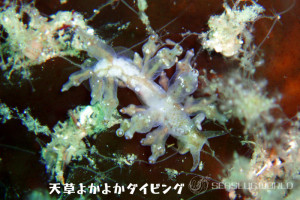

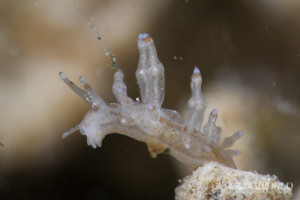
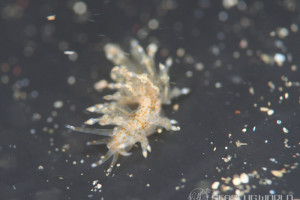






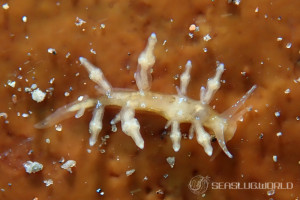
Same Genus Nudibranchs
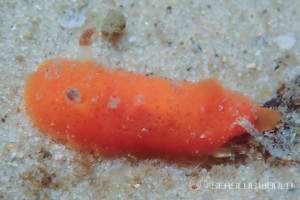
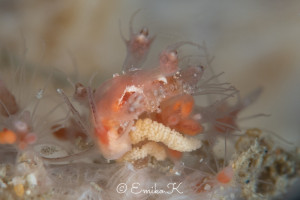
Similar Colors Nudibranchs


Academic Database
Sea slug observation data is available in international marine biodiversity databases.