Luisella babai (Schmekel, 1972)
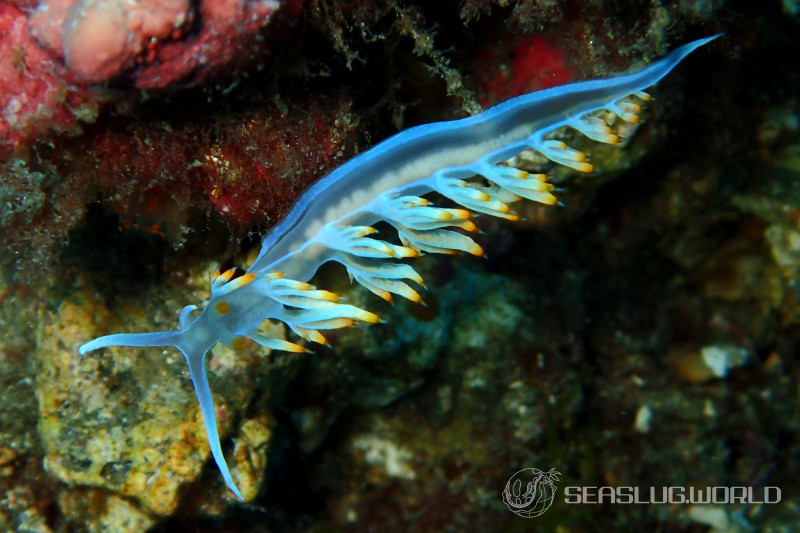
- Location
- La Herradura, Granada, Spain
- Date
- 2017/08/13
- Length
- 40mm
- Depth
- 15.0m
- Water temperature
- 23.0℃
Description
Body is translucent white to pale blue, elongated, with a long sharply-pointed tail. Total length reaches about 50 mm. Cerata are arranged in several distinct rows rather than in compact clusters; each ceras carries a yellow-orange subapical ring, while the extreme tip is clear and lacks the opaque white pigment seen on most of the body. The rhinophores are perfoliated and distinctly shorter than the long oral tentacles.Distribution
Originally described from the Mediterranean Sea. The species is now known throughout the Mediterranean (from the Turkish coast through Croatia and the Italian peninsula), in the Adriatic Sea, and along the eastern Atlantic coasts of Spain, Portugal and Senegal. Specimens are typically encountered on rocky substrates at depths of 5–50 m.Etymology
The specific epithet babai is the Latin genitive of "Baba", honouring Dr Kikutaro Baba (1905–2001), the Japanese malacologist whose work established the modern study of opisthobranchs in Japan.Remarks
The genus Luisella was erected in 2017 to honour Luise Schmekel, the German nudibranch worker who described the type species. The species was originally placed in Flabellina, but molecular phylogenies showed it to lie well outside the true Flabellinidae, and it is now treated as the only species of Luisella in the new family Samlidae. It feeds on hydroid colonies, with records from Campanularia, Bougainvillia and Eudendrium.References
- Flabellina babai n. sp., Schmekel L. (1972). Flabellina babai n. sp., ein neuer Aeolidier (Gastr. Nudibranchia) aus dem Mittelmeer. Pubblicacioni della Stazione Zoologica di Napoli. 38: 316-327.
- ババサキシマミノウミウシ, Hamatani, I., 2002. Malacological contributions of Dr, Kikutaro Baba (1905-2001). Venus, Jap. Jour. Malac., 61(1-2): 97-100.
- Luisella babai (Schmekel, 1972), comb. n., Korshunova T., Martynov A., Bakken T., Evertsen J., Fletcher K., Mudianta I.W., Saito H., Lundin K., Schrödl M. & Picton B. (2017). Polyphyly of the traditional family Flabellinidae affects a major group of Nudibranchia: aeolidacean taxonomic reassessment with descriptions of several new families, genera, and species (Mollusca, Gastropoda). ZooKeys. 717: 1-139. https://doi.org/10.3897/zookeys.717.21885
A Kindle field guide by the site author
Kimoto N. (2026). Sea Slugs of Japan & the Indo-Pacific, 2nd Edition.
Kindle Edition
View on Amazon PR (Amazon Associates)Seasonality
Shooting Locations
Loading shooting locations...
Photos of Luisella babai

Similar Colors Nudibranchs
Academic Database
Sea slug observation data is available in international marine biodiversity databases.