Nembrotha mullineri Gosliner & Behrens, 1997
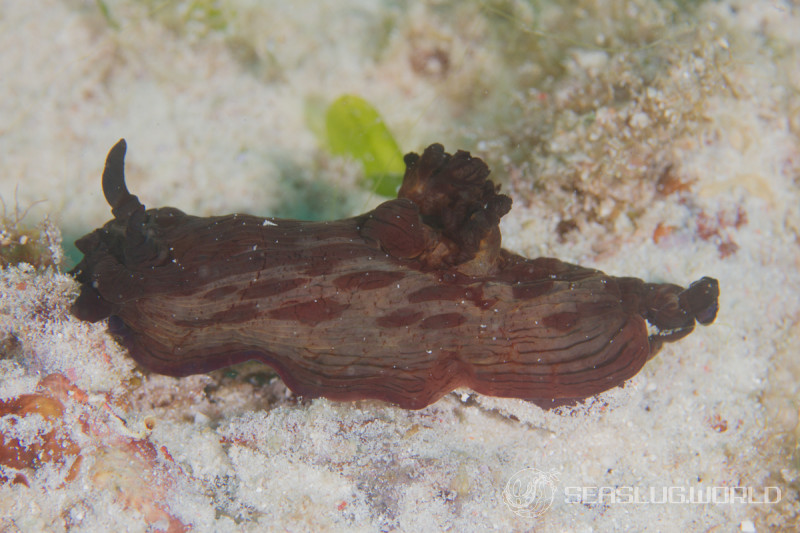
- Location
- Ka Osting, Malapascua, Philippines
- Date
- 2017/10/02
- Length
- 50mm
- Depth
- 20.0m
- Water temperature
- 30.0℃
Description
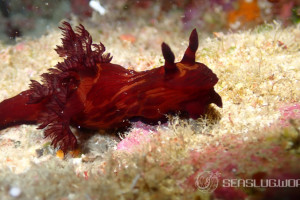
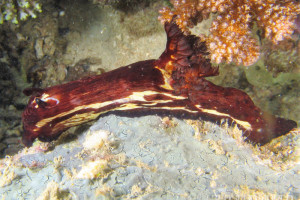
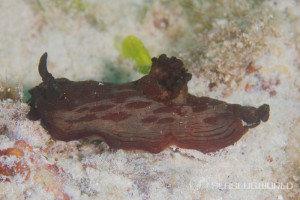
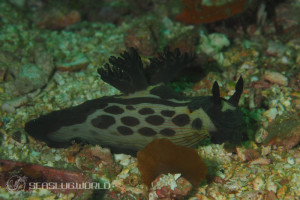
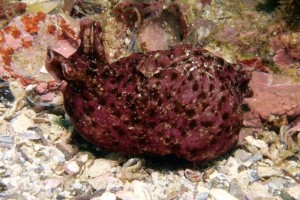
The body is robust and limaciform. Living animals exceed 100 mm in length; preserved specimens are 30–70 mm. The body is creamy white, covered with longitudinally oriented creases or wrinkles. Large blotches and areas of brown extend over the entire body, with the amount of brown blotching varying considerably among individuals — limited to spots, elongate lines, or dense brown patches. A few scattered, low pointed tubercles, greyish brown with dark brown tips, are situated between the creases in the brown areas. The head is rounded and dark brown. The rhinophores and outside of the five multipinnate gills are dark brown, with cream and brown pigment on the inner side of the gill bases. The two posterior gills on each side share a common base. The anus is situated between the gills on an elongate papilla. The genital aperture is on the right side of the body, midway between the rhinophores and the anterior end of the branchial plume. The oral tentacles are short, blunt folds.Distribution
Thus far known only from Batangas Province, Luzon Island, Philippines.Etymology
Named for David K. Mulliner of San Diego, California, who first collected this species. Mulliner is a long-time friend who has contributed much to the knowledge of opisthobranch mollusks.Remarks
Found crawling in the open on reef and rubble surfaces at 8–23 m depth; one specimen was observed on an unidentified arborescent bryozoan. Nembrotha mullineri is the only member of the genus that is cream colored with brown spots or blotches, easily distinguishing it from congeners.References
- Nembrotha mullineri Gosliner & Behrens, sp. nov., Gosliner T. M. & Behrens D. W. (1997). Description of four new species of phanerobranch dorids (Mollusca: Nudibranchia) from the Indo-Pacific, with a redescription of Gymnodoris aurita (Gould, 1852). Proceedings of the California Academy of Sciences 49(9): 287-308.
A Kindle field guide by the site author
Kimoto N. (2026). Sea Slugs of Japan & the Indo-Pacific, 2nd Edition.
Kindle Edition
View on Amazon PR (Amazon Associates)Seasonality
Shooting Locations
Loading shooting locations...
Photos of Nembrotha mullineri




Same Genus Nudibranchs
Similar Colors Nudibranchs

Color:
Brown
Academic Database
Sea slug observation data is available in international marine biodiversity databases.