Nembrotha milleri Gosliner & Behrens, 1997
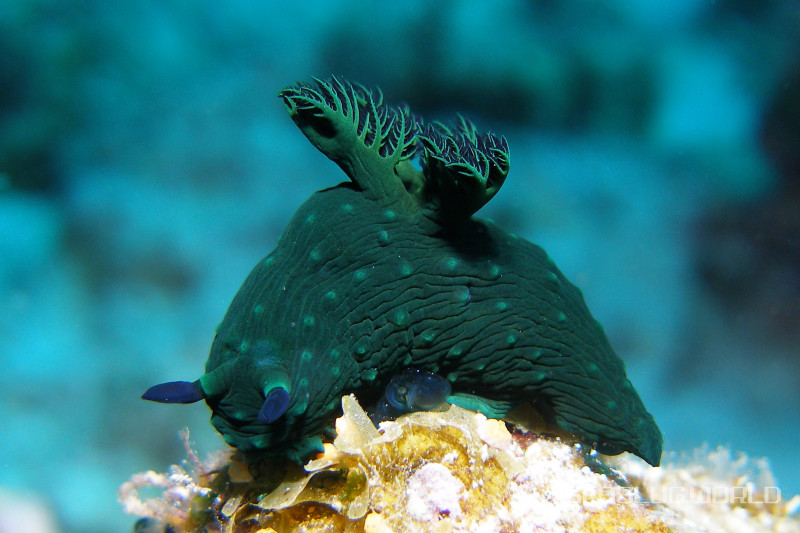
- Location
- Ozone, Kerama(Zamami・Amuro・Gahi・Agenashiku), Okinawa, Japan
- Date
- 2009/11/05
- Length
- 70mm
- Depth
- 12.0m
- Water temperature
- 25.0℃
Description
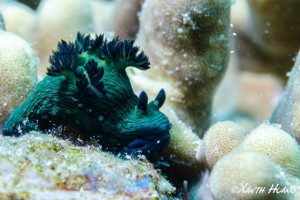
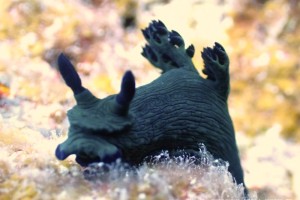
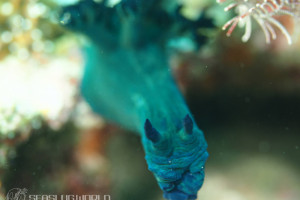
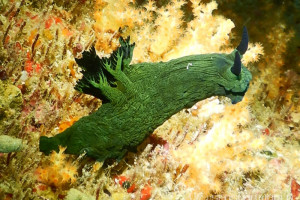
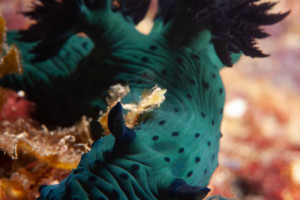
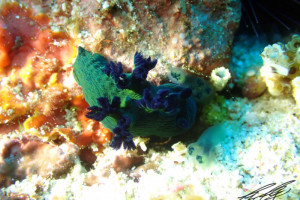
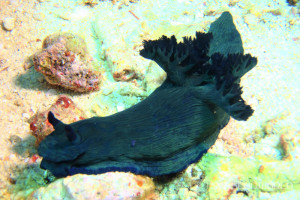
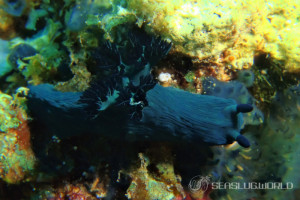
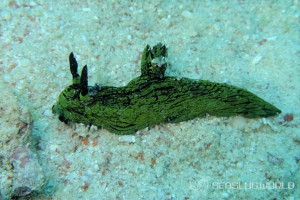
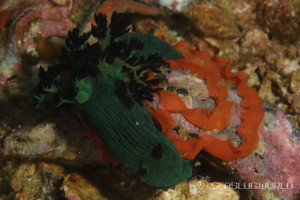
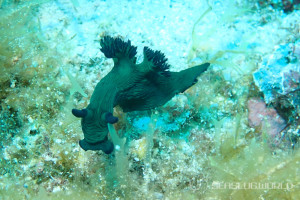
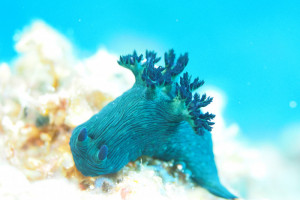
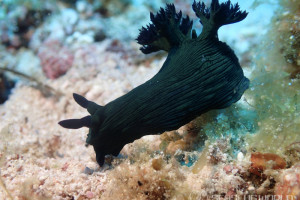
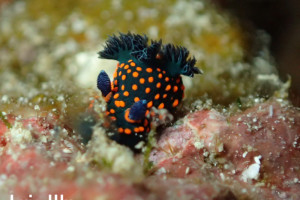
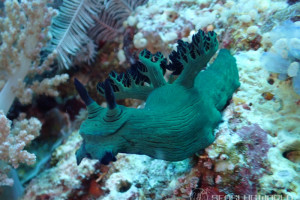
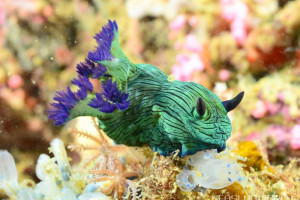
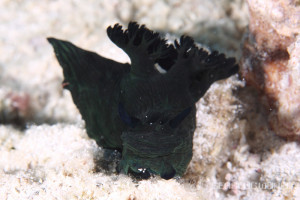
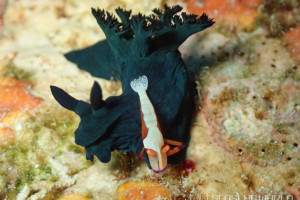
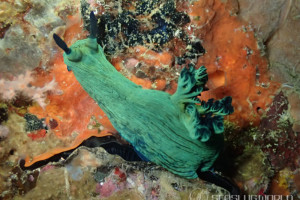
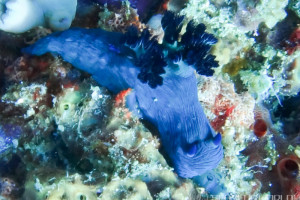
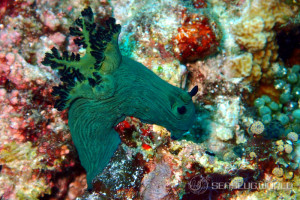
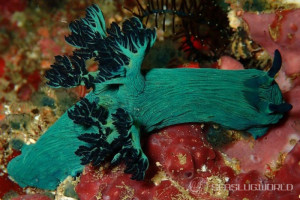
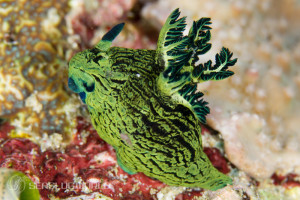
The body is elongate, limaciform and slightly undulate. Living animals reach 60 mm in length; preserved specimens are 30–60 mm. Body color is deep grey-green, with longitudinal black creases extending over the entire body surface. These creases extend up the gill stalks and onto the tips of the five multipinnate gills, which are black. The gills arise from three basal mounds. The rhinophores are perfoliate with 33 lamellae and arise from a smooth tapering sheath similar in color to the body; the clavus is black. The anus is a tall tube situated in the middle of the three gill bases. The genital aperture is located midway between the rhinophores and the anterior portion of the gills. The two oral tentacles are circular with a depression at the center. The shiny, satin gray-green body color distinguishes this species from other members of the genus.Distribution
Known from Luzon (Batangas Province), Cebu and Mindanao Islands in the Philippines, and from Sulawesi, Indonesia.Etymology
Named for Michael D. Miller of San Diego, California, who first introduced the authors to the diversity of the Philippine opisthobranch fauna.Remarks
Found crawling actively on reef and rubble surfaces at 10–29 m depth. No specific prey association has been observed.References
- Nembrotha milleri Gosliner & Behrens, sp. nov., Gosliner T. M. & Behrens D. W. (1997). Description of four new species of phanerobranch dorids (Mollusca: Nudibranchia) from the Indo-Pacific, with a redescription of Gymnodoris aurita (Gould, 1852). Proceedings of the California Academy of Sciences 49(9): 287-308.
- メンブロタ・ミレリ, 殿塚孝昌. (2003). ウミウシガイドブック〈3〉. TBSブリタニカ.
- Nembrotha milleri, Pola M., Cervera J.L. & Gosliner T.M. (2008). Revision of the Indo-Pacific genus Nembrotha (Nudibranchia: Dorididae: Polyceridae), with a description of two new species. Scientia Marina. 72(1): 145-183. https://doi.org/10.3989/scimar.2008.72n1145
A Kindle field guide by the site author
Kimoto N. (2026). Sea Slugs of Japan & the Indo-Pacific, 2nd Edition.
Kindle Edition
View on Amazon PR (Amazon Associates)Seasonality
Shooting Locations
Loading shooting locations...
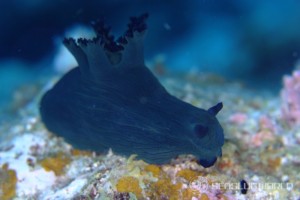
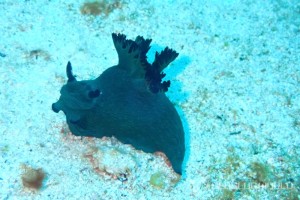
Photos of Nembrotha milleri
Tag:






















Same Genus Nudibranchs
Similar Colors Nudibranchs
Academic Database
Sea slug observation data is available in international marine biodiversity databases.