Polycera capensis Quoy & Gaimard, 1824
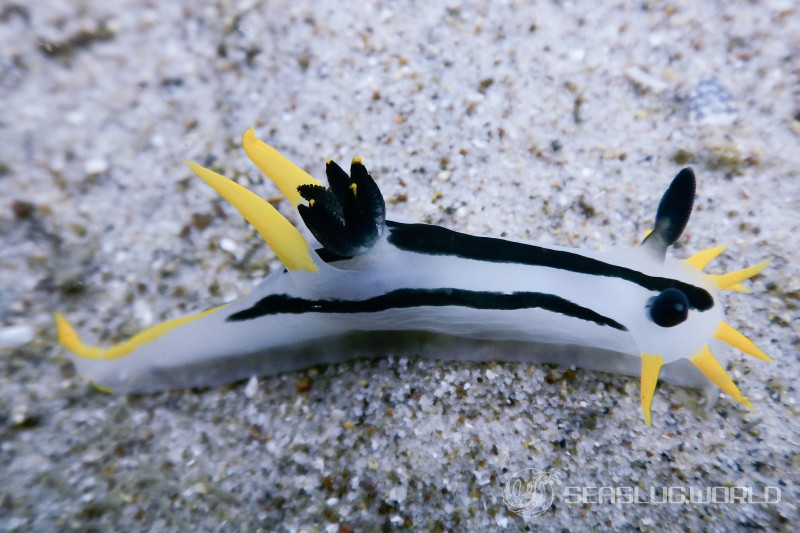
- Location
- The Pipeline, Nelson Bay, New South Wales, Australia
- Date
- 2017/12/04
- Length
- 17mm
- Depth
- 8.0m
- Water temperature
- 16.0℃
Description
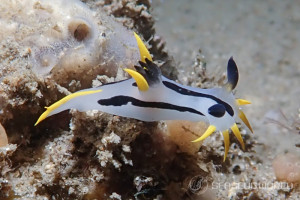
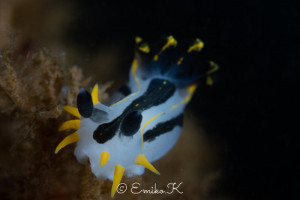
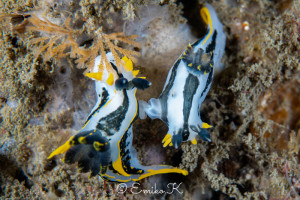
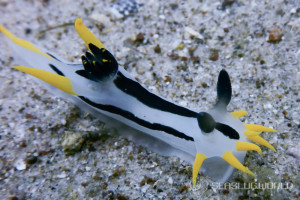
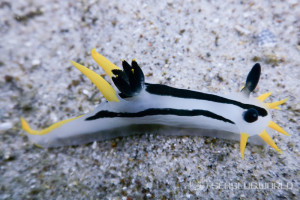
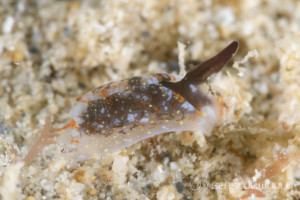
A mid-sized polycerid reaching about 40 mm in length. Body whitish with conspicuous black markings: three black longitudinal lines (one mid-dorsal, two lateral) and a black-bordered tail. The anterior cephalic margin bears six large yellow finger-like processes. Rhinophores black, with six smaller yellow papillae at their bases. Among the dorsal gill fringe is a single bright yellow plume. Posterior end forms an elongate tail bordered above by a yellow line. Foot fringed; genital opening on the right anterior side. Quoy & Gaimard described their original specimens as about 1.5 French inches long, taken on detached drift fronds of the giant kelp Fucus buccinalis (now Ecklonia buccinalis) carried offshore by currents.Distribution
Native to South Africa (Cape of Good Hope and adjacent waters); introduced to South Australia, presumably as a fouling organism on shipping. The type locality is the Cape of Good Hope, on drift kelp.Etymology
The specific epithet capensis ("of the Cape") refers to the Cape of Good Hope, the type-locality region.Remarks
Originally described by Quoy & Gaimard in their Zoologie for the Voyage autour du Monde sur les corvettes l'Uranie et la Physicienne (Pillet Aîné, Paris, 1824, p.417, pl. 66 fig. 4). The 1824 cover date applies to this fascicle, on the basis of which WoRMS attributes authorship to Quoy & Gaimard, 1824.References
A Kindle field guide by the site author
Kimoto N. (2026). Sea Slugs of Japan & the Indo-Pacific, 2nd Edition.
Kindle Edition
View on Amazon PR (Amazon Associates)Seasonality
Shooting Locations
Loading shooting locations...
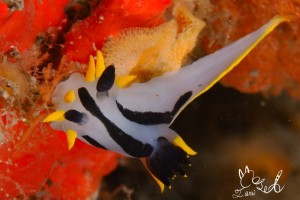
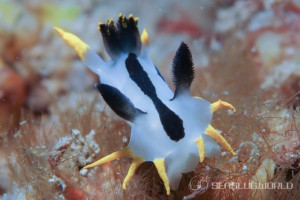
Photos of Polycera capensis
Tag:



Same Genus Nudibranchs

Similar Colors Nudibranchs
Academic Database
Sea slug observation data is available in international marine biodiversity databases.