Sakuraeolis gujaratica Rudman, 1980
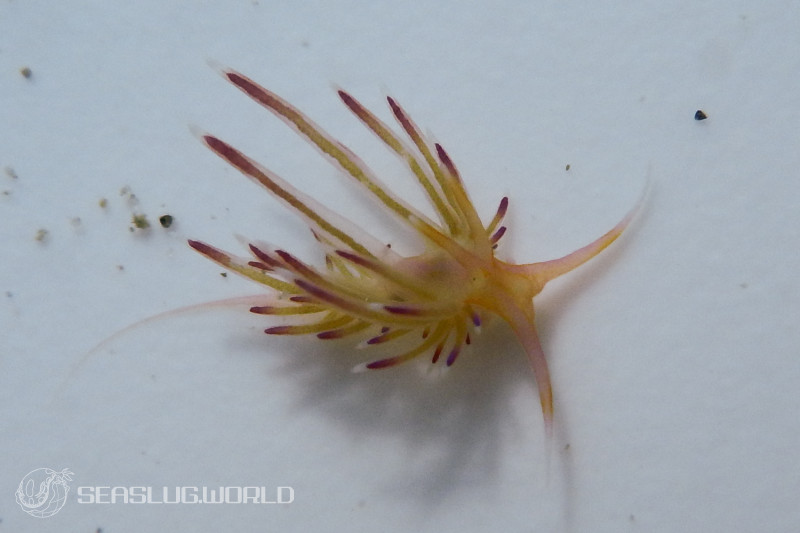
- Location
- La Balsa Park, The Sunshine Coast, Queensland, Australia
- Date
- 2017/11/19
- Length
- 15mm
- Depth
- 2.0m
- Water temperature
- 24.0℃
Description
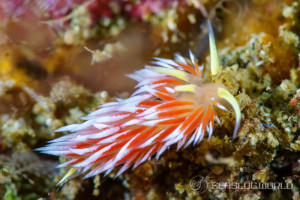
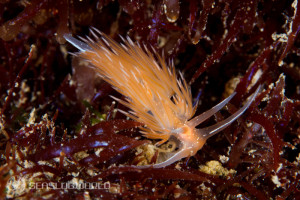
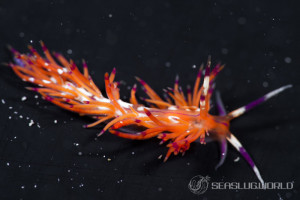
Body elongate but reasonably broad, with a prominent pericardium and a short tail. Oral tentacles long and slender; rhinophores about two-thirds their length, with slightly wrinkled surfaces. Cerata are arranged on five raised pads forming multi-rowed rounded arches per side, plus three small posterior groups. The cerata are long and slender. Body pale orange overall. Basal half of the rhinophores translucent white, the distal portion orange (most intense at the tips); basal third of the oral tentacles translucent white, the upper two-thirds orange. Cerata colourless with a faint orange tinge except for a bright orange subapical band; the digestive gland inside is deep wine-red to deep purple. Foot colourless. Holotype 30 mm long.Distribution
Known only from a single specimen collected at Adatra, near Okha, Gulf of Kutch, Gujarat State, north-western India (June 1971, under a rock at low tide).Etymology
The specific epithet gujaratica refers to Gujarat State, the region of India in which the species was discovered (verbatim from the original description).Remarks
Distinguished from the other Indo-West Pacific Sakuraeolis (Sakuraeolis enosimensis, Sakuraeolis modesta, Sakuraeolis nungunoides, Sakuraeolis kirembosa) by the combination of a pale orange body with a deep wine-red to purple digestive gland, and by the prominent triangular central cusp of the radular teeth. Diet is unknown; the single specimen was found under a rock.References
Featured in this book
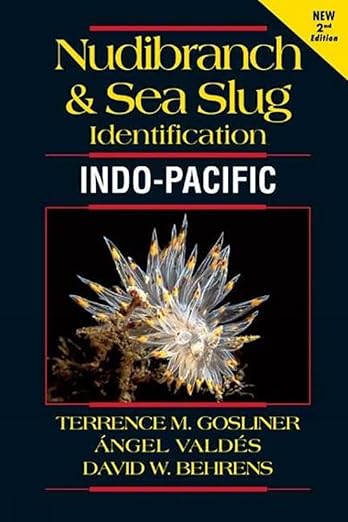
Terrence Gosliner, Ángel Valdés and David Behrens. (2018). Nudibranch and Sea Slug Identification Indo-Pacific 2nd Edition. New World Pubns Inc.
New World Publications
This species, Sakuraeolis gujaratica, is included in the book.
View on Amazon PR (Amazon Associates)Seasonality
Shooting Locations
Loading shooting locations...
Photos of Sakuraeolis gujaratica

Same Genus Nudibranchs
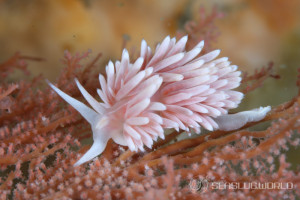
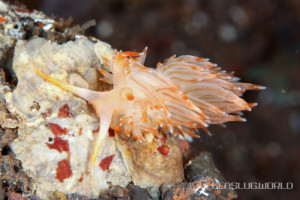
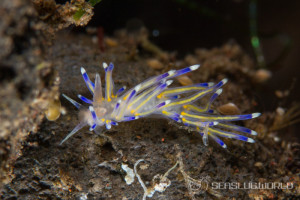
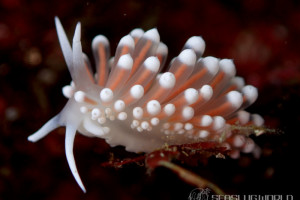
Similar Colors Nudibranchs

Academic Database
Sea slug observation data is available in international marine biodiversity databases.