Launsina tanyae Ekimova, Carmona, Mikhlina, Grishina, Stanovova, Schepetov, Hoover, De Souza-Canal, K. O. Kuznetsov & Á. Valdés, 2026
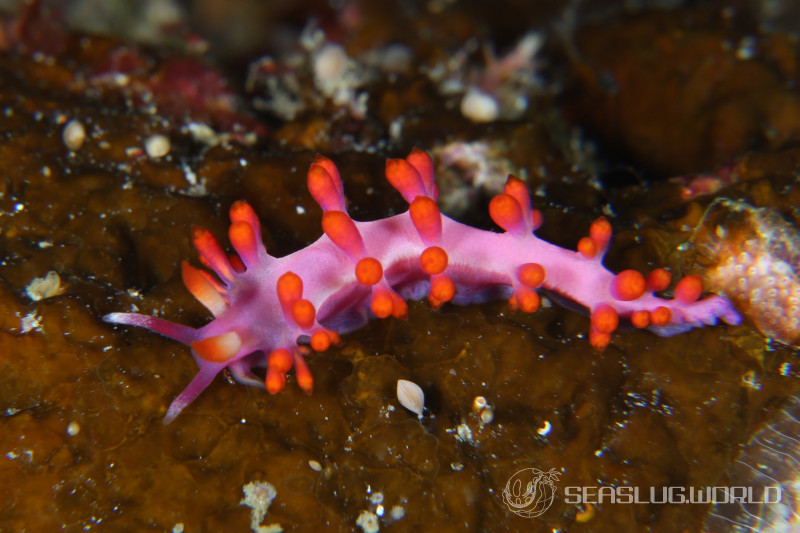
- Location
- Konse, Kerama(Aka・Geruma・Hokachi・Yakabi・Kuba), Okinawa, Japan
- Date
- 2015/12/26
- Length
- 15mm
- Depth
- 13.0m
- Water temperature
- 24.0℃
Description
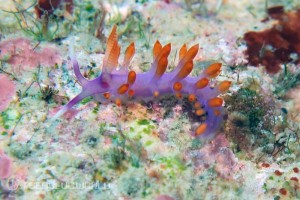
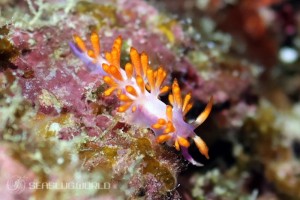
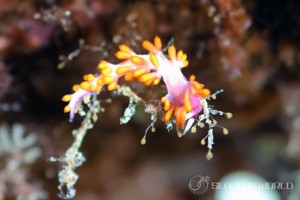
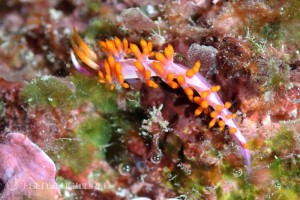
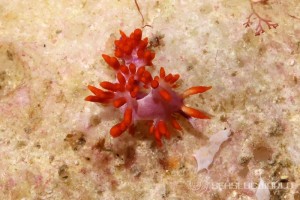
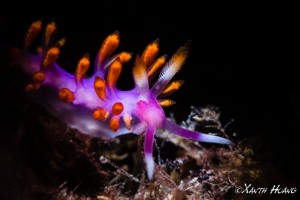
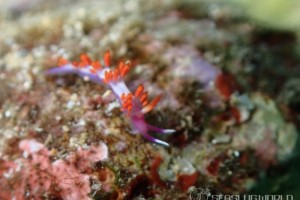
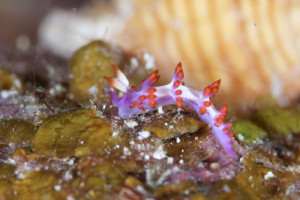
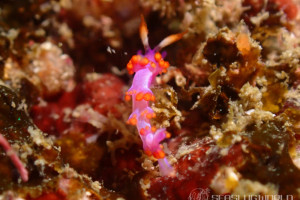
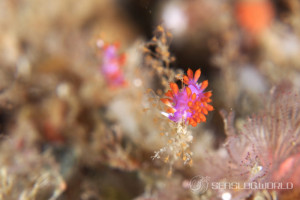
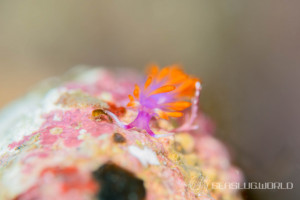
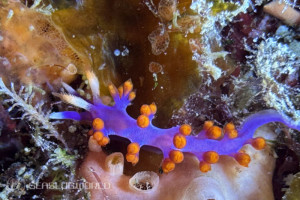
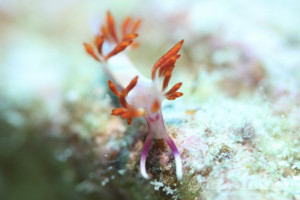
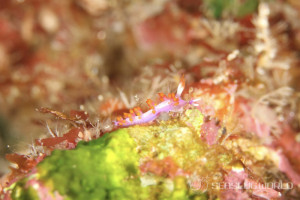
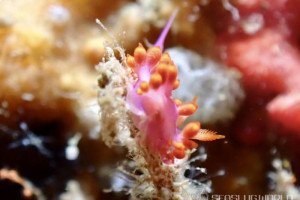
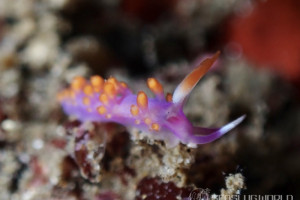
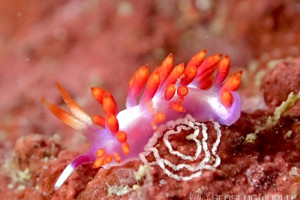
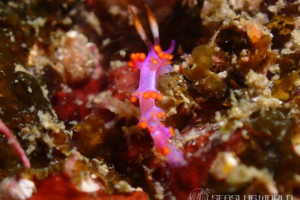
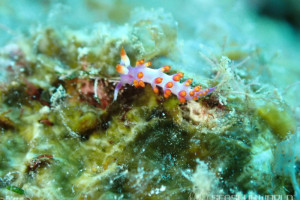
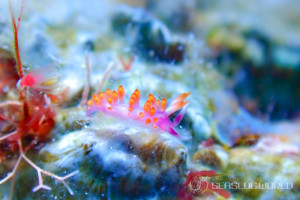
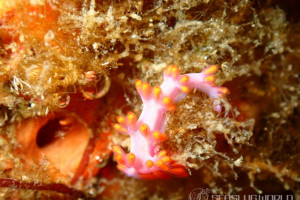
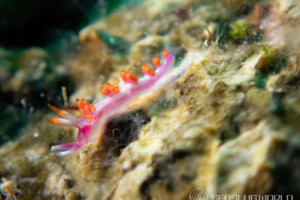
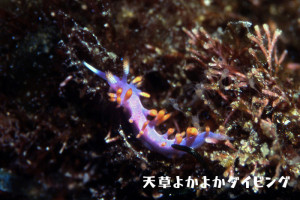
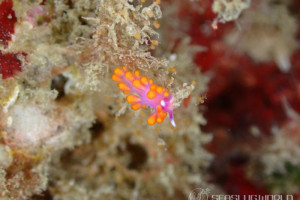
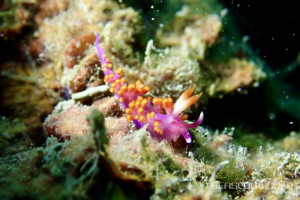
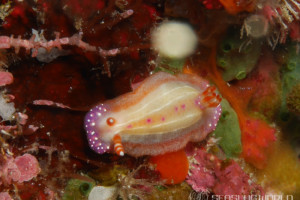
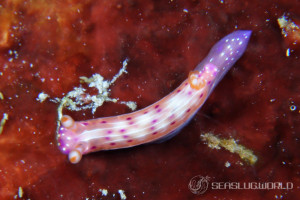
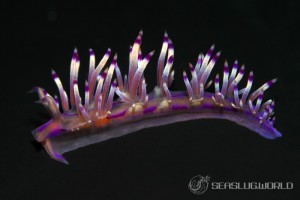
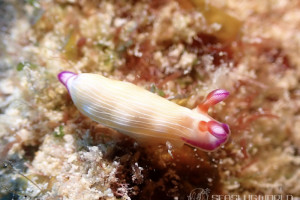
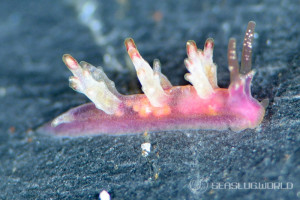
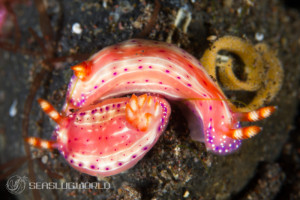
A small flabellinid up to 10 mm in length. The body is narrow and elongate, with the tail tapering posteriorly. The notal edge is completely reduced. Anterior corners of the foot are elongated, tentacle-like, and curved. The oral tentacles are elongate and narrow. The rhinophores are densely perfoliate with 13 lamellae, conical in shape, and roughly half the length of the oral tentacles.Cerata are arranged in distinct groups on low elevations and are short and fusiform. The first group contains up to 7 cerata, the second group 4, and subsequent groups 2 each. The digestive gland fills nearly the entire volume of each ceras.
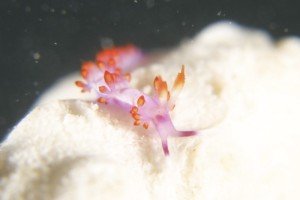
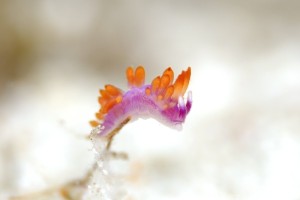
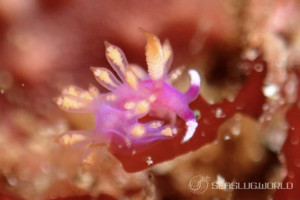
The background body color is uniformly pink-purple, with very sparse opaque white speckles confined to the notal margin and the dorsal posterior. The oral tentacles are magenta proximally with opaque white tips. The rhinophores show a tricolor gradient: white at the base, yellow in the middle, and orange at the tip. Cerata are bright orange with red cnidosacs.
Distribution
The type locality is Nok Island off Nha Trang, South China Sea, Vietnam (20 m depth). In the original description (Ekimova et al., 2026), no other records were given, but specimens of similar coloration were noted from the Ogasawara (Bonin) Islands of Japan. Specimens previously reported from Japan under the names "Flabellina rubropurpurata" or "Samla rubropurpurata" are referable to this species.Etymology
The specific epithet tanyae honors Tatiana (Tanya) Antokhina, a Russian marine biologist and diver who collected the type material and has contributed extensively to the collection and ecological study of nudibranchs across tropical and boreal seas.Remarks
The generic name Launsina derives from Laun-Sina, the Philippine goddess of the eastern skies, stars and seas, who is said to bring sunlight and cool winds during the dry season and to guard against strong typhoons.This species was long confused with Launsina rubropurpurata (type locality: Madang, Papua New Guinea; New Caledonia specimens confirmed by Ekimova et al., 2026 to match the original description). It is externally distinguished by its lighter pink-purple background color, sparse opaque white speckles confined to the notal margin and posterior dorsum (vs. dense speckles covering the entire dorsum in L. rubropurpurata), and tricolor rhinophores (white–yellow–orange in L. tanyae vs. white–orange bicolor in L. rubropurpurata). The two species differ by 12.1 % in COI sequence divergence.
References
- Flabellina sp. 3, Gosliner T.M. (1987). Nudibranchs of Southern Africa: A Guide to Opisthobranch Molluscs of Southern Africa. Sea Challengers, Monterey, CA. 136 pp.
- Flabellina rubropurpurata Gosliner & Willan, sp. nov., Gosliner, T. M.; Willan, R. C. (1991). Review of the Flabellinidae (Nudibranchia: Aeolidacea) from the tropical Indo-Pacific, with the descriptions of five new species. The Veliger. 34(2): 97-133.
- ルージュミノウミウシ(仮称), 益田一. (1999). 海洋生物ガイドブック. 東海大学出版会.
- ルージュミノウミウシ(仮称), 小野篤司. (1999). ウミウシガイドブック. TBSブリタニカ.
- ルージュミノウミウシ, 小野篤司. (2000). ウミウシガイドブック. 第2版. TBSブリタニカ.
- ルージュミノウミウシ, 鈴木敬宇. (2000). ウミウシガイドブック〈2〉. TBSブリタニカ.
- ルージュミノウミウシ, 中野理枝. (2004). 本州のウミウシ. ラトルズ.
- ルージュミノウミウシ, 小野篤司. (2004). 沖縄のウミウシ. ラトルズ.
- ルージュミノウミウシ, 小野篤司 & 加藤昌一. (2009). ウミウシ. 誠文堂新光社.
- Flabellina sp. 9, Terrence Gosliner, Ángel Valdés and David Behrens. (2015). Nudibranch and Sea Slug Identification Indo-Pacific. New World Pubns Inc.
- Samla rubropurpurata (Gosliner & Willan, 1991), comb. n., Korshunova T., Martynov A., Bakken T., Evertsen J., Fletcher K., Mudianta I.W., Saito H., Lundin K., Schrödl M. & Picton B. (2017). Polyphyly of the traditional family Flabellinidae affects a major group of Nudibranchia: aeolidacean taxonomic reassessment with descriptions of several new families, genera, and species (Mollusca, Gastropoda). ZooKeys. 717: 1-139. https://doi.org/10.3897/zookeys.717.21885
- Launsina tanyae sp. nov., Ekimova, I., Carmona, L., Mikhlina, A. L., Grishina, D., Stanovova, M. V., Schepetov, D. M., Hoover, C., de Souza-Canal, J., Kuznetsov, K. O., & Valdés, Á. (2026). Neither "lumpers" nor "splitters": A global revision of Flabellinidae s.l. nudibranchs (Gastropoda: Heterobranchia: Nudibranchia). PLoS One. 21(5): e0347759. https://doi.org/10.1371/journal.pone.0347759
Featured in this book
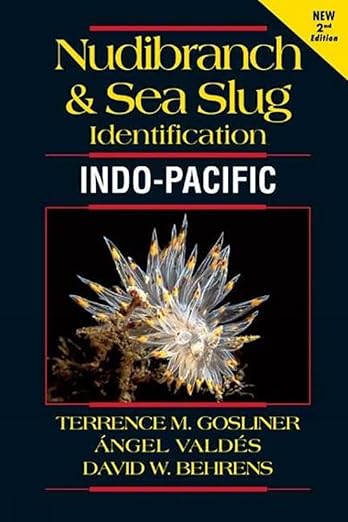
Terrence Gosliner, Ángel Valdés and David Behrens. (2018). Nudibranch and Sea Slug Identification Indo-Pacific 2nd Edition. New World Pubns Inc.
New World Publications
This species, Launsina tanyae, is included in the book.
View on Amazon PR (Amazon Associates)Seasonality
Shooting Locations
Loading shooting locations...
Photos of Launsina tanyae
Tag:





















Same Genus Nudibranchs

Similar Colors Nudibranchs

Academic Database
Sea slug observation data is available in international marine biodiversity databases.