Tayuva coerulescens (Bergh, 1888)
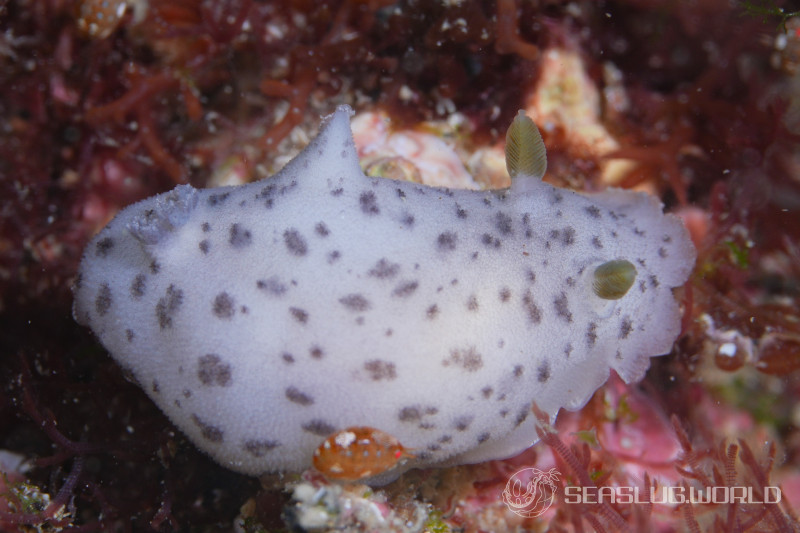
- Location
- Sokodo(Sanmata), Hachijo Island, Tokyo, Japan
- Date
- 2025/08/12
- Length
- 15mm
- Depth
- 3.0m
- Water temperature
- 22.0℃
Description
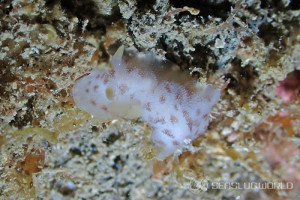
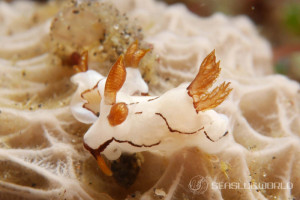
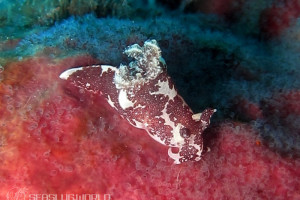
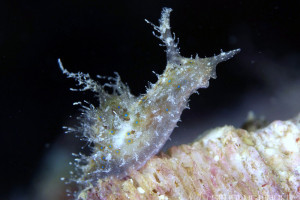
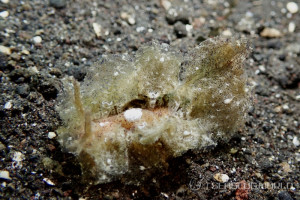
A small discodorid, the largest preserved specimen 28 mm long, up to 17 mm wide and 6 mm high. In life the body is bluish-white, with the rhinophores light yellow bearing grey blotches; preservation alters the colour to a uniform dark brownish-grey, with the upper surface slightly darker. The body is the typical elongate-oval, flattened discodorid form, with a broad and thin mantle border. The entire dorsum is dotted with extremely fine, almost imperceptible, scarcely projecting nodules; the underside of the mantle border is even flatter with a fine showing-through spicule network. The rhinophore openings, strongly contracted, project with serrated edges; the rhinophore club bears 40-50 leaves. The gill opening projects papilla-like with a serrated edge; the gill consists of six tripinnate leaves; the anal papilla is sub-median with the renal pore beside it. The oral tentacles are finger-shaped; the mouth opens as a vertical slit. The foot is not narrow, with rounded anterior corners. The animal is somewhat stiff but not hard.Distribution
Type locality: off Mauritius, Indian Ocean. Distributed across the western Indian Ocean.Etymology
The Latin coerulescens is the present participle of caerulescere ("to become bluish"), meaning "becoming blue, bluish-tinted", in reference to the bluish-white live coloration.Remarks
Originally described in Discodoris, later transferred to Tayuva.References
- Discodoris coerulescens, Bgh. n. sp., Bergh R. (1888). Nudibranchien vom Meere der Insel Mauritius. In: Semper C. (ed.), Reisen im Archipel der Philippinen. II. Wissenschaftliche Resultate. Bd. II, Abt. II (Malacologische Untersuchungen Bd. III), Heft XVI: 755-814. Wiesbaden: C.W. Kreidel's Verlag.
- ワギリウミウシ(仮称), 小野篤司. (1999). ウミウシガイドブック. TBSブリタニカ.
- ワギリウミウシ(新称), 小野篤司. (2000). ウミウシガイドブック. 第2版. TBSブリタニカ.
- Discodoris coerulescens, Terrence Gosliner, Ángel Valdés and David Behrens. (2015). Nudibranch and Sea Slug Identification Indo-Pacific. New World Pubns Inc.
- Tayuva coerulescens comb. nov., Fernández-Vilert R., Arnedo M.A., Salvador X., Valdés Á., Schrödl M. & Moles J. (2024). Shining disco: shedding light into the systematics of the family Discodorididae (Gastropoda: Nudibranchia). Zoological Journal of the Linnean Society. 203(1): zlae170. https://doi.org/10.1093/zoolinnean/zlae170
Featured in this book
Terrence Gosliner, Ángel Valdés and David Behrens. (2018). Nudibranch and Sea Slug Identification Indo-Pacific 2nd Edition. New World Pubns Inc.
New World Publications
This species, Tayuva coerulescens, is included in the book.
View on Amazon PR (Amazon Associates)Seasonality
Shooting Locations
Loading shooting locations...
Photos of Tayuva coerulescens



Similar Colors Nudibranchs

Academic Database
Sea slug observation data is available in international marine biodiversity databases.