Verconia catalai (Rudman, 1990)
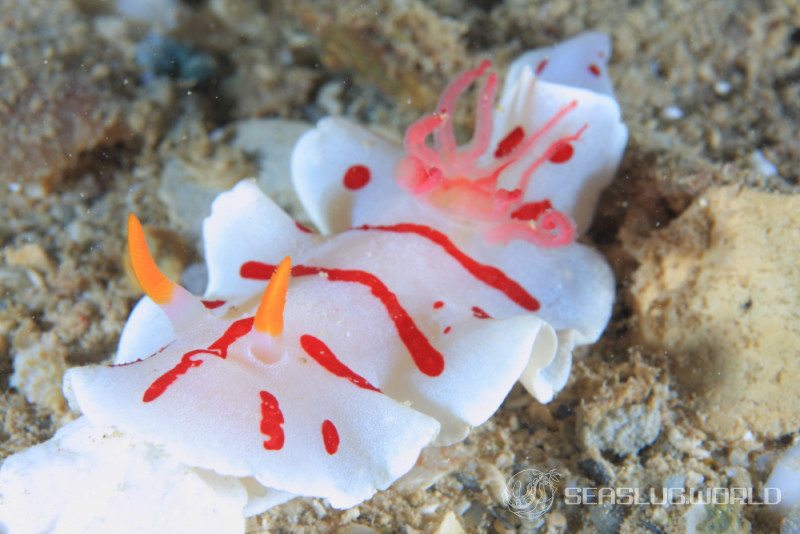
- Location
- Toho V (Wreck), New Caledonia Island, New Caledonia
- Date
- 2014/04/18
- Length
- 10mm
- Depth
- 20.0m
- Water temperature
- 26.0℃
Description
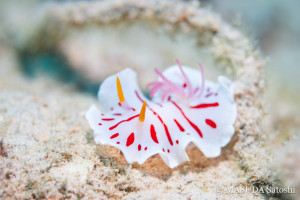
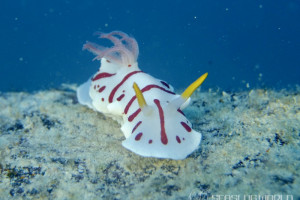
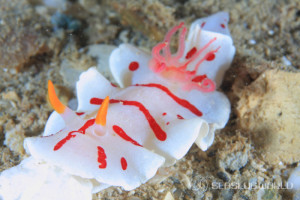
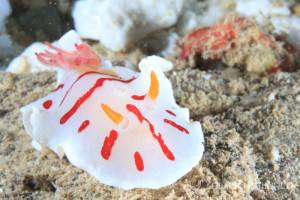
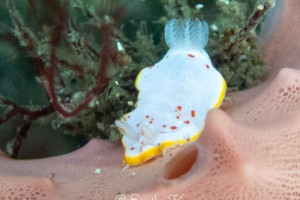
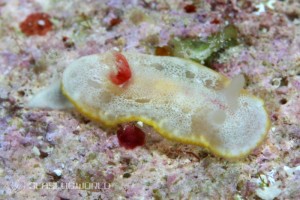
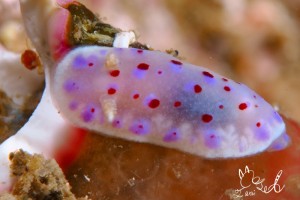
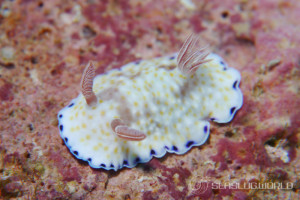
Mantle ovate with a wide but thin overlap; the tapering posterior tip of the foot extends behind the mantle. Body opaque white, somewhat translucent on the inner part of the mantle skirt, with a regular pattern of red marks — spots and lines. Spots and the outer ends of the lines form a submarginal band; lines run inwards at right angles to the mantle edge towards the centre. Two prominent lines (one just behind the rhinophores, one just in front of the gills) join their counterparts on the opposite side to form complete cross-bars across the dorsum, although in some specimens the lines are little more than elongate blotches. Foot translucent white with an opaque marginal band and red spots on the posterior dorsal surface. Rhinophore stalks translucent white; tapering clubs orange-yellow. Gills translucent white with the lamellae strongly tinged red; sub-quadrangular in section. Holotype 31 mm long preserved.Distribution
Type locality is Ilot Guétié, Ouvea, Loyalty Islands, New Caledonia, on the outer reef (20 m depth, November 1981, collected by P. Laboute). Known only from New Caledonia (the Loyalty Islands and the Aboré Barrier Reef off Noumea).Etymology
The specific epithet catalai honours Dr René Catala, a French marine biologist who founded and directed the world-famous Noumea Aquarium for many years.Remarks
Originally described as Noumea catalai and later transferred to Verconia. Larger than typical Noumea (holotype 31 mm preserved). The radula and reproductive system are typical for the genus. Feeds on yellow sponges.References
A Kindle field guide by the site author
Kimoto N. (2026). Sea Slugs of Japan & the Indo-Pacific, 2nd Edition.
Kindle Edition
View on Amazon PR (Amazon Associates)Seasonality
Shooting Locations
Loading shooting locations...
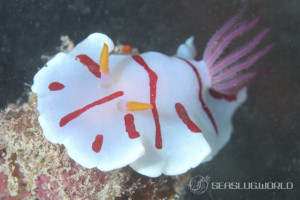
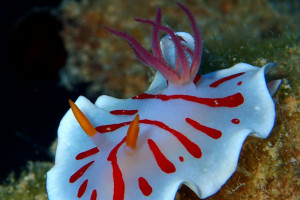
Photos of Verconia catalai



Same Genus Nudibranchs
Similar Colors Nudibranchs

Academic Database
Sea slug observation data is available in international marine biodiversity databases.