Abronica purpureoanulata (Baba, 1961)
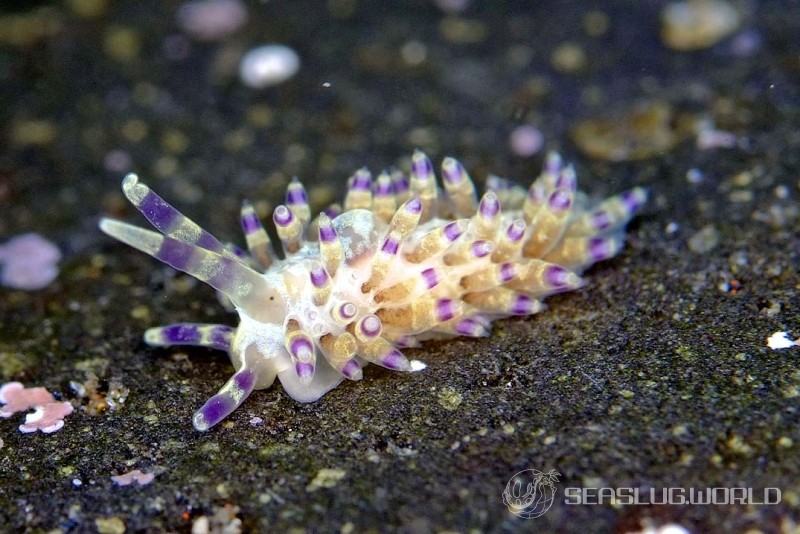
- Location
- Yahatano beach, Yawatano, Shizuoka, Japan
- Date
- 2008/07/08
- Length
- 10mm
- Depth
- 8.0m
- Water temperature
- 20.0℃
Description
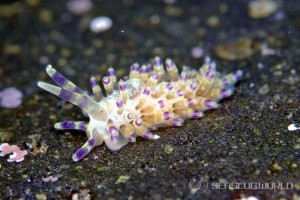
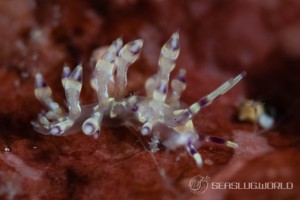
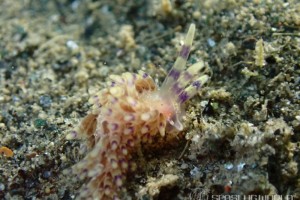
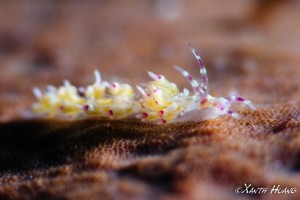
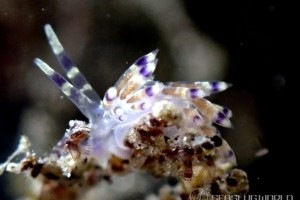
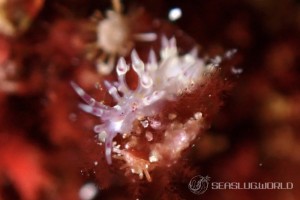
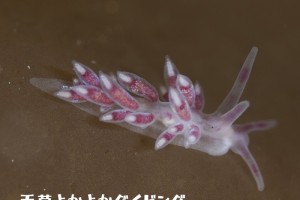
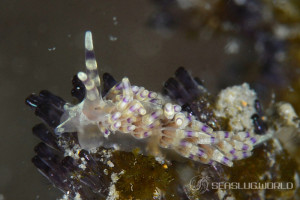
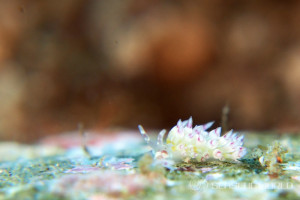
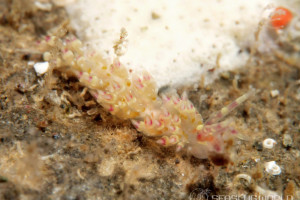
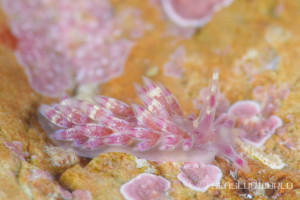
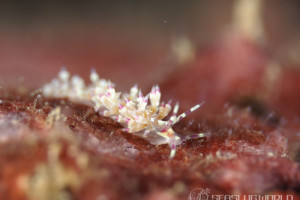
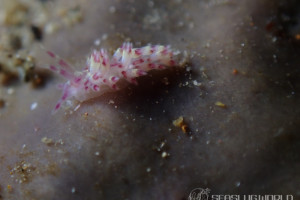
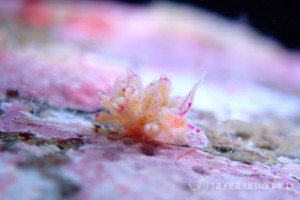
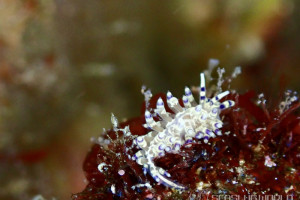
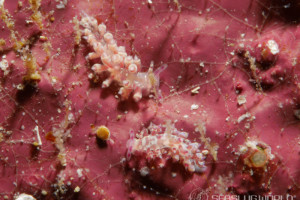
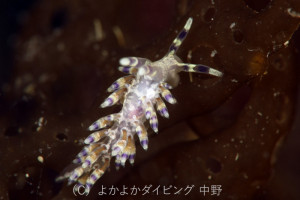
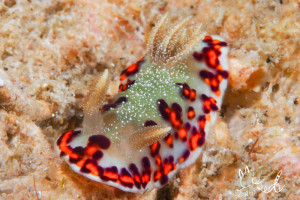
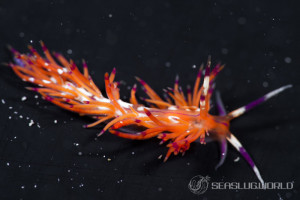
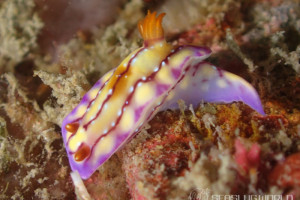
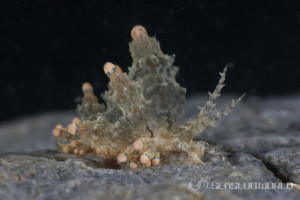
A small Aeolidacea, body length 6-10 mm. Cephalic tentacles and rhinophores smooth. Cerata long fusiform, in 11-13 simple oblique rows per side, with 4-5 cerata in the largest rows. The genital orifice opens below the middle of the right liver rows; the anus opens in front of the first right row of the posterior liver; the nephroproct is moderately preanal. Diagnostic colour: a purple band near the tip of each ceras, and two purple bands on each cephalic tentacle and rhinophore. Ground colour translucent whitish to pale, with the head and dorsum bearing clusters of opaque white (or yellowish) dots. The foot margin sometimes shows a fine purple line. The liver diverticulum is dark brown. Jaw with 15-17 denticles. Radula 22×0.1.0; the median cusp is as large as the lateral denticles (usually 5).Distribution
Type locality is Seto, Kii, Wakayama, Japan (June 1951, 1 specimen). Additional record: Tannowa, Osaka Bay (July 1957, 1 specimen, collected by Hamatani). The original description (Baba, 1961) records the species from Seto (Kii), Tannowa (Osaka Bay), Hayama (Sagami Bay), Mukaishima (Inland Sea of Seto), Awashima (Niigata), Mera (Fukui), and Tsuruga Bay; "not rare".Etymology
The specific epithet purpureoanulata is a Latin compound of purpureus (purple) and anulata (ringed), meaning "purple-ringed". The original description does not give an explicit etymology paragraph; the descriptive sense reflects the purple bands on the cerata, rhinophores, and oral tentacles. The Japanese name "Yubiwa-mino-umiushi" (ring aeolid) likewise refers to the bands.Remarks
Important taxonomic note: Originally described as Catriona purpureoanulata Baba, 1961 (a cuthonid aeolid). Later transferred to Tenellia under the 2016 Cuthonidae phylogenetic revision (Cella et al.). The DB genus name "Abronica" appears to be erroneous — Abronica is a polycerid genus unrelated to this aeolid; correction to Tenellia purpureoanulata is recommended (current valid combination per WoRMS). Distinguished from the conspecifically described Catriona pupillae (4-6 ceras rows, no purple bands) and Catriona signifera (8-9 ceras rows, ovoid dark dorsal mark) by the markedly higher number of ceras rows (11-13) and the diagnostic purple bands on the cerata and rhinophores.References
- Catriona purpureoanulata BABA, n. sp. Yubiwa-minoumiushi (n. n.), Baba K. (1961). THREE NEW SPECIES OF THE GENUS CATRIONA FROM JAPAN (NUDIBRANCHIA-EOLIDACEA). Publications of the Seto Marine Biological Laboratory. 9(2): 367-372. https://doi.org/10.5134/175287
- 高岡生物研究会. (2002). 日本海のウミウシ. 第2版.
- ユビワミノウミウシ, 中野理枝. (2004). 本州のウミウシ. ラトルズ.
- ユビワミノウミウシ, 小野篤司. (2004). 沖縄のウミウシ. ラトルズ.
- ユビワミノウミウシ, 小野篤司 & 加藤昌一. (2009). ウミウシ. 誠文堂新光社.
- Cella K., Carmona L., Ekimova I., Chichvarkhin A., Schepetov D. & Gosliner T.M. (2016). A Radical Solution: The Phylogeny of the Nudibranch Family Fionidae. PLOS ONE. 11(12): e0167800. https://doi.org/10.1371/journal.pone.0167800
- Abronica purpureoanulata, Terrence Gosliner, Ángel Valdés and David Behrens. (2018). Nudibranch and Sea Slug Identification Indo-Pacific 2nd Edition. New World Pubns Inc.
Featured in this book

Terrence Gosliner, Ángel Valdés and David Behrens. (2018). Nudibranch and Sea Slug Identification Indo-Pacific 2nd Edition. New World Pubns Inc.
New World Publications
This species, Abronica purpureoanulata, is included in the book.
View on Amazon PR (Amazon Associates)Seasonality
Shooting Locations
Loading shooting locations...
Photos of Abronica purpureoanulata



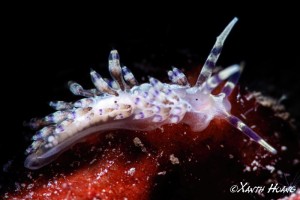

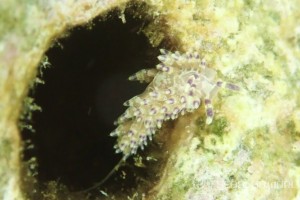

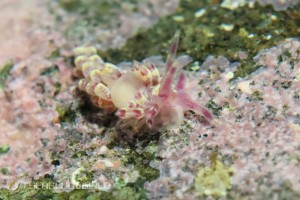

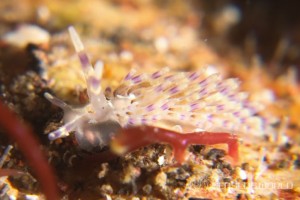












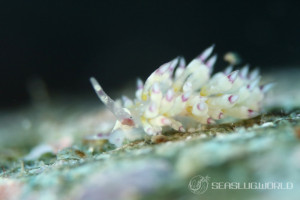

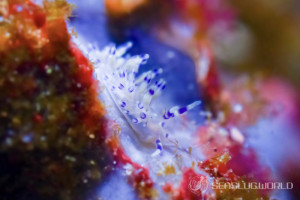

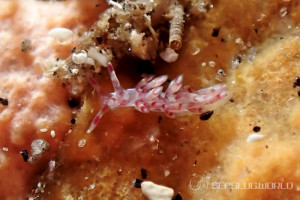

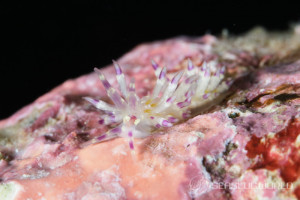

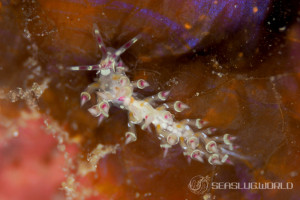

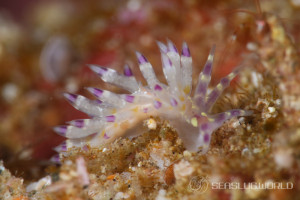
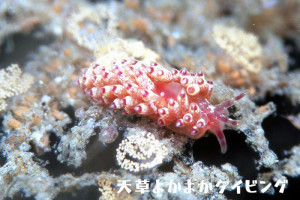
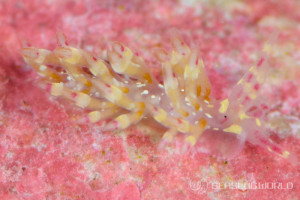


Same Genus Nudibranchs


Similar Colors Nudibranchs


Academic Database
Sea slug observation data is available in international marine biodiversity databases.