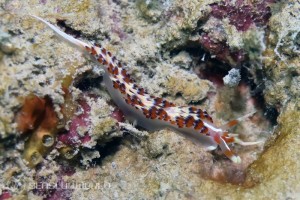
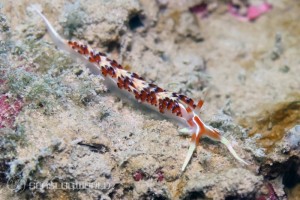
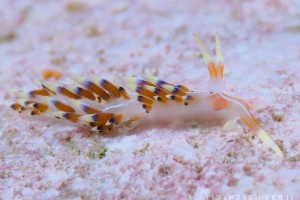
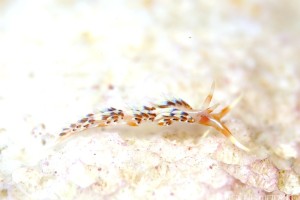
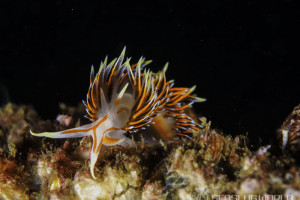
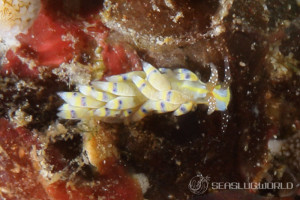
Caloria indica (Bergh, 1896)
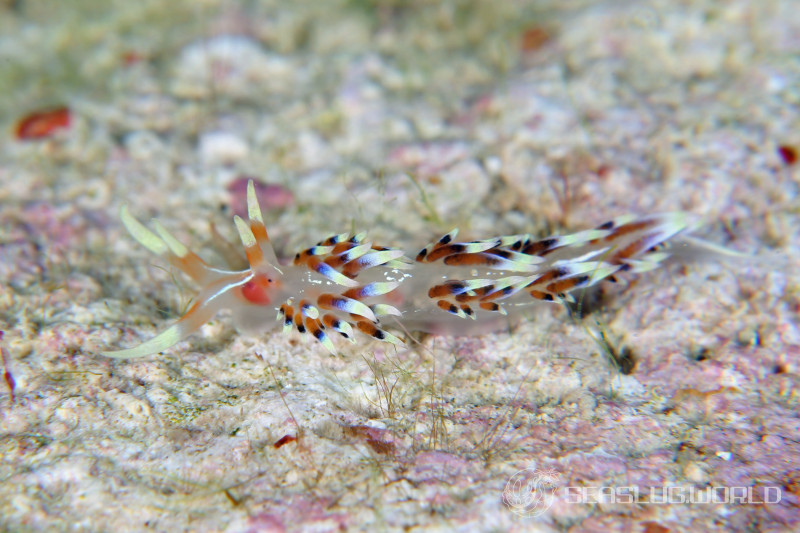
- Location
- Sunabe Water Treatment Plants, Okinawa Island (Chatan and Southern area), Okinawa, Japan
- Date
- 2015/07/30
- Length
- 10mm
- Depth
- 7.0m
- Water temperature
- 29.0℃
Description
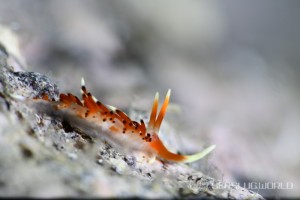
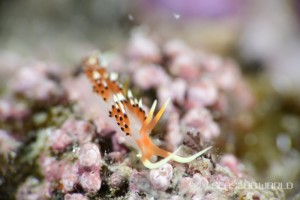
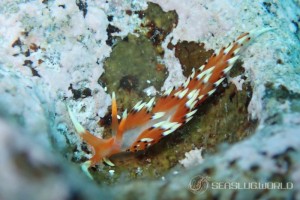
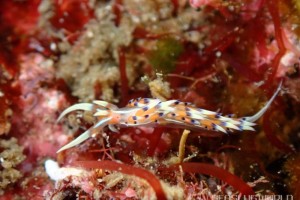
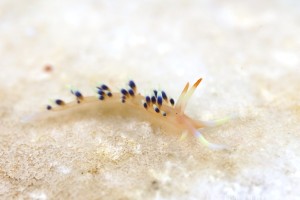
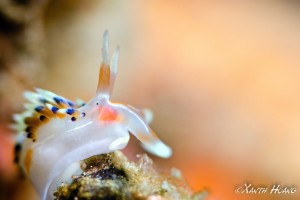
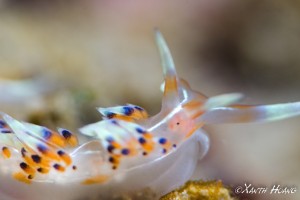
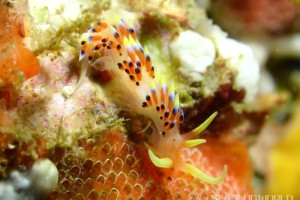
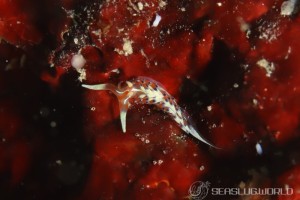
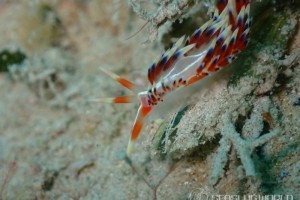
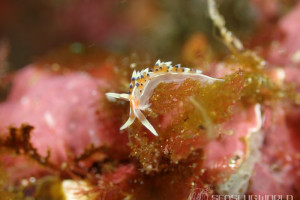
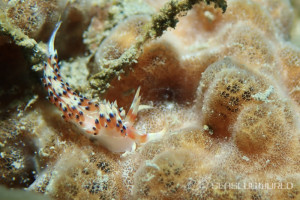
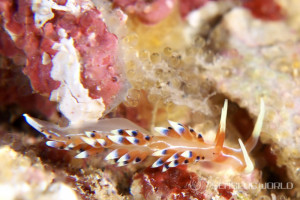
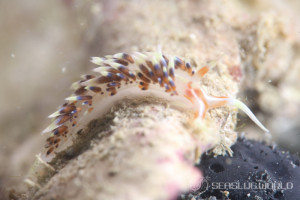
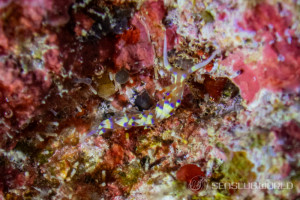
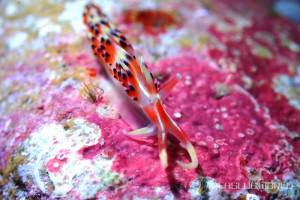
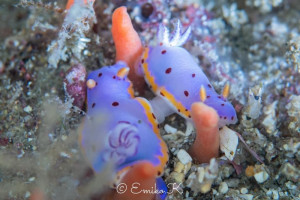
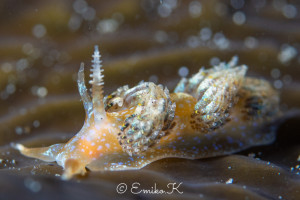
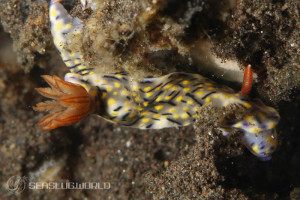
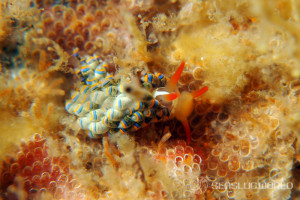
A small aeolid reaching about 30 mm in body length. The ground colour in life is translucent white, usually with the head suffused orange-red; some individuals are entirely orange-red on the dorsum. A median white longitudinal line typically runs from the base of the oral tentacles, between the rhinophores and along the dorsum, but it may be interrupted or absent. The cerata are banded from base to tip with red, blue, yellowish-white and white. The rhinophores and oral tentacles are smooth, with a red band in the middle and a yellowish-white tip. Bergh's alcohol-preserved type was 16 mm long, 2.5 mm high, 3 mm wide anteriorly, with cerata up to 4 mm long, foot sole 2.5 mm wide, lateral extensions of the anterior foot 1.4 mm long and a 2.5 mm tail. In alcohol the body was yellowish, with olive cerata tipped yellow. The body is slender and slightly compressed, with a protruding dorsal margin bearing the cerata; a shallow lateral groove runs between the dorsal margin and the foot edge. The head is fairly large, with a T-shaped, terminal mouth. The rhinophores are annulate (not perfoliate) and the oral tentacles are simple. The cerata are arranged in five paired groups along the dorsal margin: the first group has 7 rows, the second 5, the third 4, the fourth 3 and the fifth 5–6, with the last 1–2 groups reduced to a single ceras. The genital opening lies on the left, beneath the last row of the first ceratal group, and the anal papilla lies on the outside between the first and second rows of the second group.Distribution
Indo-West Pacific to the central Pacific. Type locality: vicinity of Ambon Island, Maluku, Indonesia, based on a single specimen collected during the Malay Archipelago expedition of Maurice Bedot and Camille Pictet 1890. The species has subsequently been recorded from South Africa, Tanzania, Aldabra Atoll, Oman, Christmas Island, Australia, New Caledonia, Fiji, the Solomon Islands, Papua New Guinea, Malaysia, Indonesia, the Philippines, Hong Kong, Japan and Hawaii.Etymology
The specific epithet indica is the feminine of Latin indicus ("Indian, of India / the Indian Ocean"), in reference to the type locality given in the original description as the "Mer des Indes" (Indian Ocean). Bergh's original description does not include an explicit etymology.Remarks
In the original description Bergh erected the new genus Learchis with this species as its type. Bergh placed Learchis in the Facelinidae and noted that, although the shape of the penis recalls Trinchese's genus Caloria, Learchis lacks the specialised jaw structure of Caloria and Facalana and instead has jaws of a typical Facelina-like form; the rhinophores are annulate rather than perfoliate. The genus name Learchis, as Bergh notes in a footnote, is taken from the name of an ancient Greek poetess. The species was later transferred to Caloria on the basis of subsequent taxonomic revision; the parentheses in the author citation reflect this generic transfer. The Japanese name "ヒブサミノウミウシ" refers to the orange-red ("flame-coloured") head and the colour-banded cerata.References
- Learchis indica Bgh. nov. sp., Bergh R. (1896). Eolidiens d'Amboine (Voyage de MM. M. Bedot et C. Pictet dans l'Archipel Malais). Revue Suisse de Zoologie. 4: 385-394, Planche XVI.
- Hibusa-mino-umiushi, Baba K. (1969). RECORDS OF LEARCHIS INDICA BERGH, 1896 FROM JAPAN AND HAWAII (NUDIBRANCHIA : EOLIDOIDEA). Publications of the Seto Marine Biological Laboratory. 16(6): 399-403. https://doi.org/10.5134/175561
- 高岡生物研究会. (2002). 日本海のウミウシ. 第2版.
A Kindle field guide by the site author
Kimoto N. (2026). Sea Slugs of Japan & the Indo-Pacific, 2nd Edition.
Kindle Edition
View on Amazon PR (Amazon Associates)Seasonality
Shooting Locations
Loading shooting locations...
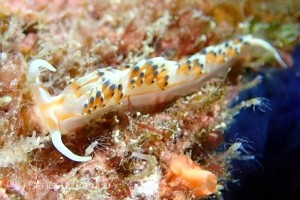
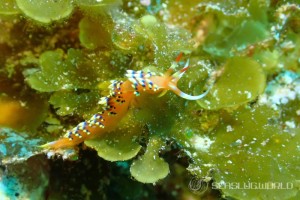
Photos of Caloria indica



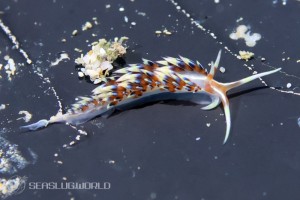

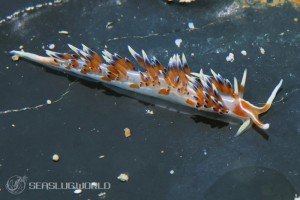
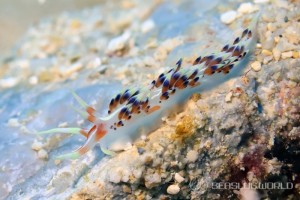
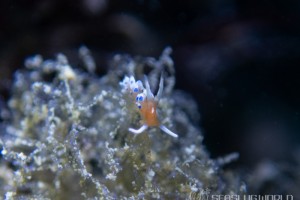











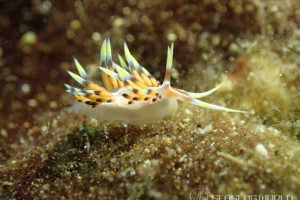

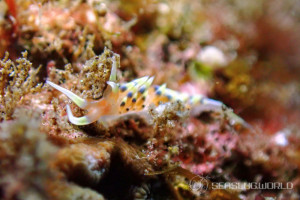

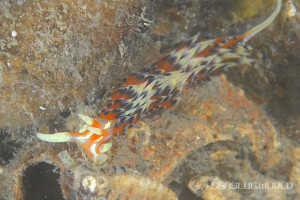

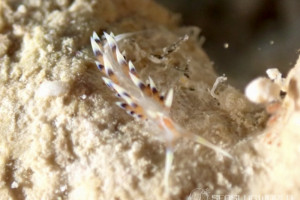
Same Genus Nudibranchs
Similar Colors Nudibranchs
Academic Database
Sea slug observation data is available in international marine biodiversity databases.