Caloria militaris (Alder & Hancock, 1864)
Description
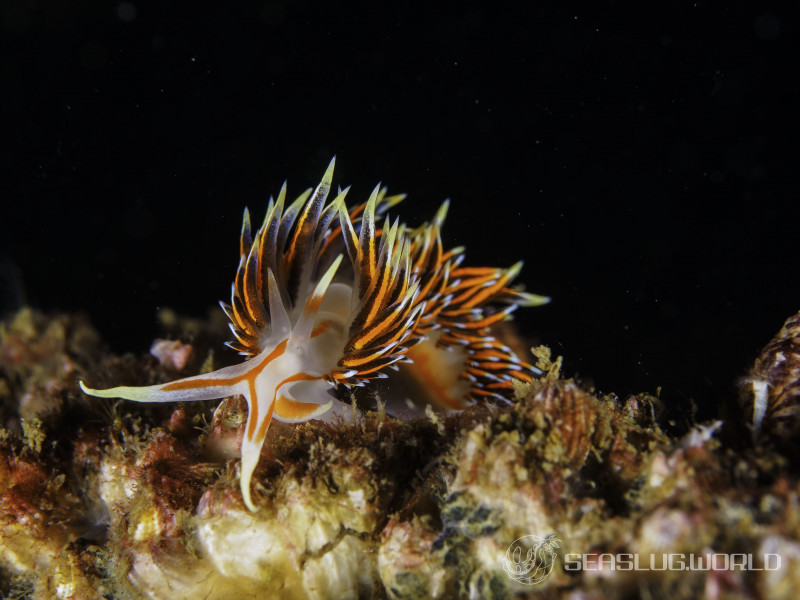
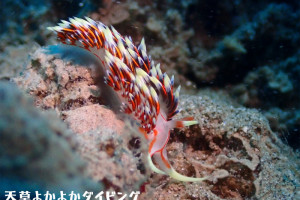
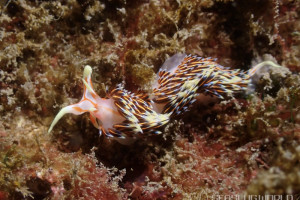
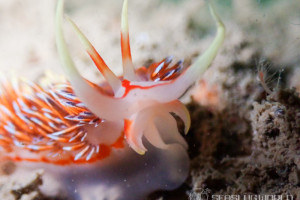
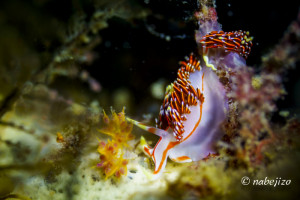
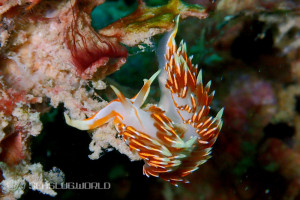
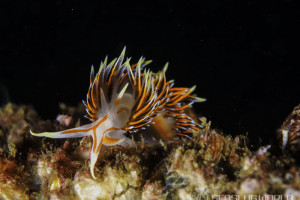
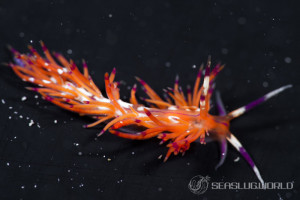
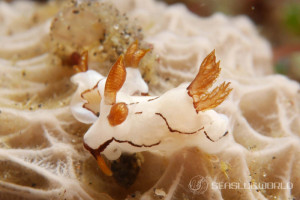
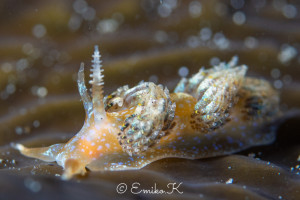
A medium-sized aeolid reaching about 1 inch (ca. 2.5 cm) in body length. The body is rather stout, tapering to a fine point behind, of a pale flesh-colour or nearly white. The dorsal tentacles are rather long, smooth, swelling a little in the centre, and tapering to a point above, with a broad belt of scarlet near the centre, gradually fading into flesh-colour below; bright yellow on the upper half, excepting the extreme tips, which are white. The oral tentacles are large, stout, and tapering, coloured as the dorsal, excepting that the scarlet central belt is extended down each tentacle in a narrow line, the two uniting in a bulb on the centre of the head, and continued thence backwards to the commencement of the branchial papillae; a scarlet line also runs along each side of the body from the anterior angles of the foot. The branchial papillae are numerous, moderately stout, of a reddish-brown colour, with bright yellow tips, forming six clusters on each side, and nearly meeting on the back. The foot has the anterior angles much produced and stout, terminating behind in a slender tail considerably behind the branchiae. The radula has a single series of fifteen or sixteen denticulated spines, with seven denticles on each side. The jaws are broad, with the cutting edge denticulated. The species bears considerable resemblance to Eolis [Caloria] indica Bergh in colour and markings but differs in the absence of rings on the dorsal tentacles, and in the produced anterior angles of the foot. The colours are also more brilliant. Only the remains of a single specimen were in the collection.Distribution
Type locality: Waltair, near Vizagapatam, Coromandel coast, Madras Presidency, India (now Visakhapatnam, Andhra Pradesh). Based on the remains of a single specimen collected by Walter Elliot in 1853–1854. The species has subsequently been recorded across the Indo-West Pacific.Etymology
The specific epithet militaris is Latin for "soldierly / military", in reference to the species' striking scarlet longitudinal bands and yellow-tipped cerata evoking the bright colours of military uniform.Remarks
In the original description Alder & Hancock placed the species in Eolis. The species was later transferred to Caloria Trinchese, 1888 (the parentheses in the author citation reflect this generic transfer), a Mediterranean genus typified by Caloria elegans to which several Indo-Pacific species including militaris were subsequently moved.References
- Eolis militaris n. sp., Alder J. & Hancock A. (1864). Notice of a collection of nudibranchiate Mollusca made in India by Walter Elliot Esq., with descriptions of several new genera and species. Transactions of the Zoological Society of London. 5(3): 113-147.
- Caloria militaris, Terrence Gosliner, Ángel Valdés and David Behrens. (2015). Nudibranch and Sea Slug Identification Indo-Pacific. New World Pubns Inc.
- Caloria militaris, Gosliner, T. et al. (2023). Southern African Sea Slugs. Southern Underwater Research Group Press, 7 Blackwood Drive, Hout Bay 7806, Cape Town, South Africa.
Featured in this book
Terrence Gosliner, Ángel Valdés and David Behrens. (2018). Nudibranch and Sea Slug Identification Indo-Pacific 2nd Edition. New World Pubns Inc.
New World Publications
This species, Caloria militaris, is included in the book.
View on Amazon PR (Amazon Associates)Seasonality
Shooting Locations
Loading shooting locations...
Photos of Caloria militaris






Same Genus Nudibranchs
Similar Colors Nudibranchs

Academic Database
Sea slug observation data is available in international marine biodiversity databases.