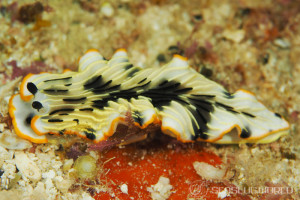
Chromodoris joshi Gosliner & Behrens, 1998
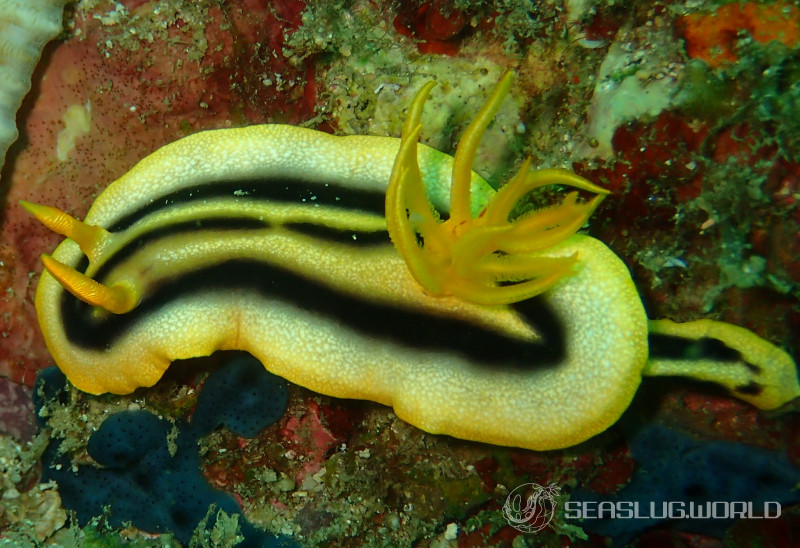
- Location
- Puerto Galera, Mindoro Island, Philippines
- Date
- 2017/11/04
- Length
- 45mm
- Depth
- 15.0m
- Water temperature
- 27.0℃
Description
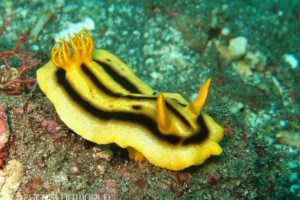
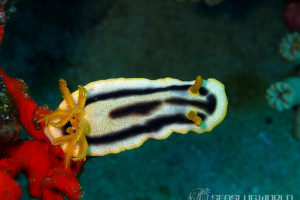
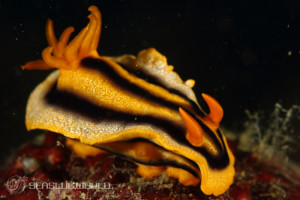
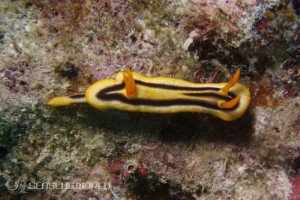
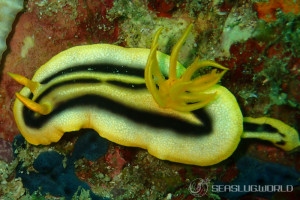
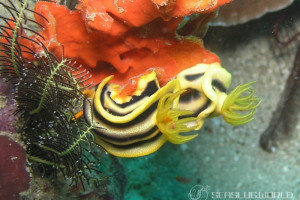
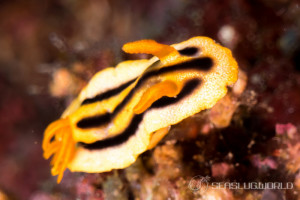
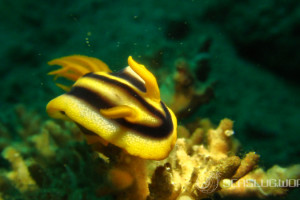
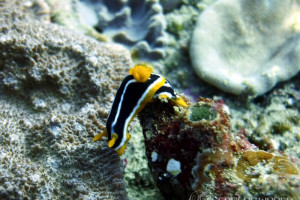
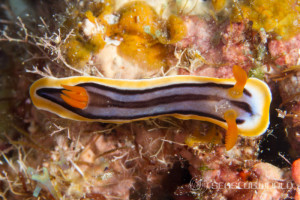
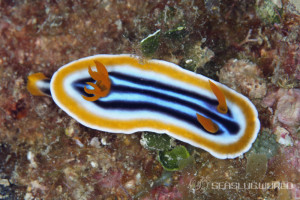
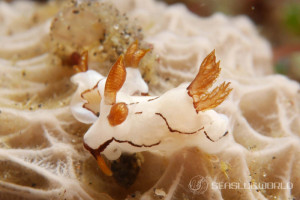
A medium-sized chromodorid up to 60 mm long. The living animal is a bright buttery yellow with a darker, golden-yellow margin and dense, fine white flecks scattered through the yellow areas. A wide black submarginal band encircles the dorsum from the front of the notum to a short distance behind the gill plume; the band is variable in width and may be hourglass-shaped at the middle, or split into two narrower bands separated by a narrow gray area. A black mid-dorsal stripe of the same width starts at or just behind the rhinophores and runs longitudinally between the marginal bands; it may be discontinuous. The triangular foot is the same color as the body and bears two black stripes along its dorsal surface. Rhinophores and gills are uniformly pumpkin-orange. The branchial plume bears 11–15 unipinnate gills; the perfoliate rhinophores carry about 30 lamellae.Distribution
Type locality: Kirby's Rock, Caban Island, Maricaban Strait, Philippine Islands (Holotype CASIZ 106464 [sic — actually CASIZ 083806], collected 24 February 1992 by Jerry Allen). Recorded from the Philippines (multiple localities), Indonesia (Sumatra; Debelius 1996), and the Andaman Sea, Thailand (photographs by Mark Strickland). Found on the outer edges of rock walls and reef fronts at 5–30 m depth.Etymology
The species is named for Joshua Todd Gosliner, the first author's son — a bright, enthusiastic student who had to endure several missed birthdays while his father was conducting fieldwork in the Philippines.Remarks
A member of the Chromodoris quadricolor species complex, described in the same paper as C. dianae and C. michaeli. Most similar in external appearance to C. africana Eliot, 1904, C. magnifica (Quoy & Gaimard, 1832), and C. kuiteri Rudman, 1982. C. joshi differs from C. africana in retaining a wider submarginal black band rather than spreading the pigment across the dorsum; mantle glands are densely clustered as in C. africana rather than separated as in C. magnifica. Radular morphology — vestigial rachidian, inner lateral teeth with 0–4 outer denticles, middle laterals with 1–5 outer denticles — separates C. joshi from C. kuiteri and C. magnifica, which both possess a triangular rachidian.References
- Chromodoris joshi sp. nov., Gosliner, T. M.; Behrens, D. W. (1998). Five new species of Chromodoris (Molluscs: Nudibranchia: Chromodorididae) from the tropical Indo-Pacific Ocean. Proceedings of the California Academy of Sciences. 4(50): 139-165., available online at http://www.biodiversitylibrary.org/page/15659747 page(s): 145-150
- ハンシンウミウシ, 益田一. (1999). 海洋生物ガイドブック. 第2刷. 東海大学出版会.
- クロモドリス・ヨシ, 殿塚孝昌. (2003). ウミウシガイドブック〈3〉. TBSブリタニカ.
- Chromodoris joshi, Johnson R.F. & Gosliner T.M. (2012). Traditional taxonomic groupings mask evolutionary history: a molecular phylogeny and new classification of the chromodorid nudibranchs. PLoS ONE 7(4): e33479.
- Chromodoris joshi, Terrence Gosliner, Ángel Valdés and David Behrens. (2015). Nudibranch and Sea Slug Identification Indo-Pacific. New World Pubns Inc.
- Chromodoris joshi, Layton K.K., Gosliner T.M. & Wilson N.G. (2018). Flexible colour patterns obscure identification and mimicry in Indo-Pacific Chromodoris nudibranchs (Gastropoda: Chromodorididae). Molecular Phylogenetics and Evolution. 124: 27-36. https://doi.org/10.1016/j.ympev.2018.02.008
Featured in this book
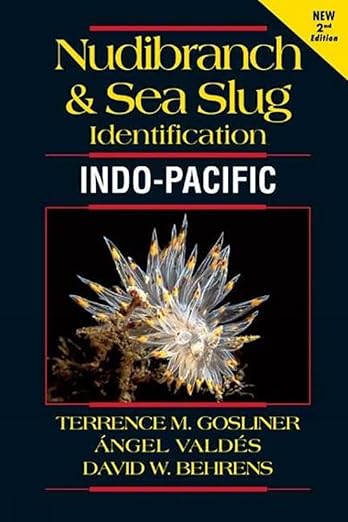
Terrence Gosliner, Ángel Valdés and David Behrens. (2018). Nudibranch and Sea Slug Identification Indo-Pacific 2nd Edition. New World Pubns Inc.
New World Publications
This species, Chromodoris joshi, is included in the book.
View on Amazon PR (Amazon Associates)Seasonality
Shooting Locations
Loading shooting locations...
Photos of Chromodoris joshi
Tag:








Same Genus Nudibranchs

Similar Colors Nudibranchs


Academic Database
Sea slug observation data is available in international marine biodiversity databases.