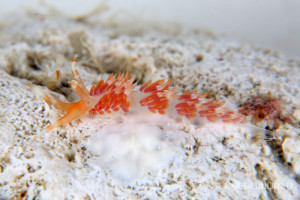
Coryphella pseudoverrucosa Martynov, Sanamyan & Korshunova, 2015
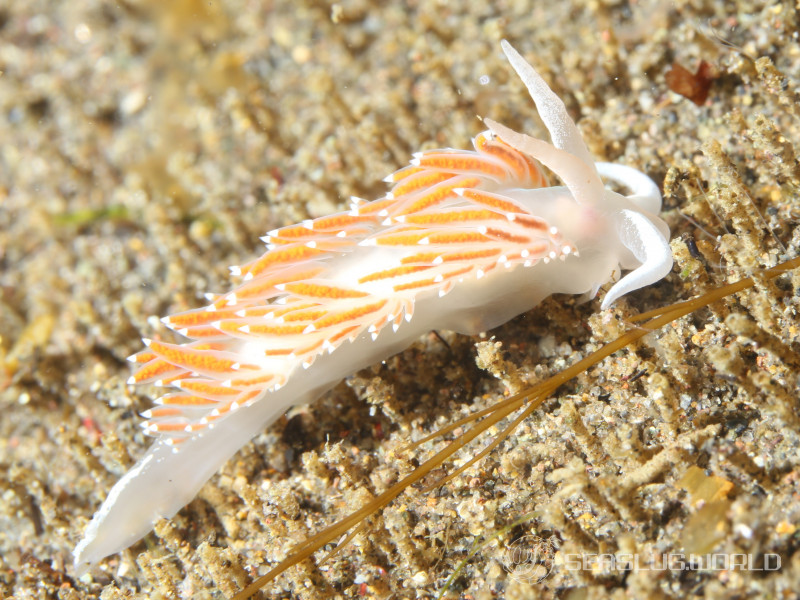
- Location
- Rousokuiwa, Rausu, Hokkaido, Japan
- Date
- 2015/05/30
- Length
- 10mm
- Depth
- 10.0m
- Water temperature
- 5.0℃
Description
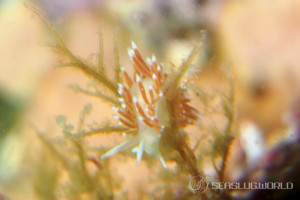
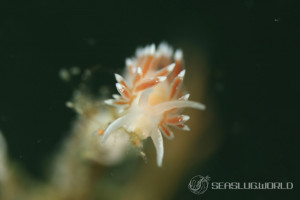
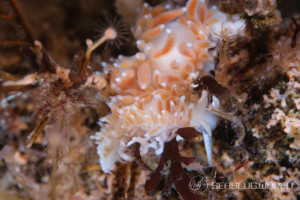
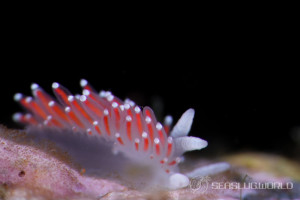
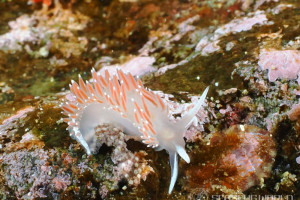
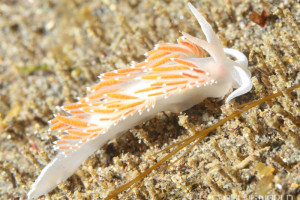
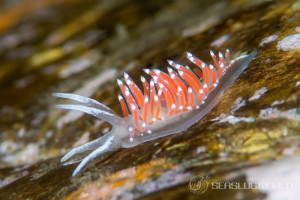
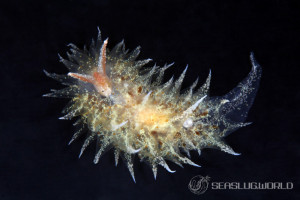
A medium-sized Aeolidacea, body length 23 mm in the holotype. Body elongate with a large semicircular head and elongate-conical oral tentacles. Rhinophores smooth, almost finger-shaped, thinner than the oral tentacles and about 1.5 times shorter. Cerata spindle-shaped to nearly cylindrical, arranged on a barely visible notal edge; the anterior cluster is the most distinct, the posterior clusters poorly developed. Foot narrow, with anterior corners reduced into tentacular processes. Pleuroproctic anus below the second ceras row of the right posterior liver. Body translucent white. Digestive-gland diverticula in the cerata are dark red to red-brown. The cerata are dotted with white pigment. Rhinophores and oral-tentacle tips are dorsally white-pigmented; cerata bear a thin white subapical ring and a transparent apex. A median white line runs along the tail. Radula formula 17 × 1.1.1; central tooth with a massive cusp and elongate horseshoe-shaped base, with 6 lateral denticles each side; lateral teeth about half the length of the central base, triangular, attenuated, with 9-12 claw-like inner denticles.Distribution
Type locality is Sukhoputnaya Bight, Ussuri Bay, Peter the Great Bay, Sea of Japan, Russia (2-5 m depth). Paratypes from southern coast of Sakhalin Island, off Cape Povorotny, and SE Kamchatka, Avachinsky Bay. Distributed in the Russian Far East — Pacific coast of Kamchatka, Sea of Japan (Peter the Great Bay, central Primorye, Sakhalin), and Bering Sea. The original description notes that records of Coryphella verrucosa from the Pacific coast of North America may also belong to this species.Etymology
The Latin compound epithet combines pseudo- ("false") with verrucosa, reflecting close external resemblance to the North-Atlantic sister species Coryphella verrucosa. The Japanese name "Hokkai-mino-umiushi" (north-sea aeolid) reflects the species' northern distribution.Remarks
Externally distinguished from C. verrucosa by the combination of intense red digestive-gland diverticula in the cerata and abundant white pigment dots. Found exclusively in the upper subtidal in the Russian Far East, in contrast to C. verrucosa which is intertidal in the White and Barents Seas. The original description hypothesises that the morphologically and ecologically similar mass species Coryphella athadona, which inhabits the Far Eastern intertidal, excludes C. pseudoverrucosa from that zone.References
- フラベリーナ・ベルルコサ, 中野理枝. (2004). 本州のウミウシ. ラトルズ.
- Coryphella pseudoverrucosa n.sp., Martynov A.V., Sanamyan N.P., Korshunova T. A. (2015). [in Russian] New data on the opisthobranch molluscs (Gastropoda: Opisthobranchia) of waters of Commander Islands and Far-Eastern seas of Russia. In: Conservation of biodiversity of Kamchatka and coastal waters. Proceedings of XV international scientific conference Petropavlovsk-Kamchatsky. Kamchat Press: Petropavlovsk-Kamchatsky, Russia. pp. 55-69, pl. 2-6.
- Coryphella pseudoverrucosa, Korshunova T., Martynov A., Bakken T., Evertsen J., Fletcher K., Mudianta I.W., Saito H., Lundin K., Schrödl M. & Picton B. (2017). Polyphyly of the traditional family Flabellinidae affects a major group of Nudibranchia: aeolidacean taxonomic reassessment with descriptions of several new families, genera, and species (Mollusca, Gastropoda). ZooKeys. 717: 1-139. https://doi.org/10.3897/zookeys.717.21885
- ホッカイミノウミウシ(新称), 中野理枝. (2018). 日本のウミウシ. 文一総合出版.
Featured in this book
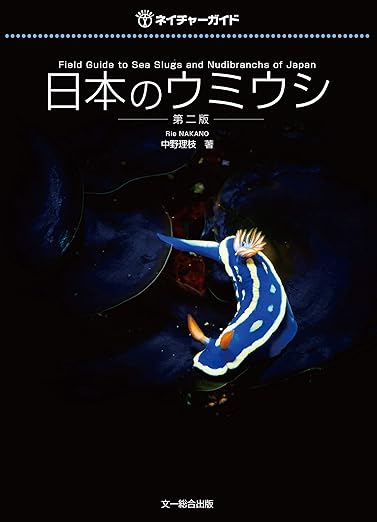
中野理枝. (2019). 日本のウミウシ. 第二版. 文一総合出版.
文一総合出版
This species, Coryphella pseudoverrucosa, is included in the book.
View on Amazon PR (Amazon Associates)Seasonality
Shooting Locations
Loading shooting locations...
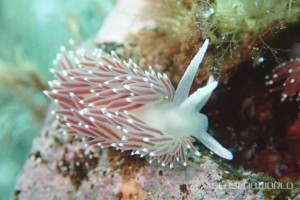
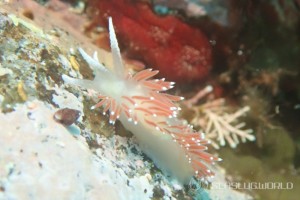
Photos of Coryphella pseudoverrucosa
Tag:







Same Genus Nudibranchs


Similar Colors Nudibranchs
Academic Database
Sea slug observation data is available in international marine biodiversity databases.