Cratena peregrina (Gmelin, 1791)
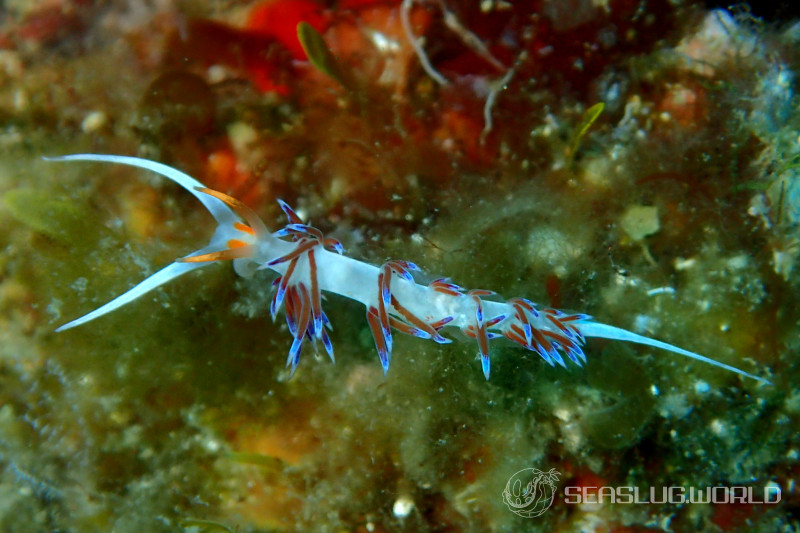
- Location
- Aigua Blava, Costa Brava, Spain
- Date
- 2017/07/23
- Length
- 35mm
- Depth
- 15.0m
- Water temperature
- 22.0℃
Description
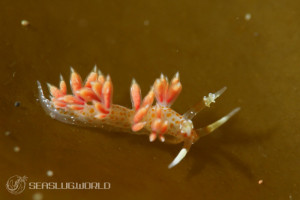
A fairly large facelinid aeolid, reaching up to 50 mm in body length. The body is translucent white, with a pair of bright orange-red spots on either side of the head, situated below the rhinophores and toward the bases of the oral tentacles. Rhinophores are smooth, with their distal half flushed with orange-red. The cerata are translucent, with the digestive gland inside ranging from reddish-brown through purple-red to orange, and the ceratal tips are white. The cerata are arranged in an anterior arched group followed by several rows behind.Distribution
Mediterranean Sea and tropical eastern Atlantic (Portugal, southern Spain, Senegal, Canary Islands), with records also from Madeira and the Azores. Specimens previously reported as C. peregrina from the Indian subcontinent (Gujarat and Maharashtra) were shown by a 2020 study to represent two undescribed species (Cratena poshitraensis and Cratena pawarshindeorum); the species therefore does not occur in the Indian Ocean.Etymology
The specific name peregrina is the feminine form of the Latin adjective peregrinus ("foreign", "from elsewhere"). The original description by Gmelin 1791 provides no explicit reason for the name.Remarks
Originally described in Doris; under current classification the species is reassigned to Cratena, hence the parentheses in the author citation.Hervia costai Haefelfinger, 1961, Cuthona peregrina and Rizzolia peregrina are junior synonyms.
The species feeds on hydroids, notably Pennaria disticha and members of the genus Eudendrium. A 2020 study, using molecular phylogenetics (COI, 16S) and species-delimitation methods (ABGD) together with comparisons of colour pattern and internal anatomy, demonstrated that two morphotypes from western India that had been treated as C. peregrina belong to undescribed species, which they named Cratena poshitraensis sp. nov. (Poshitra, Gujarat) and Cratena pawarshindeorum sp. nov. (Uran, Maharashtra). As a consequence the confirmed range of C. peregrina is restricted to the Mediterranean and the tropical eastern Atlantic.
References
A Kindle field guide by the site author

Kimoto N. (2026). Sea Slugs of Japan & the Indo-Pacific, 2nd Edition.
Kindle Edition
View on Amazon PR (Amazon Associates)Seasonality
Shooting Locations
Loading shooting locations...
Photos of Cratena peregrina
Tag:

Same Genus Nudibranchs
Similar Colors Nudibranchs
Academic Database
Sea slug observation data is available in international marine biodiversity databases.