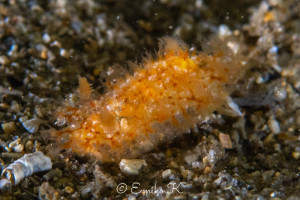
Doto rosacea Baba, 1949
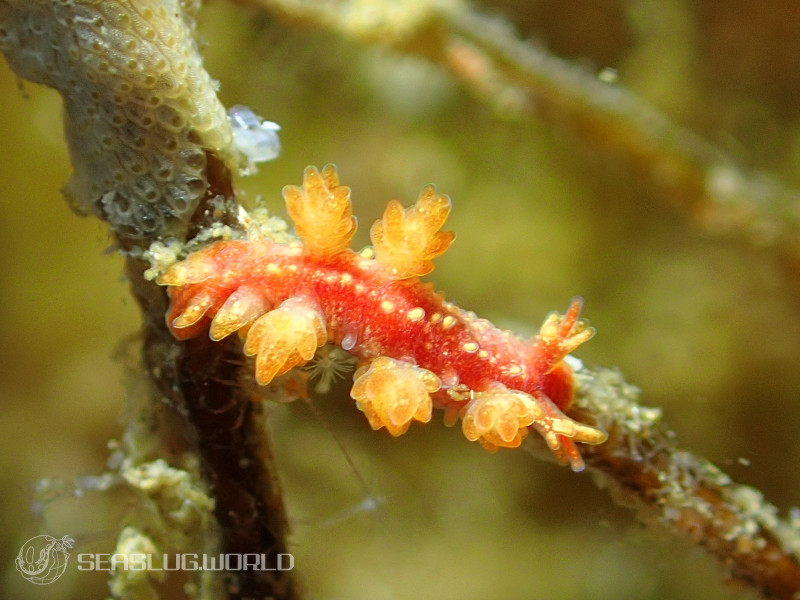
- Location
- Ushitsuki Rock, Kumomi, Shizuoka, Japan
- Date
- 2016/07/27
- Length
- 10mm
- Depth
- 10.0m
- Water temperature
- 22.0℃
Description
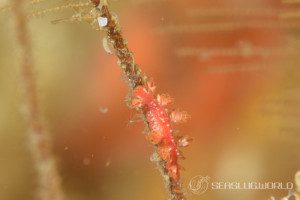
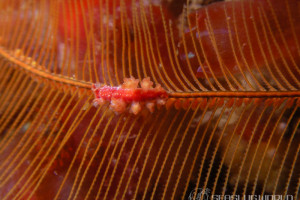
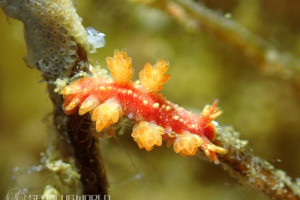
A small Dotidae, body length about 1 cm. The rhinophore sheath margin is wavy, forming 5 small lobes. There are 7 pairs of cerata; no gills are present. The surface tubercles on the cerata are slightly elongate with pointed tips, usually arranged in 3 whorls, each whorl with 4-5 tubercles. The whole body is pale pink; the tubercles on the cerata are not blackened at the tip. A longitudinal band of white fine dots runs along the dorsal midline, the anterior end of which bifurcates and ascends along the posterior margin of each rhinophore sheath. Radula formula 35×0.1.0. The central tooth bears 2-3 denticles on each side of the median cusp.Distribution
Type locality is Hayama-Samejima-Kagitori-iwa, Sagami Bay (9 m depth, January 1939, single specimen). The original description (Baba, 1949) records the species only from the type locality.Etymology
The specific epithet rosacea is Latin for rosy or rose-coloured. The original description does not give an explicit etymology paragraph; the descriptive sense reflects the pale pink body colour. The Japanese name "Bara-iro-matsukasa-umiushi" (rose-coloured matsukasa sea slug) likewise refers to the pink ground.Remarks
Distinguished from sympatric Doto japonica and Doto bella by (1) the absence of gills (Doto japonica has dendritic gills on the inner face of each ceras), (2) cerata tubercles that are not blackened at the tip, and (3) the white-dotted longitudinal band on the dorsal midline that bifurcates anteriorly.References
A Kindle field guide by the site author
Kimoto N. (2026). Sea Slugs of Japan & the Indo-Pacific, 2nd Edition.
Kindle Edition
View on Amazon PR (Amazon Associates)Seasonality
Shooting Locations
Loading shooting locations...
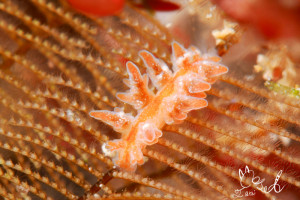
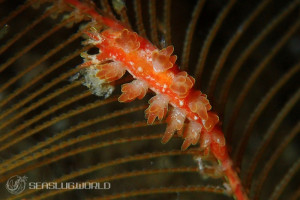
Photos of Doto rosacea





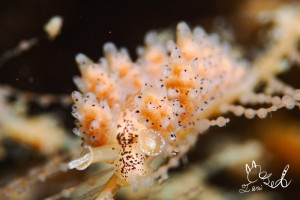
Same Genus Nudibranchs


Similar Colors Nudibranchs
Academic Database
Sea slug observation data is available in international marine biodiversity databases.