Fiona pinnata (Eschscholtz, 1831)
Description
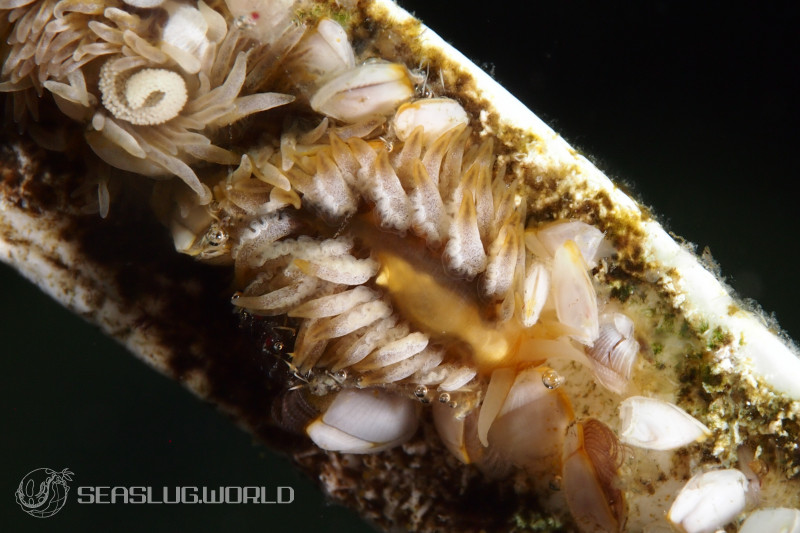
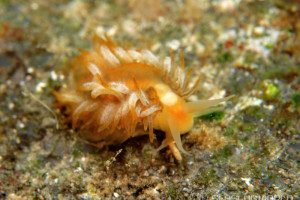
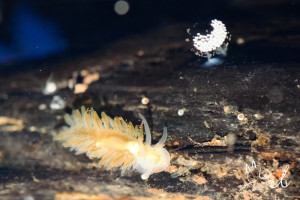
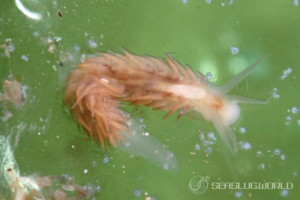
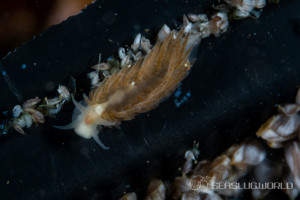
A small pelagic aeolid that lives drifting on the open ocean. Body length is typically around 20 mm, reaching up to 50 mm. The cerata are arranged in oblique rows along the dorsal margin and bear a thin, wing-like membranous fringe (lateral lobe), a feature that immediately distinguishes Fiona pinnata from other aeolids. Body colour is strongly influenced by diet: pale brown to whitish when feeding on goose barnacles, while the digestive gland inside the cerata turns vivid blue when the animal feeds on Velella velella. The rhinophores and oral tentacles are similar in shape and both are smooth. The species lacks eyes and, unusually for an aeolid, lacks cnidosacs in the cerata.Distribution
Cosmopolitan in temperate and tropical open oceans worldwide. Fiona pinnata is associated with floating substrates — driftwood, drifting algae, pelagic goose barnacles, and the by-the-wind sailor Velella velella — and is therefore a true pelagic species rather than a coastal one. Specimens are reported from waters around Japan, often washing ashore with floating debris after storms. The species is based on material collected during the second Kotzebue circumnavigation voyage (1823–1826) in which Eschscholtz participated.Etymology
The specific epithet pinnata is Latin for "feathered" or "winged".Remarks
Type species of the family Fionidae. Fiona pinnata is an obligate pelagic predator, feeding mainly on goose barnacles such as Lepas anatifera and on the by-the-wind sailor Velella velella; Janthina snails and other floating cnidarians have also been recorded as prey. The species was originally described as Eolidia pinnata by Eschscholtz 1831 in his Zoologischer Atlas, and later placed in Fiona Alder & Hancock, 1853. Molecular work by Trickey et al. 2016 indicated that F. pinnata represents a species complex of cryptic lineages, but no segregate species have yet been formally named.Holleman 1972 provided detailed observations of growth, feeding, reproduction and larval development based on captive specimens collected from driftwood off central California. He documented an approximately 900% increase in body length over 24 days when fed Lepas anatifera, clearly size-selective predation on barnacles, and a short embryonic period yielding free-swimming veligers within 5 days of egg laying.
References
- ヒダミノウミウシ, Baba K. (1949). Opisthobranchia of Sagami Bay collected by His Majesty the Emperor of Japan (相模湾産後鰓類図譜). Iwanami Shoten, Tokyo. 4+2+194+7 pp., pls. 1-50.
- Fiona pinnata (Eschscholtz, 1831), Holleman J.J. (1972). Observations on growth, feeding, reproduction and development in the opisthobranch, Fiona pinnata (Eschscholtz). The Veliger. 15(2): 142-146.
- 高岡生物研究会. (2002). 日本海のウミウシ. 第2版.
A Kindle field guide by the site author
Kimoto N. (2026). Sea Slugs of Japan & the Indo-Pacific, 2nd Edition.
Kindle Edition
View on Amazon PR (Amazon Associates)Seasonality
Shooting Locations
Loading shooting locations...
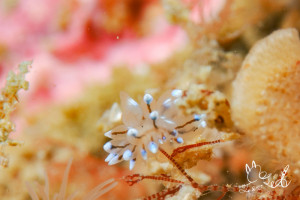
Photos of Fiona pinnata





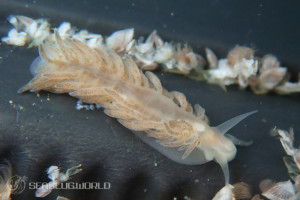

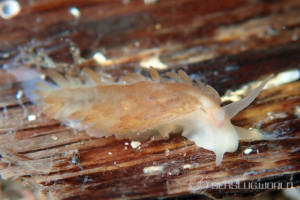
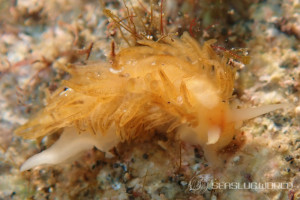
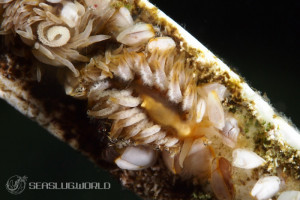

Similar Colors Nudibranchs
Academic Database
Sea slug observation data is available in international marine biodiversity databases.