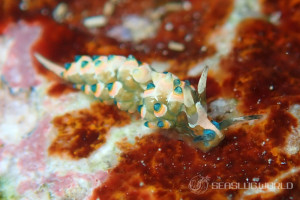
Onchidoris bilamellata (Linnaeus, 1767)
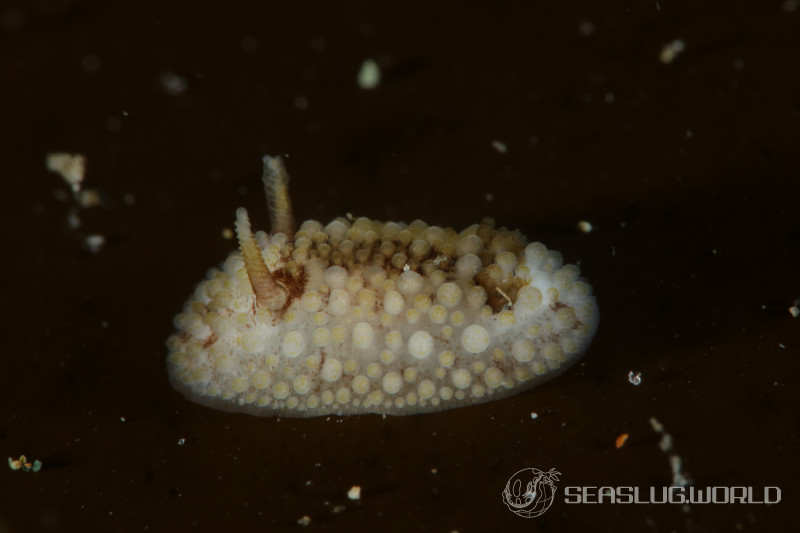
- Location
- Maehama Beach, Hakodate Usujiri, Hokkaido, Japan
- Date
- 2016/06/17
- Length
- 10mm
- Depth
- 6.0m
- Water temperature
- 12.0℃
Description
The body is ashy yellow to translucent white, with the dorsum entirely covered by rounded tubercles of varying sizes that contain calcareous spicules. Irregular chocolate-brown blotches are scattered over the back, typically arranged in three longitudinal bands along the midline. The rhinophores and gills are chocolate brown. The branchial circle consists of around 20 or more simply pinnate gill leaves. A semicircular oral veil is present at the front. A whitish form lacking the dark pigmentation also occurs. Length reaches about 10–40 mm.Distribution
Widely distributed in the cold waters of the North Pacific and North Atlantic. In Japan, recorded from Hokkaido (Akkeshi Bay, Muroran, Shirikishinai) and the Tohoku coast (Onagawa, off Rikuchu). In the North Pacific, the range extends from the Bering Sea and Alaska through Vancouver Island to California; in the North Atlantic, from Svalbard, Iceland, Greenland and the Norwegian coast to the British Isles and the eastern North American coast. It occurs from the intertidal zone down to about 20 m, on rocky bottoms, dead shells, and pebbles.Etymology
From Latin bi- (two) and lamella (a small plate or thin layer), meaning "with two lamellae," in reference to the gill structure that Linnaeus highlighted to distinguish this species from other members of Doris.Remarks
This is a specialised barnacle predator. It feeds on acorn barnacles of the genera Balanus and Semibalanus, drilling through the shell plates with the radula and sucking out the soft parts; juveniles feed on bryozoans. Mass spawning aggregations, in which large numbers of adults gather to deposit spiral egg ribbons, have been reported from Scotland to California.Originally described as Doris bilamellata by Linnaeus in 1767, the species was later placed in Lamellidoris and is now assigned to Onchidoris Blainville, 1816. Doris fusca O. F. Müller, 1776 and Onchidoris leachii Blainville, 1816 are junior synonyms. The Japanese name "Rameri-umiushi" was proposed by Kikutaro Baba in 1957, derived from the then-current generic name Lamellidoris.
References
- Onchidoris bilamellata — type species, Blainville H.M.D. de (1816). Quatrième mémoire sur les mollusques, de l'ordre des Cyclobranches. Bulletin des Sciences, par la Société Philomathique de Paris. 1816: 93-97.
- Lamellidoris (Lamellidoris) fusca (O.F. Muller) Rameri-umiushi (n. n.), Baba, K. 1957. A revised list of the species of Opisthobranchia from the northern part of Japan, with some additional descriptions. J. Fac. Sci., Hokkaido Univ.,ser. 6, Zool. 13(1-4):8-14.
- オンキドーリス・ビラメラータ, 中野理枝. (2004). 本州のウミウシ. ラトルズ.
- コガモウミウシ(新称), 中野理枝. (2018). 日本のウミウシ. 文一総合出版.
- Onchidoris bilamellata, Behrens D.W., Hermosillo A., Fletcher K. & Jensen G.C. (2022). Nudibranchs & Sea Slugs of the Eastern Pacific. Molamarine.
Featured in this book
Behrens D.W., Hermosillo A., Fletcher K. & Jensen G.C. (2022). Nudibranchs & Sea Slugs of the Eastern Pacific. Molamarine.
Molamarine
This species, Onchidoris bilamellata, is included in the book.
View on Amazon PR (Amazon Associates)Seasonality
Shooting Locations
Loading shooting locations...
Photos of Onchidoris bilamellata

Same Genus Nudibranchs
Similar Colors Nudibranchs


Academic Database
Sea slug observation data is available in international marine biodiversity databases.