Pleurobranchus grandis Pease, 1868
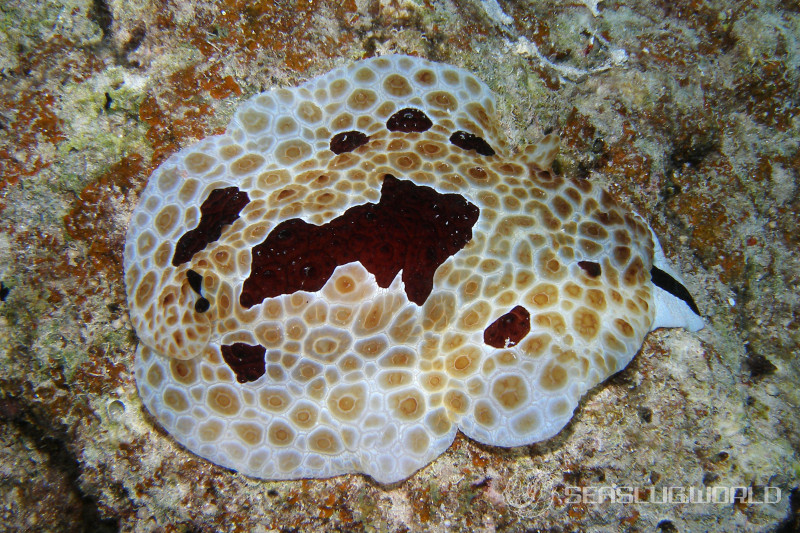
- Location
- Thoma No.2, Kerama(Zamami・Amuro・Gahi・Agenashiku), Okinawa, Japan
- Date
- 2011/03/15
- Length
- 300mm
- Depth
- 6.0m
- Water temperature
- 22.0℃
Description
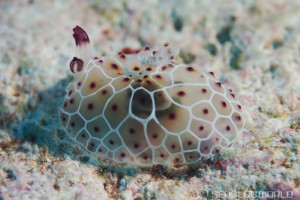
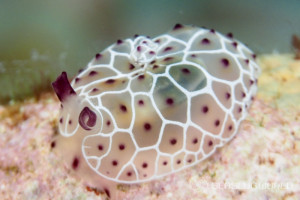
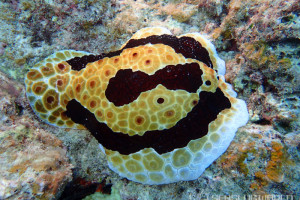
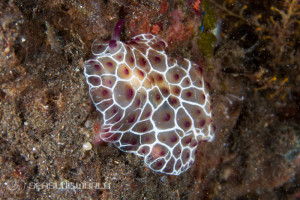
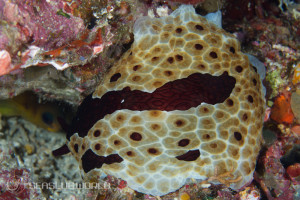
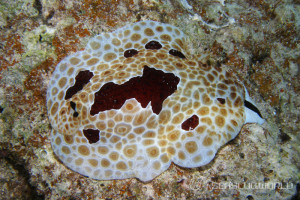
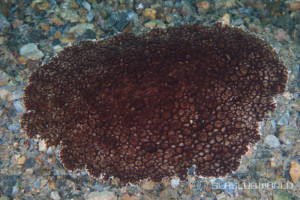
A large pleurobranch reaching about 15 cm in body length, the largest and most delicate species of the genus. There is no shell. The body is oblong-oval, subpellucid, flaccid, depressly convex above, covered with a network of impressed lines whose interspaces are finely tuberculate. The mantle covers the head and is deeply notched in front to accommodate the rhinophores. The head is small and narrow; the oral veil is moderately developed, subtriangular, with biplicate sides. The rhinophores are smooth, stout, truncate and involute. The eyes are very minute, scarcely visible without a lens, deeply immersed at the base of the rhinophores. The foot is large, thin, elongate-oblong, convexly truncate and duplicate in front, rounded behind, projecting far behind the mantle when crawling and largely exposed from above together with the gill. The gill is very large, of two alternating rows of 26 tripinnate plumules each, the plumules tuberculate at their bases. The gill is attached to the body for two-thirds of its length by a lax thin membrane. The anal duct, at the posterior end of the membrane, is cylindrical, truncate and deeply crenulate at the tip. The generative organs are very large, immediately anterior to the gill, connected by a prominent grooved ridge. The whole upper surface of the mantle is covered with a reticulation of pale bluish-ash lines whose interspaces are fawn-coloured, becoming obsolete towards the margin and more or less dotted with whitish. There is a large oblong dorsal spot of deep purple-brown, surrounded by a series of irregular spots of the same colour, all dotted with pale blue. The inner side of the under surface of the mantle and the upper side of the foot are deep purple-brown. The locomotive disk is bluish-ash, tinged anteriorly with cream-yellow and marked posteriorly with a purple-brown stripe. The veil is the same colour as the foot. The gill is deep purple-brown and the generative organs purple-black.Distribution
Central to western Pacific. Type locality: Huahine, Society Islands, based on a specimen collected by Andrew Garrett and described by Pease. Subsequently recorded from the Hawaiian Islands, southern Japan, the Philippines, Indonesia, Guam, the Red Sea and elsewhere.Etymology
The specific epithet grandis is the Latin adjective meaning "large, grand", in reference to the species reaching 6 inches (≈ 15 cm) in body length, making it the largest member of the genus. Pease did not state an etymology, but the meaning is consistent with his Remarks "This large and delicate species differs from others of the genus".Remarks
Placed by Pease in Pleurobranchus, where it is still currently retained. Pease distinguished the species from others of the genus by (1) the mantle being extended over the head and notched for the accommodation of the rhinophores, and (2) the gill plumules being tuberculate at their bases — a feature he attributed to the large size of the gill. Several specimens were examined and no shell was found. The Japanese name "ソバカスフシエラガイ" ("freckled pleurobranch") refers to the freckle-like spotting overlying the reticulated dorsal pattern.References
- Pleurobranchus grandis Pease n. sp., Pease W.H. (1868). Descriptions of Marine Gasteropodae, inhabiting Polynesia. American Journal of Conchology. 4(2): 71-80; 4(3): 91-102, pls. 7-10.
- ソバカスフシエラガイ, 益田一. (1999). 海洋生物ガイドブック. 第2刷. 東海大学出版会.
- プレウロブランクス・グランディス, 殿塚孝昌. (2003). ウミウシガイドブック〈3〉. TBSブリタニカ.
- ヨコヅナフシエラガイ(新称), 中野理枝. (2018). 日本のウミウシ. 文一総合出版.
Featured in this book

中野理枝. (2019). 日本のウミウシ. 第二版. 文一総合出版.
文一総合出版
This species, Pleurobranchus grandis, is included in the book.
View on Amazon PR (Amazon Associates)Seasonality
Shooting Locations
Loading shooting locations...
Photos of Pleurobranchus grandis



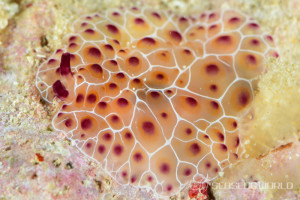
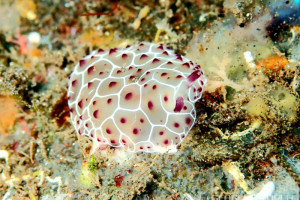

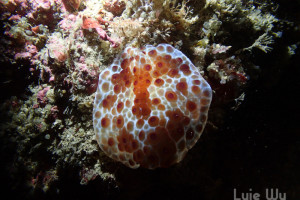

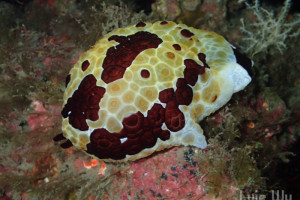





Same Genus Nudibranchs



Similar Colors Nudibranchs

Academic Database
Sea slug observation data is available in international marine biodiversity databases.