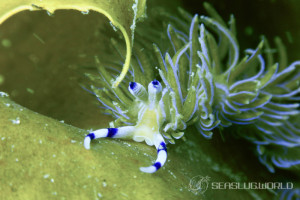
Pteraeolidia ianthina (Angas, 1864)
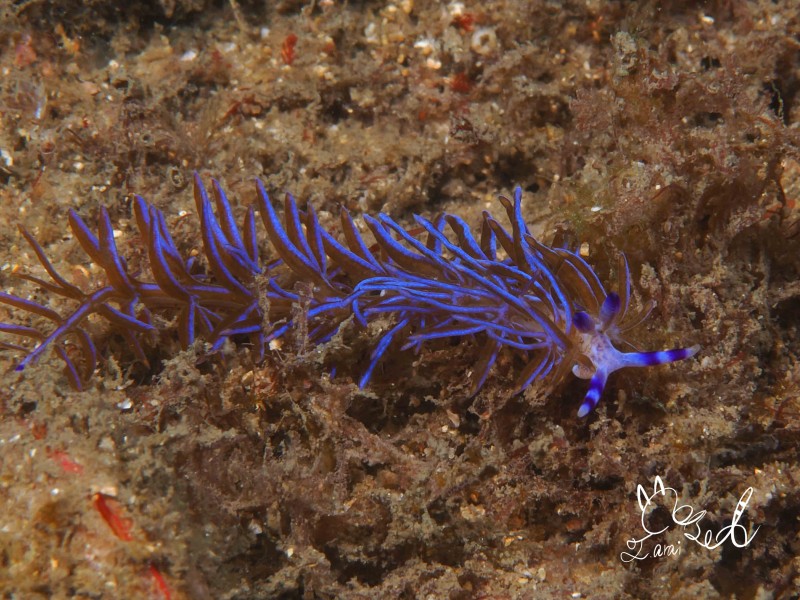
- Location
- Bare Island East, New South Wales, Australia
- Date
- 2026/04/29
- Length
- 25mm
- Depth
- 15.0m
- Water temperature
- 20.0℃
Description
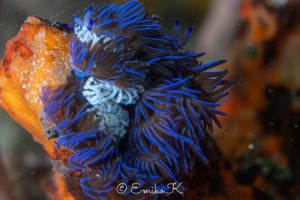
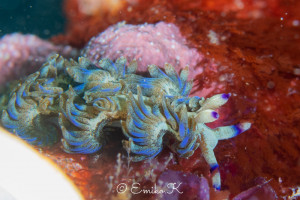
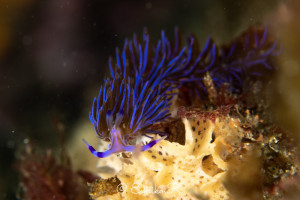
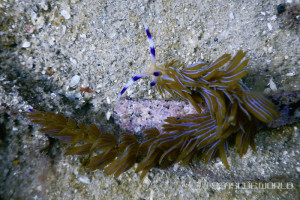
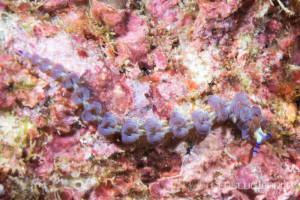
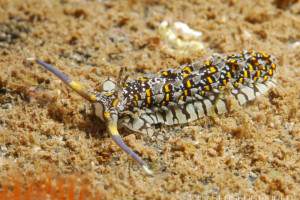
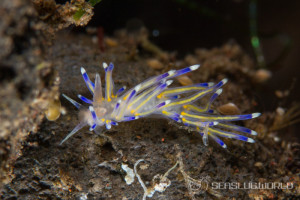
A large aeolid reaching about 99 mm in body length (including cerata and oral tentacles) and 20 mm in width. The body is elongate and the ground colour is bluish-olive. Eighteen ceratal groups are arranged along each side of the body, each group well separated from the others. The cerata are bright blue and were described by Angas as showing colour-changes "like opal or topaz, with iridescent reflections that vary according to the angle of light". The ceratal tips are violet-blue tinged with greenish-yellow, the middle olive, and the base bluish-olive. The foot tapers posteriorly with two angular whitish processes anteriorly. The oral tentacles are of moderate length, mottled olive and violet with scattered blue patches. The rhinophores meet at their bases, are clavate, and are shaded olive-and-violet to the apex. Angas's type was 99 mm long and 20 mm wide; he also observed individuals up to 4 inches (≈ 10 cm).Distribution
Indo-West Pacific to the central Pacific. Type locality: rock pools at Watson's Bay (within Port-Jackson Harbour), New South Wales, based on specimens collected by Angas during the southern spring and summer. Subsequently recorded across eastern Australia, southern Japan, the Philippines, Indonesia, New Caledonia, Fiji, the Hawaiian Islands and many other localities.Etymology
The specific epithet ianthina derives from Greek ianthinos ("violet-coloured, iridescent"), in reference to the iridescent violet-blue display of the cerata. The meaning is consistent with Angas's Latin diagnosis "fasciculis 18 branchiarum vivide et opalino cærulearum, in cæruleum magnificum mutantibus, reflexibus chamæleontis ut illis opali aut topazii" ("with 18 ceratal groups vividly opal-blue, changing to magnificent blue with chameleon-like reflections like those of opal or topaz").Remarks
Originally placed by Angas in Flabellina. Crosse appended a footnote noting that Flabellina is sometimes confused with Æolis, but is distinguished by its cerata being arranged in well-separated groups rather than continuously along the body. Later transferred to Pteraeolidia; the parentheses in the author citation reflect this generic transfer. The species is well known for sequestering symbiotic zooxanthellae from its hydroid prey within the cerata, making it one of the few fully photosynthetic aeolids.References
- Flabellina ianthina Angas n. sp., Angas G.F. (1864). Description d'espèces nouvelles appartenant à plusieurs genres de Mollusques Nudibranches des environs de Port-Jackson (Nouvelle-Galles du Sud), accompagnée de dessins faits d'après nature. Journal de Conchyliologie, 12(1): 43-70, pl. IV.
- Wilson N.G. & Burghardt I. (2015). Here be dragons - phylogeography of Pteraeolidia ianthina (Angas, 1864) reveals multiple species of photosynthetic nudibranchs (Aeolidina: Nudibranchia). Zoological Journal of the Linnean Society. 175(1): 119-133. https://doi.org/10.1111/zoj.12266
A Kindle field guide by the site author
Kimoto N. (2026). Sea Slugs of Japan & the Indo-Pacific, 2nd Edition.
Kindle Edition
View on Amazon PR (Amazon Associates)Seasonality
Shooting Locations
Loading shooting locations...
Photos of Pteraeolidia ianthina
Tag:



Same Genus Nudibranchs
Similar Colors Nudibranchs
Academic Database
Sea slug observation data is available in international marine biodiversity databases.