Catriona alpha (Baba & Hamatani, 1963)
Description
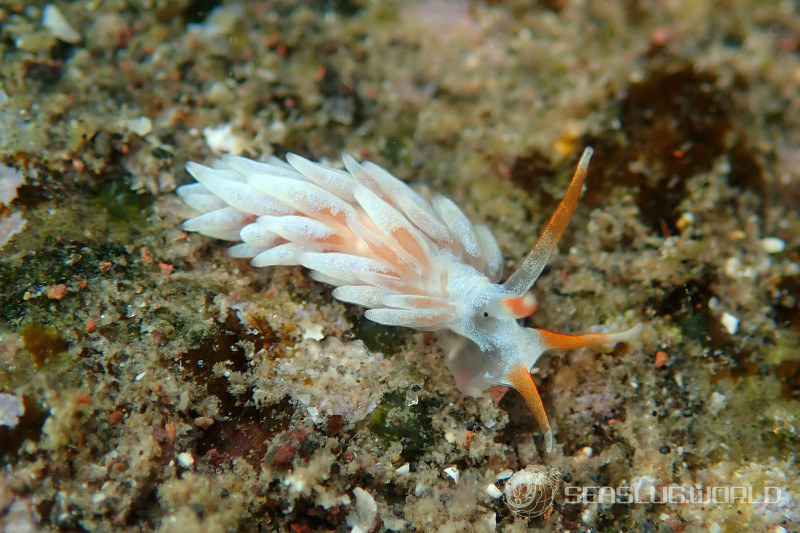
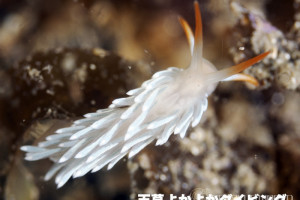
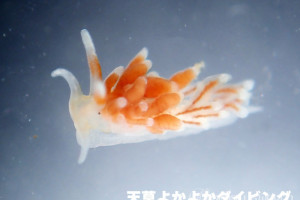
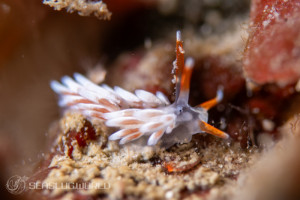
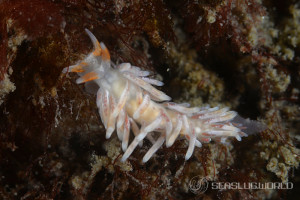
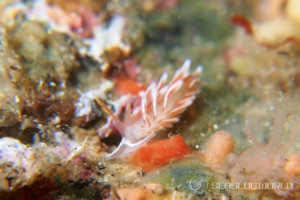
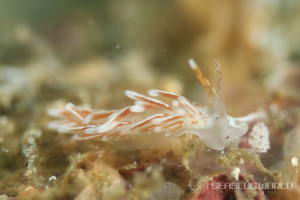
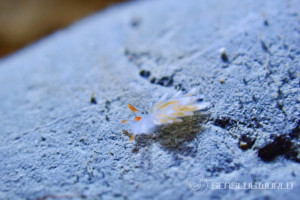
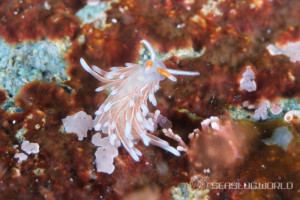
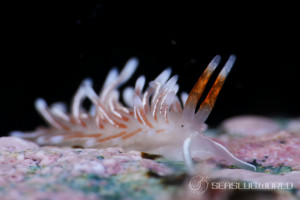
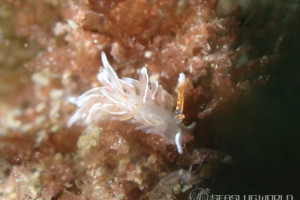
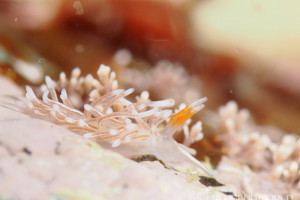
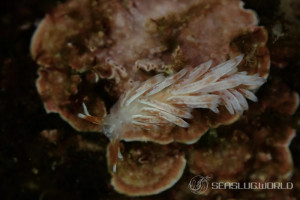
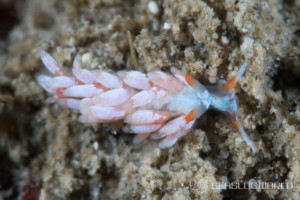
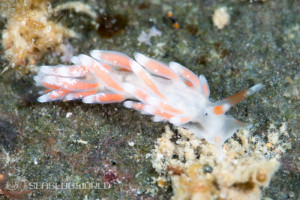
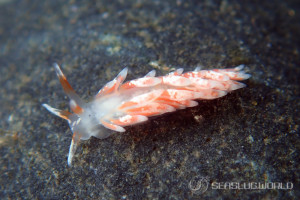
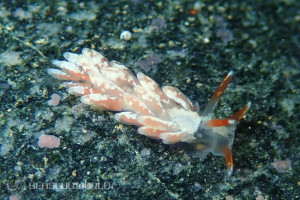
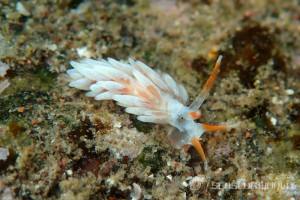
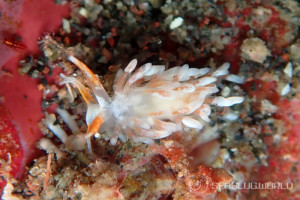
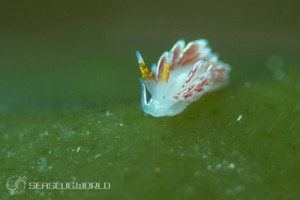
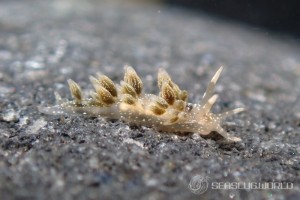
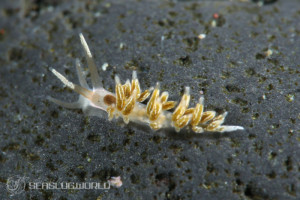
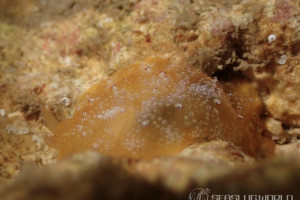
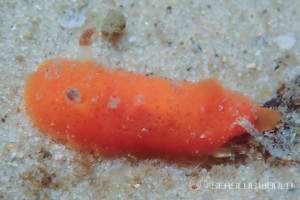
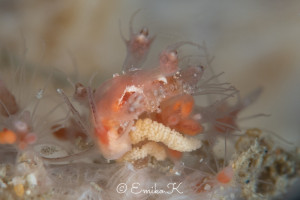
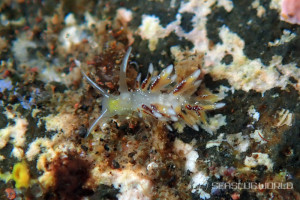
A small aeolid, 13-15 mm long when extended. The body is translucent yellowish white, densely sprinkled with opaque white dots along the dorsal midline of the head, on the cephalic tentacles and rhinophores, and over almost the whole outer surface of the cerata. The most striking external character is the vivid orange suffusion of the cephalic tentacles and rhinophores; in some individuals the orange may fade from either the tentacles or the rhinophores but not from both. The cerata are long and fusiform, set in nine simple oblique rows on each side of the holotype, with up to fourteen rows in some paratypes; the liver diverticulum within each ceras is yellowish brown. The rhinophores are simple. The radula is colourless, with a formula of about 80 x 0.1.0 (up to 105 x 0.1.0 in the longest paratype). The median cusp of the tooth is retracted and shorter than the lateral denticles (Catriona-type), with 2-3 lateral denticles on each side, often interspersed with smaller denticles. The penis is elongately conical, muscular, and lacks a stylet (Cuthona-type).Distribution
Type locality: the shore of Kozuchi-jima off Tamano, Inland Sea of Seto, Japan (holotype, 21 April 1962, collected by the authors). Paratypes are also recorded from Abugashima in Toyama Bay, on the Japan Sea side of Honshu, where additional specimens were subsequently collected by Mr. Takeo Abe.Etymology
The specific epithet alpha is the Greek letter α, applied as a symbolic name to mark the discovery of a "mosaic" species combining a Cuthona-type penis (unarmed, lacking a stylet) with a Catriona-type radula (median cusp retracted). A footnote in the original paper foreshadowed a sister species, Cuthona beta, found by the senior author together with Mr. Takeo Abe and described shortly afterwards (Baba & Abe, 1964, Annual Report of the Noto Marine Laboratory, University of Kanazawa, vol. 4). Catriona alpha therefore stands as the first member of this α/β symbolic series.Remarks
The Japanese vernacular name "Kozuchi-minoumiushi" refers to Kozuchi-jima, the small islet that is the type locality. The original description appeared as Contribution No. 108 of the Tamano Marine Laboratory of Okayama University. Part of the paratype series came from specimens collected by Mr. Takeo Abe of Takaoka Senior High School, Toyama Prefecture. Baba & Hamatani originally placed the species in Cuthona; It was later transferred to Catriona, the placement followed here in line with the current WoRMS classification.References
- Kozuchi-minoumiushi (n. n.), Baba K. & Hamatani I. (1963). A CUTHONID, CUTHONA ALPHA N. SP., WITH A RADULA OF CATRIONA TYPE (NUDIBRANCHIA-EOLIDOIDEA). Publications of the Seto Marine Biological Laboratory. 11(2): 339-343. https://doi.org/10.5134/175339
- 高岡生物研究会. (2002). 日本海のウミウシ. 第2版.
- コヅチミノウミウシ?, 中野理枝. (2004). 本州のウミウシ. ラトルズ.
- コヅチミノウミウシ?, 中野理枝. (2018). 日本のウミウシ. 文一総合出版.
Featured in this book
中野理枝. (2019). 日本のウミウシ. 第二版. 文一総合出版.
文一総合出版
This species, Catriona alpha, is included in the book.
View on Amazon PR (Amazon Associates)Seasonality
Shooting Locations
Loading shooting locations...
Photos of Catriona alpha















Same Genus Nudibranchs

Similar Colors Nudibranchs
Academic Database
Sea slug observation data is available in international marine biodiversity databases.