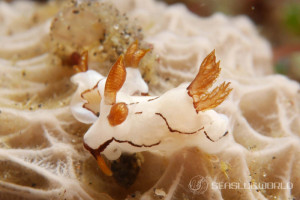
Tenellia yamasui (Hamatani, 1993)
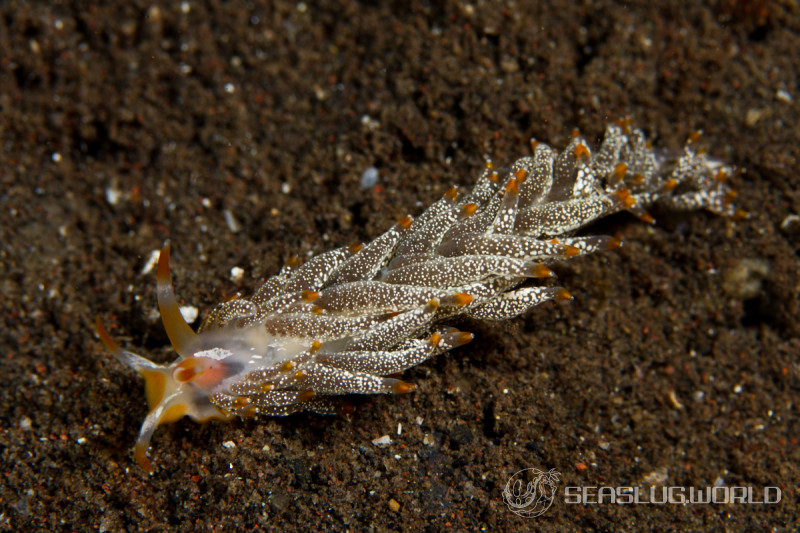
- Location
- MINA point, Tulamben, Pulau Bali, Indonesia
- Date
- 2018/01/12
- Length
- 30mm
- Depth
- 15.0m
- Water temperature
- 28.0℃
Description
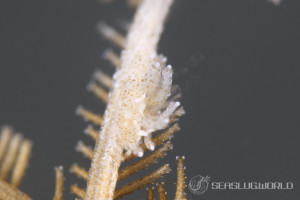
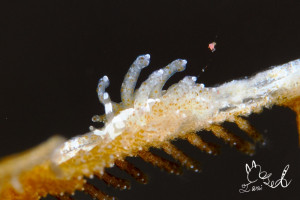
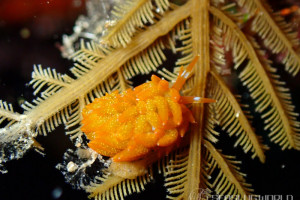
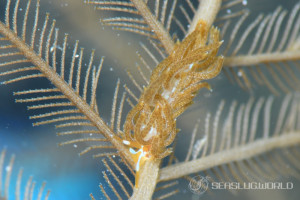
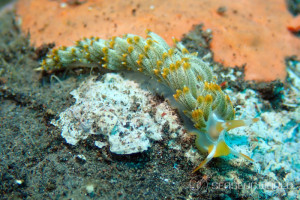
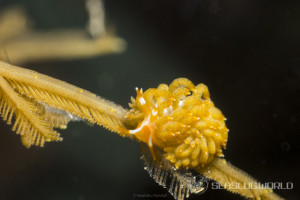
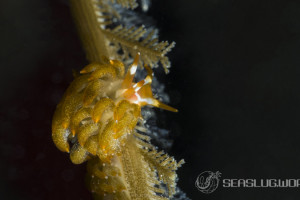
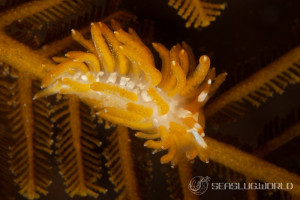
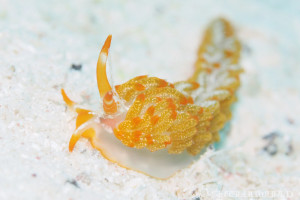
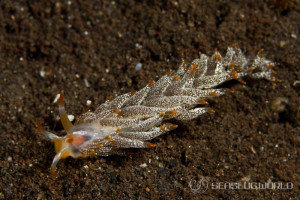
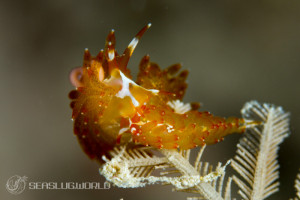
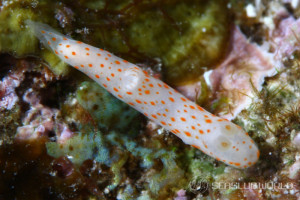
A small aeolid nudibranch reaching about 15 mm in extended body length, with a slender, limaciform body. Smooth rhinophores and oral tentacles are roughly equal in length. The animal is tinted overall with a light orange-yellow cast; the ground colour is translucent or pale orange-yellow, while the head, oral tentacles and rhinophores are mostly orange-red. A conspicuous opaque white longitudinal band runs along the dorsal midline of the head between the rhinophores, extending forward to the basal halves of the oral tentacles and laterally onto the outer sides of the rhinophores. Numerous irregular opaque white patches are scattered across the dorsal and lateral surfaces. The tips of the oral tentacles and rhinophores are white; the sole is translucent and colourless. Cerata are elongate and fusiform when extended, curved slightly inwards; when contracted, the upper quarter swells and becomes slightly dorsoventrally flattened. Each ceras ends in a small pointed tip; just below the tip is a small white ring, the upper portion is reddish orange, and the lower portion is covered with clusters of opaque white dots.Distribution
Type locality: Cape Zanpa, Okinawa Island, southwestern Japan, on the colony of the plumulariid hydroid Aglaophenia cupressina Lamouroux, 1816 (Japanese name "Futogaya") growing on a rocky bed at about 2 m depth. At the time of the original description (Hamatani 1993) the species was known only from the type locality. Subsequent records have extended the distribution across the Indo-West Pacific.Etymology
The specific epithet yamasui is dedicated to Dr. Terufumi Yamasu of the University of the Ryukyus, who collected the type material.Japanese vernacular name
The Japanese name "Futogaya-minoumiushi" (フトガヤミノウミウシ) is taken from the Japanese vernacular of the host hydroid Aglaophenia cupressina ("Futogaya"), upon which the species exclusively lives.Remarks
The diet appears to consist exclusively of the host hydroid Aglaophenia cupressina. The egg mass is a semicircular ribbon roughly 5 mm in diameter and 140 μm wide, containing more than 300 eggs deposited directly on the host. Externally most similar to Tenellia diversicolor (Baba, 1975), originally described as Trinchesia diversicolor; the two species are separated by (1) the opaque white head band of T. yamasui not being crossed by a yellow band as in T. diversicolor, and (2) the absence in T. yamasui of a marked subapical orange-yellow band on the cerata that is conspicuous in T. diversicolor.References
- Cuthona yamasui n. sp. フトガヤミノウミウシ(新称), Hamatani I. (1993). A new Cuthonid species (Nudibranchia, Aeolidacea), Cuthona yamasui n. sp., from Okinawa, Southwestern Japan. Venus: the Japanese Journal of Malacology, 52(2): 127-133.
- Cuthona yamasui, Terrence Gosliner, Ángel Valdés and David Behrens. (2015). Nudibranch and Sea Slug Identification Indo-Pacific. New World Pubns Inc.
Featured in this book
Terrence Gosliner, Ángel Valdés and David Behrens. (2018). Nudibranch and Sea Slug Identification Indo-Pacific 2nd Edition. New World Pubns Inc.
New World Publications
This species, Tenellia yamasui, is included in the book.
View on Amazon PR (Amazon Associates)Seasonality
Shooting Locations
Loading shooting locations...
Photos of Tenellia yamasui
Tag:










Same Genus Nudibranchs
Similar Colors Nudibranchs
Academic Database
Sea slug observation data is available in international marine biodiversity databases.