The Takaoka Biological Club — Fifty Years of Amateur Opisthobranch Research on the Central Japan Sea Coast
When Japanese sea slug taxonomy is told as a story, the names that come up first are usually Kikutaro Baba and Iwao Hamatani. Behind that academic line, however, there is a quieter group that spent more than fifty years systematically documenting the opisthobranchs of the central Japan Sea coast: the Takaoka Biological Club (TBC), based in Takaoka City, Toyama Prefecture.
TBC began in 1950 as the biology club of Takaoka High School. Through the alumni Opistha Club of 1953 and a rename to the current TBC in 1964, the group built up records from more than 170 localities and 1,500 survey events, stretching from Aomori in the north to the Oki Islands of Shimane in the south. Their fieldwork underpinned a long list of new-species descriptions whose type localities lie in Toyama Bay, the Noto Peninsula, Wakasa Bay, and the Echizen coast.
1950: starting at Abugashima
In the summer of 1950, the Takaoka High School biology club began an investigation called Opisthobranch fauna of Toyama Bay, centred on Abugashima, a small island in Toyama Bay. The proposal came from Dr. Kenzo Hori, a teacher at the school. The same year, Iwanami Shoten published Opisthobranchia of Sagami Bay — compiled by the Biological Research Institute of the Imperial Household, with descriptions written by Kikutaro Baba on specimens collected by Emperor Shōwa. Toyama Bay was chosen as the Japan Sea counterpart to be surveyed against that Pacific baseline.
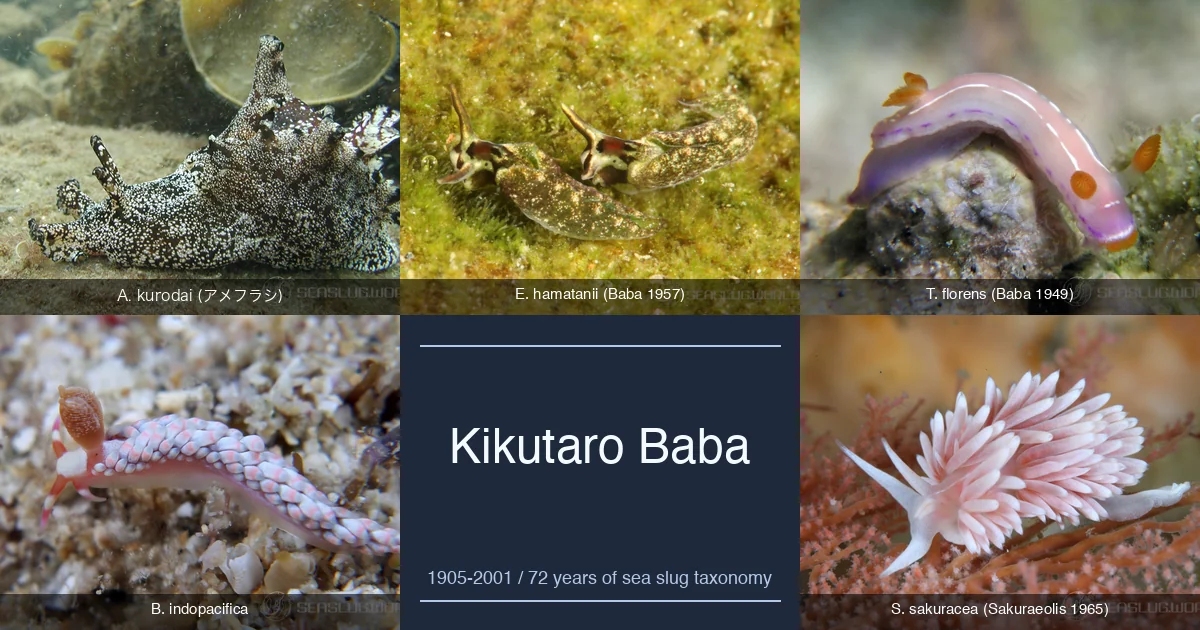
From 1951 onward, Dr. Kikutaro Baba of Osaka Gakugei University began guiding the work directly. Specimens collected by the high school students were sent to Osaka for identification and description — a back-and-forth that would continue for half a century. For Baba himself, see the separate article on Dr. Kikutaro Baba.
1957: Prime Minister's Prize, Japan Student Science Award
The Toyama Bay opisthobranch study won the Prime Minister's Prize at the inaugural Japan Student Science Award in 1957. The faculty advisor, Takeo Abe, was twice invited to present specimens and research materials for an imperial viewing (in 1958 and 1969). That an amateur high-school programme received such recognition is itself a measure of how seriously the work was taken.
From Opistha Club to TBC: 1953–1964
In 1953 a group of biology-club alumni formed the Opistha Club (after Opisthobranchia, the Latin name for the order), independent of the school programme. From the 1957 Hegurajima expedition onward, the alumni ran summer survey camps every year, reaching the 43rd at Cape Echizen in 2004.
The 1964 publication of Opisthobranchia of Toyama Bay and Adjacent Waters (Hokuryukan, edited by the high school biology research group under Baba's supervision) covers 129 species and stands as the Japan Sea counterpart to Opisthobranchia of Sagami Bay. The same year, the alumni group reorganised under its current name, the Takaoka Biological Club.
The journal JANOLUS: from 1967
In 1967 TBC launched its in-house journal, JANOLUS, named after the genus Janolus that Baba and Abe were then describing from Toyama Bay. Each issue carried field records, interim reports, and member exchanges. The 100th issue in 1999 was put together as a "50 years of opisthobranch research" memorial volume and included a consolidated Checklist of opisthobranchs from the Japan Sea coast of central Japan drawn from five decades of data.
CD-ROM atlas Sea Slug from the Japan Sea coasts of Middle Japan: 2000 / 2002
In the late 1990s TBC began digitising its accumulated slides and field notes. A digest version was previewed in August 1999 at the 50th-anniversary survey at Abugashima, and a full CD-ROM atlas followed in December 2000 (192 species), with a second edition in December 2002 (209 species). TBC's own English title for the disc is Sea Slug from the Japan Sea coasts of Middle Japan.
On this site, the second edition is registered as bibliographic reference no. 297; species are linked from their detail pages to a listing of species recorded in Sea Slug from the Japan Sea coasts of Middle Japan.
1997: Toyama Environment Award
In January 1997 TBC mounted a "Sea Slugs" exhibition at the Uozu Aquarium, presenting opisthobranch phylogeny, diversity, ecology, and research history to a general audience. Two months later the group received the top prize at the first Toyama Environment Award. The exhibition and the award together mark TBC's transition from a closed-society research group to a public-facing biodiversity programme rooted in its local region.
New-species descriptions tied to the central Japan Sea coast
A number of new opisthobranch species described by Baba (with co-authors Takeo Abe, Takasi Tokioka, Shiro Kawaguti, and later Iwao Hamatani) are based on TBC material. The list below splits them by whether the species epithet honours a place or a person.
Toponym epithets (central Japan Sea localities)
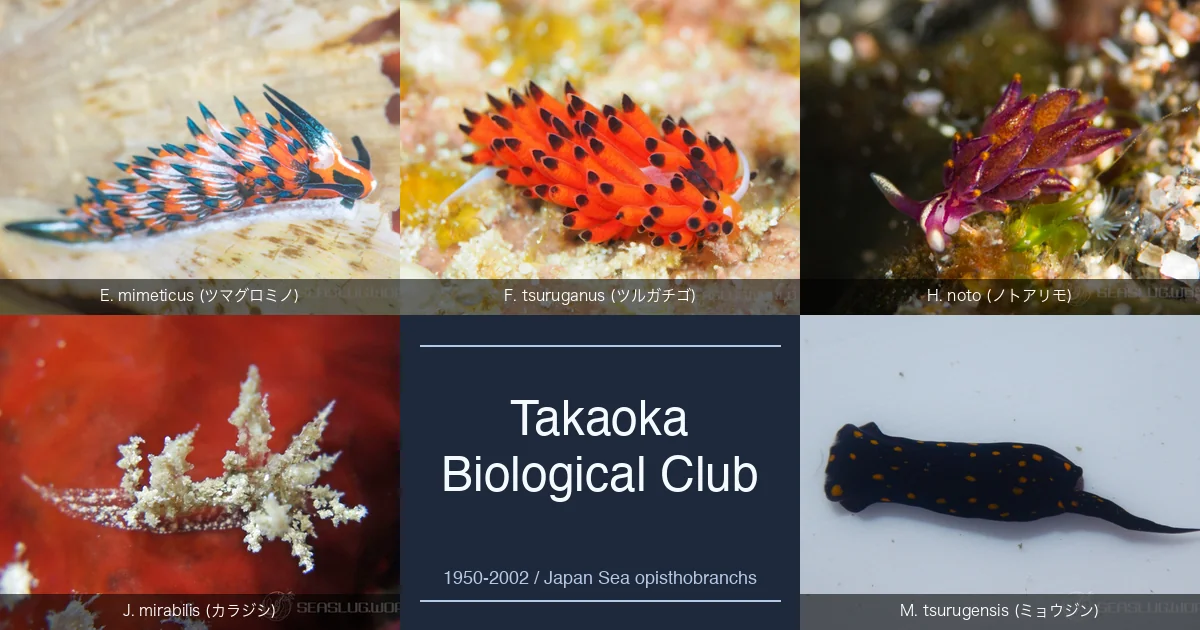
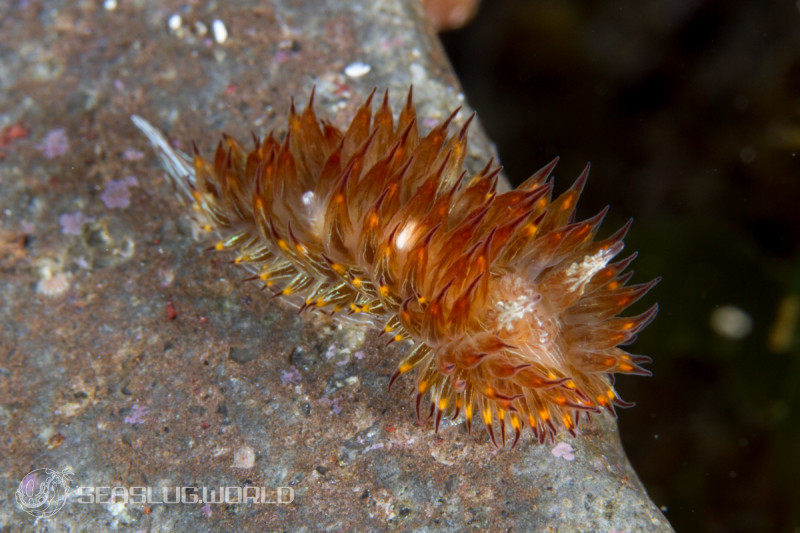
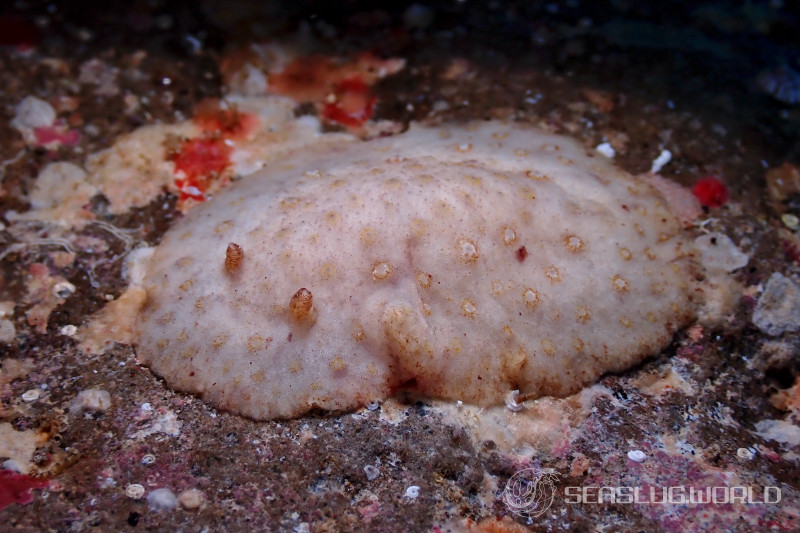
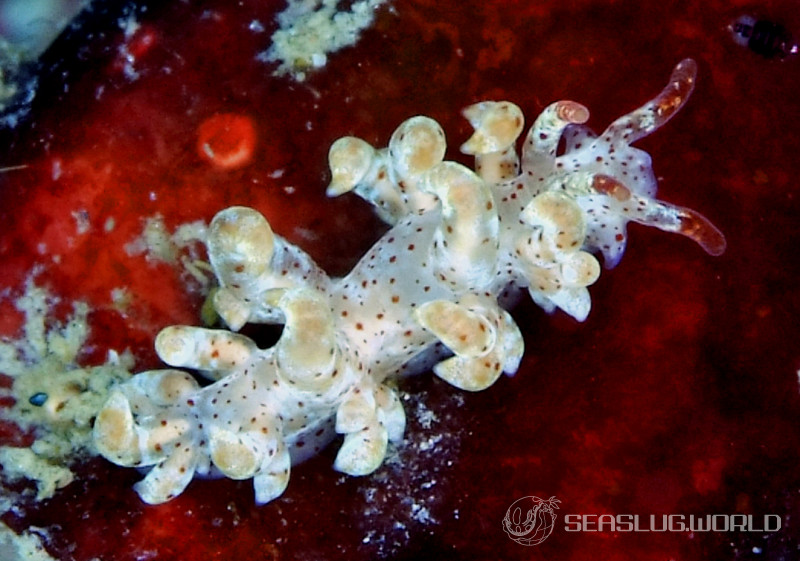
- Aplysiopsis toyamana — Baba, 1959. Type locality Abugashima, Toyama Bay (first recorded 1952). The epithet toyamana refers to Toyama Bay
- Janolus toyamensis — Baba & Abe, 1970. Nakada, Toyama Bay (1960)
- Janolus mirabilis — Baba & Abe, 1970. Abugashima, Toyama Bay (1958)
- Hermaea noto — Baba, 1959. Ushitsu, Noto Peninsula (1953). The epithet noto refers to the Noto Peninsula
- Mariaglaja tsurugensis — described as Chelidonura tsurugensis by Baba & Abe, 1959. Myojin-saki, Tsuruga Bay (1956)
- Paradoris tsurugensis — Baba, 1986. Okazaki, Tsuruga Bay (1961)
- Favorinus tsuruganus — Baba & Abe, 1964. Mizushima, Tsuruga Bay (1956)
- Eubranchus echizenicus — Baba, 1975. Konyu, Echizen coast (1973). The epithet echizenicus refers to the Echizen coast
- Eubranchus mimeticus — Baba, 1975. Konyu, Echizen coast (1973)
Patronyms (Japan Sea field collaborators)
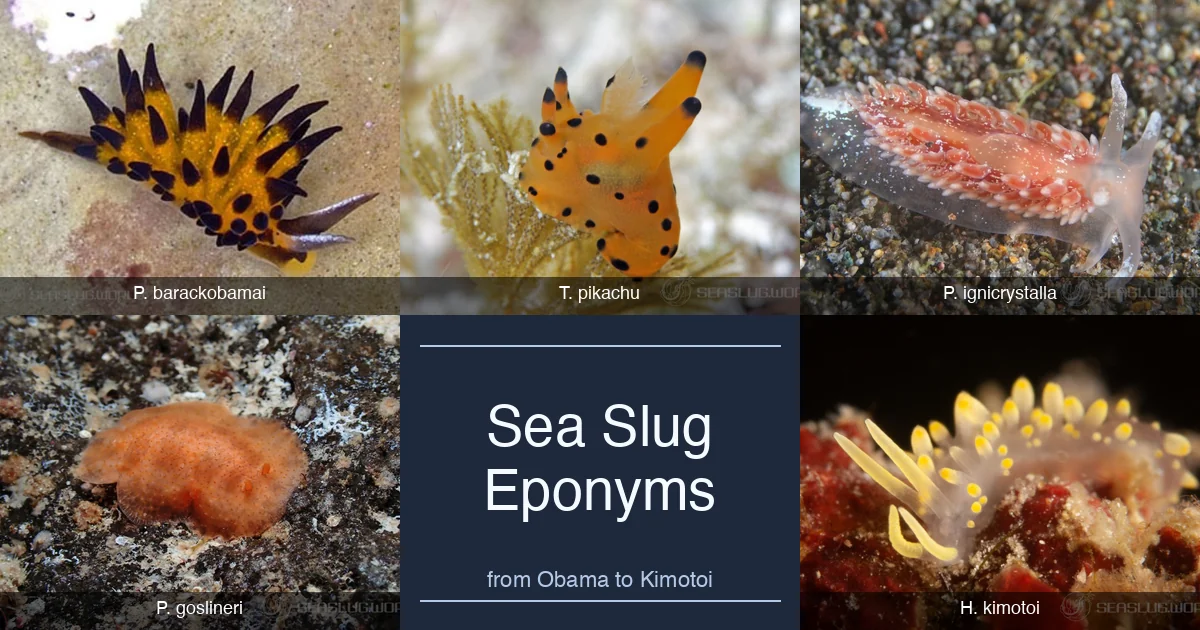
- Eubranchus horii Baba, 1960 (now Nihonbranchus horii) — Baba named the species after Kenzo Hori, the high school teacher who originally proposed the Toyama Bay opisthobranch survey. Type locality Abugashima, Toyama Bay (first recorded 1951)
- Polycera abei — Baba, 1960. Named for Takeo Abe, the advisor of the Takaoka High School biology club; type locality Amaharashi, Toyama Bay (first recorded 1958)
- Coryphella abei — described as Flabellina abei by Baba, 1987. Same dedication to Takeo Abe; type locality Abugashima, Toyama Bay (first recorded 1963)
- Apata sp. 1 (Japanese name "Usuki-mino-umiushi") — no formal scientific patronym yet (the species is still treated as an undescribed Apata), but TBC has adopted the Japanese vernacular "Usuki" in honour of Itaru Usuki, professor at Niigata University and long-term collaborator who supported TBC's surveys from the Sado Marine Biological Station
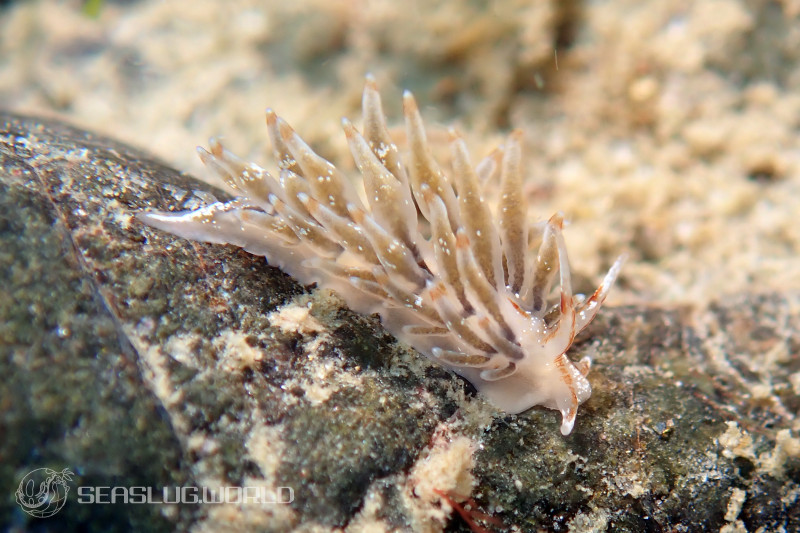
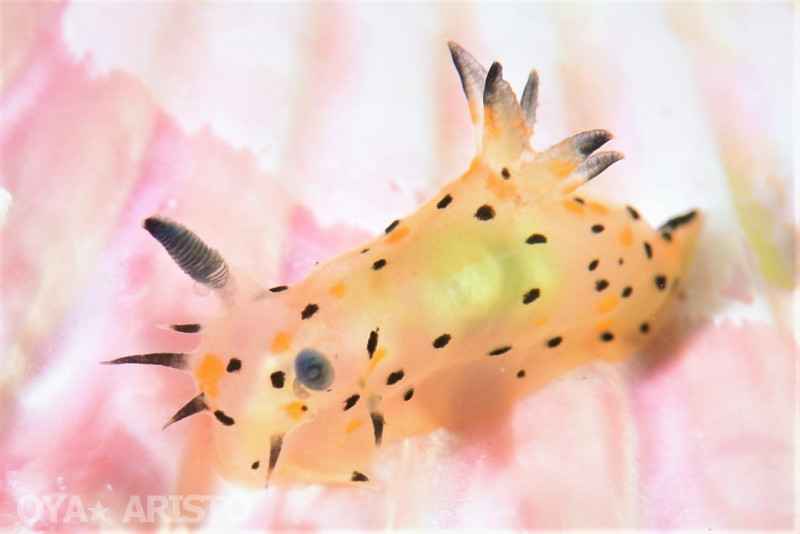
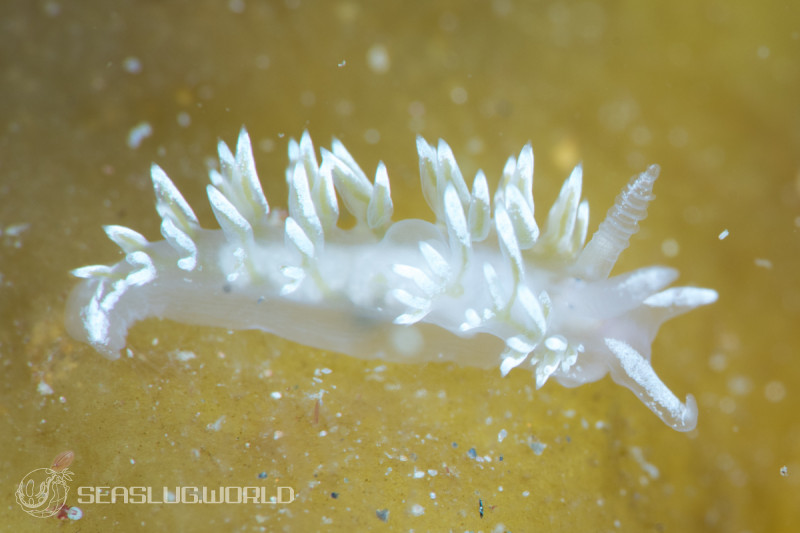
1971, Hime on the Noto Peninsula: Antonietta janthina
Among the central Japan Sea descriptions, Antonietta janthina stands out as a marker of how widely TBC's network ran by the 1970s. Type locality: Hime, Noto Peninsula (first recorded 1971); described by Baba & Hamatani, 1977.
Unlike Baba's pre-war Amakusa descriptions or his post-war Sagami Bay descriptions, this species was not collected directly by Baba. It is built on specimens that TBC members collected and observed at Hime over years, then sent to Osaka. The pairing of Baba/Hamatani's lab in Kansai with TBC's observation network in Hokuriku is the kind of collaboration that ran through most of TBC's later descriptive output.
People behind TBC
The post-face of the 2002 CD-ROM atlas lists the editorial team of that edition:
- Editor — Shigeru Hayashi
- Text, photography, editing — Haruo Izumi, Hirokazu Uchijima, Iwao Okada, Eiko Kaneko, Tetsushi Segawa, Seigoro Takahashi, Yasumasa Nagao
- Photo contributors — Mareo Ohta (underwater photographer), Hisashi Hagiwara, Kohsuke Amano, Shigeo Takahashi
- Advisory / collaborative — Kikutaro Baba (Osaka Kyoiku University, emeritus), Iwao Hamatani (formerly Osaka Kyoiku University High School), the late Dr. Itaru Usuki (formerly Niigata University; Sado Marine Biological Station)
Usuki in particular contributed both his published work — the single-author Opisthobranchs of the Niigata coast, with focus on Sado (1969, Sado Museum Bulletin) and two 1975 papers co-authored with TBC editor Shigeru Hayashi (Journal of the Niigata Biology Education Society, vol. 10) — and his complete Sado Marine Biological Station slide archive, which he donated to TBC in 1999 and which forms the basis of the disc's Sado material.
Institutional partners contributing images and field information included the Uozu Aquarium (Shigeki Takayama), Notojima Marine Park Aquarium (Tatsuru Nasuda), Noto Marine Centre (Hiroyuki Fukushima), the Fukui Prefectural Coast Nature Centre, and the Echizen-Matsushima Aquarium. The fieldwork was tied into a chain of small aquaria and marine stations along the Japan Sea coast.
Closing
While the second edition of the CD-ROM was being prepared, in November 2001, Kikutaro Baba — who had guided TBC for fifty years — passed away at the age of 96. The second edition, released about a year later, can be read as TBC's own act of closing out their half-century with Baba.
The group's office is still listed as being in Takaoka City, Toyama Prefecture, though the current state of JANOLUS and TBC's post-2010 activity is not fully tracked from outside the group. This site will continue to consolidate species information tied to the legacy of Baba, Hamatani, and the Takaoka Biological Club.
Enjoyed this post? You can tip the author directly —
Tip this post