Aplysia gigantea G. B. Sowerby II, 1869
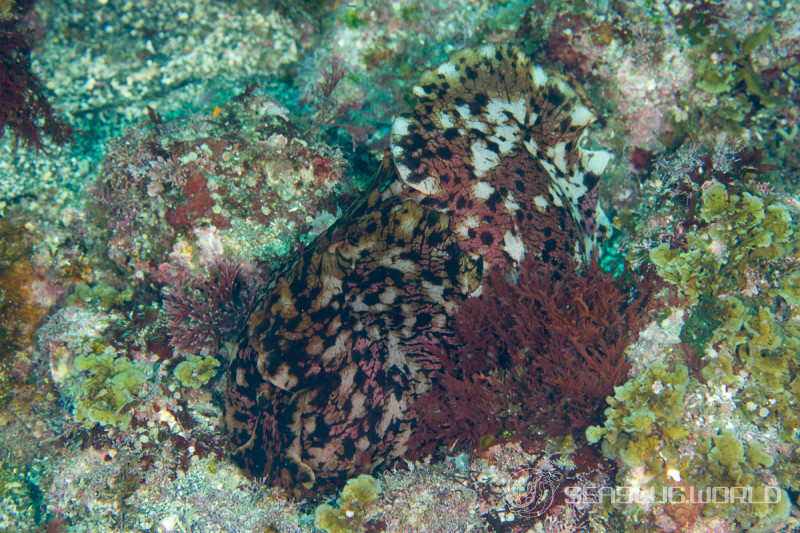
- Location
- Sokodo(Sanmata), Hachijo Island, Tokyo, Japan
- Date
- 2016/07/13
- Length
- 300mm
- Depth
- 10.0m
- Water temperature
- 22.0℃
Description
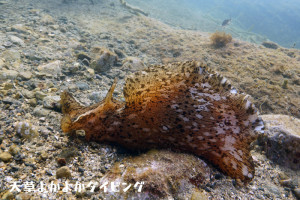
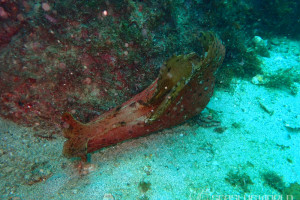
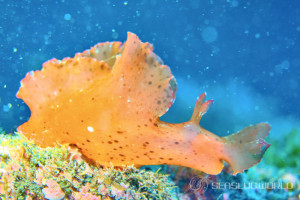
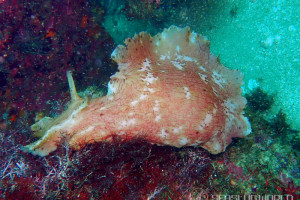
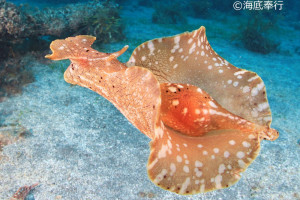
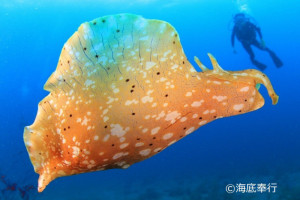
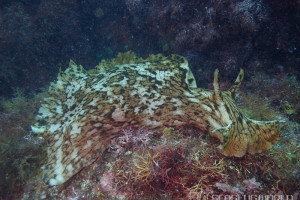
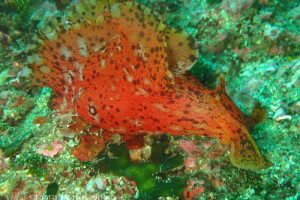
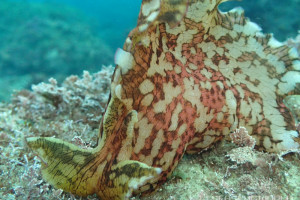
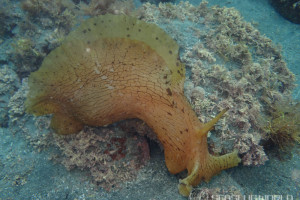
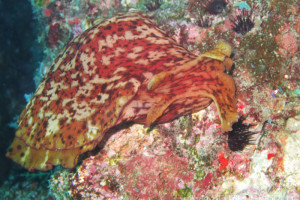
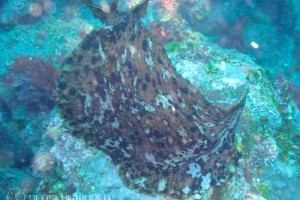
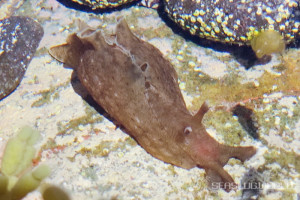
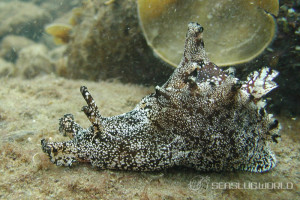
A very large sea hare reaching up to 60 cm in length, among the largest members of the family. The body is uniformly dark brown to black, with well-developed parapodia that allow short bouts of swimming. An internal, fragile calcareous shell remains in the visceral mass. When disturbed, the animal releases purple ink and a milky white opaline secretion; both are strongly toxic, and dogs that lick or chew stranded individuals on the beach can suffer severe poisoning.Distribution
Type locality is the Swan River, Western Australia (in Sowerby's 1869 original description "Swan River" was used as the colonial-era name for the Western Australian region as a whole). The confirmed range is concentrated in the southwestern corner of Western Australia, from Duke of Orleans Bay east of Esperance to Bluff Point north of Geraldton. In Japan the species has been recorded from Suruga Bay under the name Aplysia extraordinaria Allan, 1932; if A. extraordinaria is regarded as a junior synonym, the range extends into the northwestern Pacific.Etymology
The specific epithet gigantea is Latin for "giant," referring to this species being one of the largest members of the genus.Remarks
In southwestern Australia, mass strandings of hundreds of individuals occur on summer beaches between January and March. The animal is a simultaneous hermaphrodite and, during the breeding season, forms mating chains of 2 to 20 individuals, each acting as male to the animal in front and female to the one behind. Secondary metabolites from a diet of red algae accumulate in the body and are thought to be the source of the toxic ink and opaline secretion. Aplysia extraordinaria Allan, 1932 has long been suspected to be a junior synonym of this species, but no formal taxonomic decision has been published.References
- Aplysia gigantea n. sp., Sowerby G.B. II (1869). Monograph of the genus Aplysia. In: Reeve L.A. (ed.), Conchologia Iconica, or, Illustrations of the shells of molluscous animals, vol. 17. L. Reeve & Co., London. [August 1869]
- ジャンボアメフラシ(新称), 鈴木敬宇. (2000). ウミウシガイドブック〈2〉. TBSブリタニカ.
- 高岡生物研究会. (2002). 日本海のウミウシ. 第2版.
- アプリシア・ギガンテア, 中野理枝. (2004). 本州のウミウシ. ラトルズ.
- ショウワアメフラシ(馬場新称), I.Hamatani & Baba, K. 2004. A New Record of Aplysia (Varria) extraordinaria (Allan, 1932) (Opisthobranchia: Anaspidea) from Suruga Bay, Japan
- ゾウアメフラシ, 中野理枝. (2018). 日本のウミウシ. 文一総合出版.
- ゾウアメフラシ, 小野篤司 & 加藤昌一. (2020). 新版 ウミウシ. 誠文堂新光社.
Featured in this book
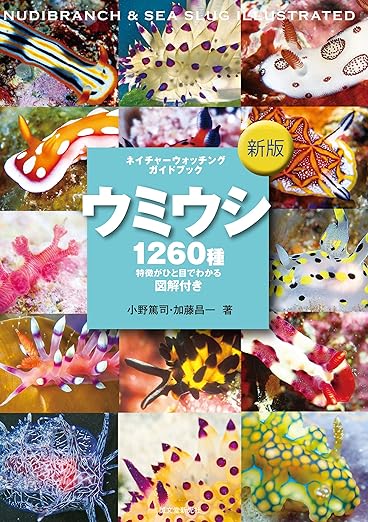
小野篤司 & 加藤昌一. (2020). 新版 ウミウシ. 誠文堂新光社.
誠文堂新光社
This species, Aplysia gigantea, is included in the book.
View on Amazon PR (Amazon Associates)Seasonality
Shooting Locations
Loading shooting locations...
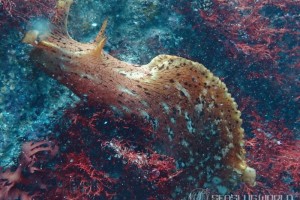
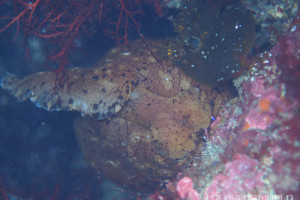
Photos of Aplysia gigantea













Same Genus Nudibranchs
Similar Colors Nudibranchs

Academic Database
Sea slug observation data is available in international marine biodiversity databases.