Chelidonura hirundinina (Quoy & Gaimard, 1833)
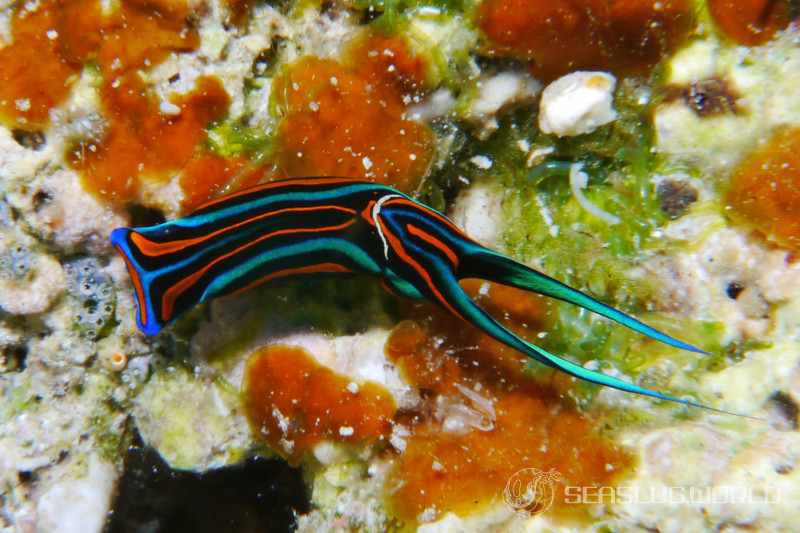
- Location
- Nanaban, Kerama(Zamami・Amuro・Gahi・Agenashiku), Okinawa, Japan
- Date
- 2015/06/26
- Length
- 5mm
- Depth
- 7.0m
- Water temperature
- 10.0℃
Description
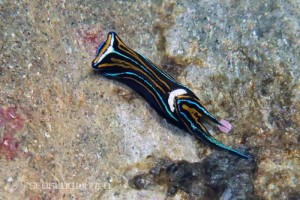
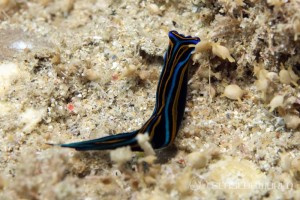
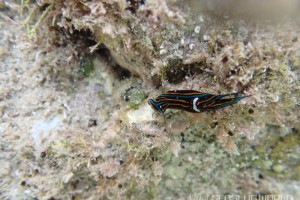
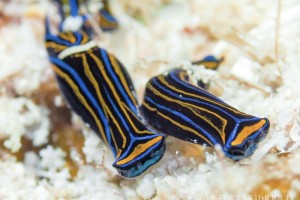
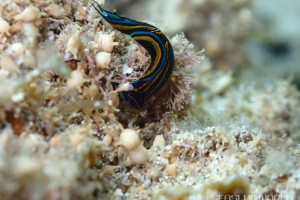
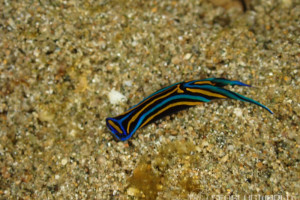
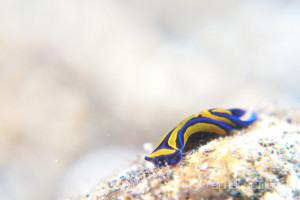
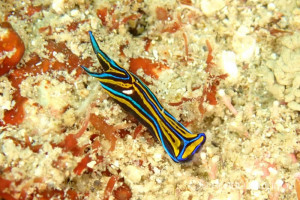
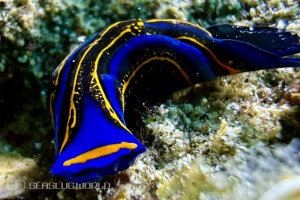
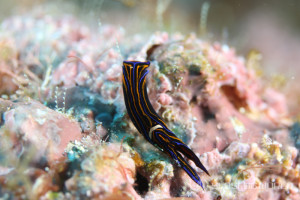
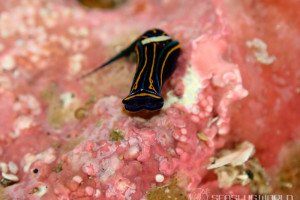
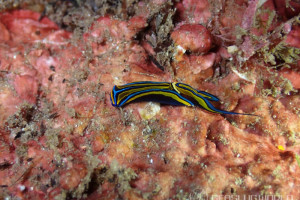
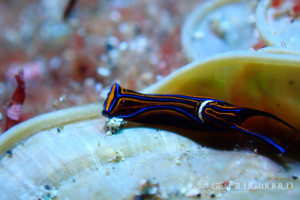
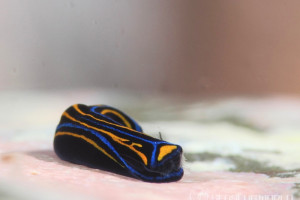
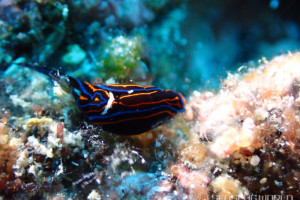
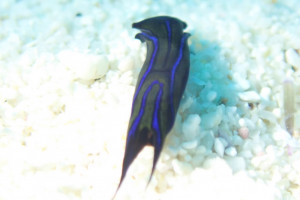
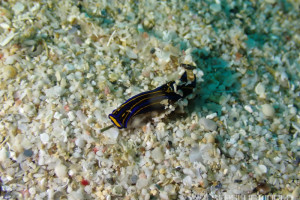
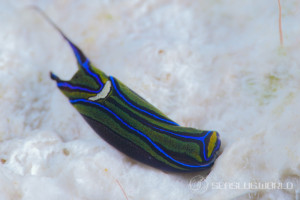
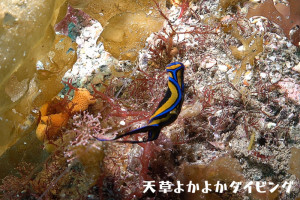
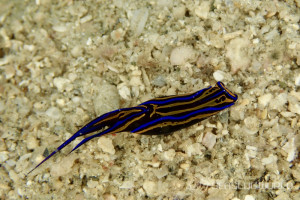
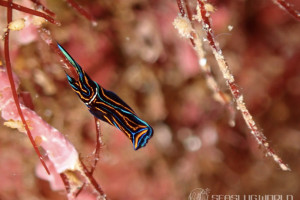
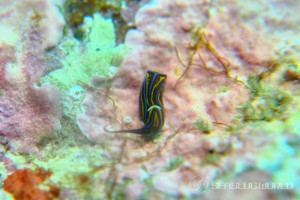
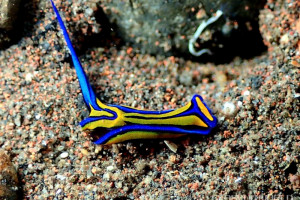
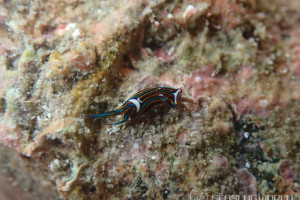
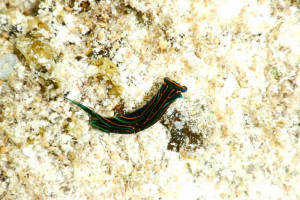
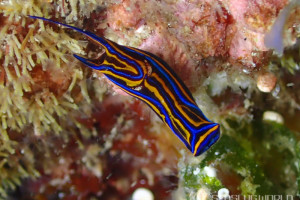
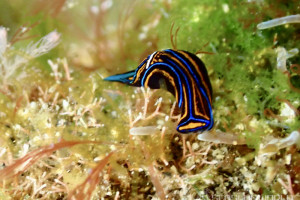
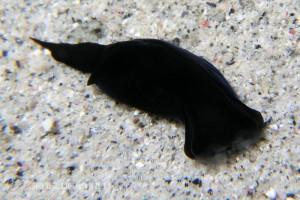
A small headshield slug, about 20–30 mm in body length, with a black background colour crossed by fine white, yellow and blue-green lines and spots. The mantle shield is divided into anterior and posterior lobes, with the rear of the posterior lobe drawn out into a pair of slender tail-like extensions reminiscent of a swallow's forked tail — the feature that inspired both the genus and species names. The shell is internal, hidden under the anterior mantle lobe and not visible externally. The head is broad and somewhat squared off in front, with the sides expanded into ear-like flaps. Colour patterning varies considerably between regions: the number and colour of the longitudinal lines (blue, yellow or orange) and the presence of a white transverse band on the rear of the mantle differ between Indo-Pacific and Caribbean populations.Distribution
A pantropical species widely distributed in shallow tropical and subtropical seas across the Indo-West Pacific and the Caribbean. The type locality is the area around Mauritius (Quoy & Gaimard, 1832). The first Japanese record of the genus Chelidonura was a single specimen collected on 23 July 1928 by Shōgo Hareyama in a tide pool near the breakwater of the Seto Marine Biological Laboratory of Kyoto Imperial University (Kii-Seto), reported by Taki 1930 as Chelidonura cf. hirundinina; the Japanese vernacular name ニシキツバメガイ was proposed in the same paper.Etymology
From the Latin hirundo (swallow), in the diminutive form: "little swallow", referring to the pair of slender tail-like extensions at the rear of the body that recall a swallow's forked tail. The genus name Chelidonura is from the Greek chelidōn (swallow) + oura (tail), reflecting the same feature.Remarks
The species crawls on sandy and rubble bottoms and is believed to feed on flatworms and other small cephalaspideans. Geographic variation in colour pattern is extreme, and several regional forms originally described as distinct varieties or species — including Chelidonura adamsi Angas, 1867 (Australia) and Chelidonura philinopsis Eliot, 1903 (Zanzibar) — are now treated as junior synonyms of C. hirundinina. The Japanese name ニシキツバメガイ combines 錦 ("brocade", evoking the brilliantly variegated body) with ツバメ ("swallow"), reflecting both the colour pattern and the swallow-tail body shape highlighted by Taki 1930.References
- ニシキツバメガイ Chelidonura cf. hirundinina (Quoy et Gaimard), 瀧巌. (1930). 貝類雑記 (2). ヴヰナス. 2(2): 51-60.
- ニシキツバメガイ, Baba K. (1949). Opisthobranchia of Sagami Bay collected by His Majesty the Emperor of Japan (相模湾産後鰓類図譜). Iwanami Shoten, Tokyo. 4+2+194+7 pp., pls. 1-50.
- Chelidonura hirundinina (Quoy & GAIMARD, 1832). Nishiki-tsubamegai., Baba K. & Abe T. (1959). THE GENUS CHELIDONURA AND A NEW SPECIES, C. TSURUGENSIS, FROM JAPAN. Publications of the Seto Marine Biological Laboratory. 7(2): 279-280. https://doi.org/10.5134/174605
- ニシキツバメガイ, 高岡高等学校生物研究会(編). (1964). 富山湾産後鰓類図譜.
- ニシキツバメガイ, 益田一. (1999). 海洋生物ガイドブック. 第2刷. 東海大学出版会.
- ニシキツバメガイ, 小野篤司. (1999). ウミウシガイドブック. TBSブリタニカ.
- ニシキツバメガイ, 鈴木敬宇. (2000). ウミウシガイドブック〈2〉. TBSブリタニカ.
- 高岡生物研究会. (2002). 日本海のウミウシ. 第2版.
- ニシキツバメガイ, 殿塚孝昌. (2003). ウミウシガイドブック〈3〉. TBSブリタニカ.
- ニシキツバメガイ, 小野篤司. (2004). 沖縄のウミウシ. ラトルズ.
- ニシキツバメガイ, 中野理枝. (2004). 本州のウミウシ. ラトルズ.
- ニシキツバメガイ, 小野篤司 & 加藤昌一. (2009). ウミウシ. 誠文堂新光社.
- ニシキツバメガイ, 中野理枝. (2018). 日本のウミウシ. 文一総合出版.
- Chelidonura hirundinina, Terrence Gosliner, Ángel Valdés and David Behrens. (2018). Nudibranch and Sea Slug Identification Indo-Pacific 2nd Edition. New World Pubns Inc.
Featured in this book

Terrence Gosliner, Ángel Valdés and David Behrens. (2018). Nudibranch and Sea Slug Identification Indo-Pacific 2nd Edition. New World Pubns Inc.
New World Publications
This species, Chelidonura hirundinina, is included in the book.
View on Amazon PR (Amazon Associates)Seasonality
Shooting Locations
Loading shooting locations...
Photos of Chelidonura hirundinina
Tag:
























Same Genus Nudibranchs

Similar Colors Nudibranchs
Academic Database
Sea slug observation data is available in international marine biodiversity databases.