Chelidonura alisonae Gosliner, 2011
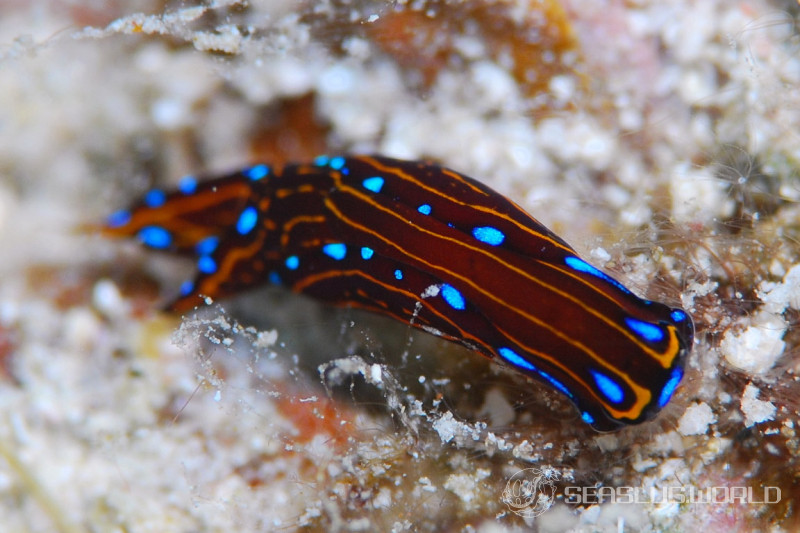
- Location
- Thoma No.2, Kerama(Zamami・Amuro・Gahi・Agenashiku), Okinawa, Japan
- Date
- Length
- 10mm
- Depth
- 5.0m
- Water temperature
- 25.0℃
Description
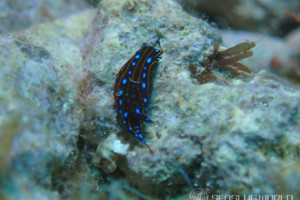
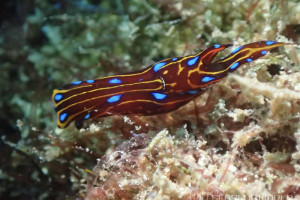
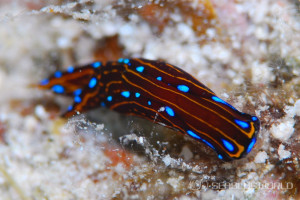
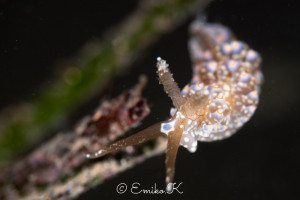
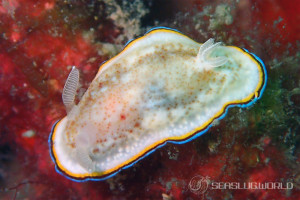
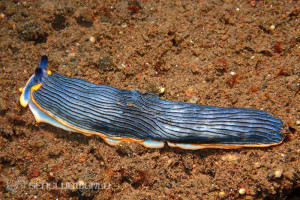
An aglajid head-shield slug with a black to brown general body colour. The head shield bears a pair of bright blue spots, each of which is surrounded by a pair of orange lines that connect anteriorly and form a loop around the blue spots. The two outer bands terminate at the outer edges of the cephalic shield after a short distance, while the two inner bands continue to the posterior end of the cephalic shield where they converge. At the posterior end of the cephalic shield a white or blue band is usually present, but may be absent in some specimens. There is also a large blue pigment spot on the anterior end of the head.The margins of the parapodia are decorated with five to seven pairs of bright blue spots. A submarginal orange line extends the length of the parapodia. Additional blue pigment spots are present on the dorsal portion of the posterior shield and on the surfaces of the two posterior extensions. Additional orange lines occur on the posterior shield, often coalescing into a reticulated network, and orange lines are also present on the ventral surface of the foot, where they form a network of interconnected lines. A specimen from Easter Island had less orange pigment that did not reach the end of the cephalic shield, with opaque white spots scattered on the dorsal and ventral surfaces, but the network of orange lines on the foot was still present.
The anterior end of the cephalic shield is trilobate. The cephalic shield is triangular, broadest anteriorly, and terminates posteriorly with a short rounded lobe. Elongate sensory bristles are visible on the anterior end of the head. The posterior shield is well rounded anteriorly and ends in two moderately elongate, broad posterior lobes that are acutely pointed at their ends; the left lobe is always longer than the right. The gill is plicate with 7–8 primary folds. The penis is somewhat variable in shape but has a smooth, conical penial papilla devoid of any armature.
Distribution
Central and eastern Pacific Ocean. Type locality: Diamond Head Beach Park, Honolulu, Oahu, Hawaii (intertidal reef platform). Recorded from the Hawaiian Islands, Johnston Atoll, Phoenix Islands, Moorea, the northern Marianas Islands and Easter Island. Found on exposed intertidal reef platforms and shallow reefs in 1–10 m depth.Etymology
Named in honour of the late Dr E. Alison Kay, Professor Emeritus of the University of Hawaii. Dr Kay was a superb mentor to many students, including the author of this paper, and pioneered the modern study of the molluscan fauna of the Hawaiian Islands and the biogeography of the central Pacific.Remarks
Diet: observed feeding on acoel flatworms of the genus Convoluta. Frequently misidentified as the sympatric Chelidonura hirundinina, but the two species are clearly distinguished by external morphology (the blue spots with orange loops on the head shield and the reticulated orange network on the foot), reproductive system, species mate recognition systems and molecular markers (23 % difference in the COI gene). Originally described in Gosliner T. 2011 Zootaxa 2751: 1-24.References
A Kindle field guide by the site author
Kimoto N. (2026). Sea Slugs of Japan & the Indo-Pacific, 2nd Edition.
Kindle Edition
View on Amazon PR (Amazon Associates)Seasonality
Shooting Locations
Loading shooting locations...
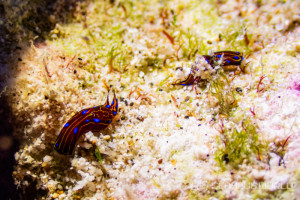
Photos of Chelidonura alisonae




Same Genus Nudibranchs


Similar Colors Nudibranchs


Academic Database
Sea slug observation data is available in international marine biodiversity databases.