Baeolidia scottjohnsoni Carmona, Pola, Gosliner & Cervera, 2014
Baeolidia scottjohnsoni
No field photograph submitted for this species yet
Have you photographed this species?Description
Body short and broad, tapering toward the posterior end of the foot; foot corners tentaculiform. Ground colour brownish. Bright white spots cover the head, dorsum and foot. The white spots on the notum form an almost continuous patch from the pericardial area to the posterior end of the foot, excluding the ceratal insertions. Iridescent blue pigment overlies the white spots, most evident where the cerata of both sides converge mid-dorsally and near the ceratal bases. Rhinophores, oral tentacles, and foot corners are brownish with bright white spots. Rhinophores are roughly the same length as the oral tentacles and bear elongate papillae; distal papillae whiter, with white tips. Cerata moderately short, flattened, leaf-like, slightly recurved inward; brown with white spots on the posterior side and a double subapical band on the anterior side. Upper half of each ceras white; lower half iridescent blue, sometimes reaching the base. An orange or pale ochre patch may occur on the distal posterior side, overlain by a bright ochre reticulate that converges at the apex; the apex is ringed in white. Cerata arranged in two arches with two rows on each side, with a distinct gap between pre- and post-pericardial groups.Distribution
Marshall Islands (type locality: Enewetak Pinnacle, Kwajalein Atoll, 10 m, on Caulerpa) and the Hawaiian Islands (paratype from Wahikuli, Maui).Etymology
Dedicated to Scott Johnson, the U.S. Navy-based naturalist and underwater photographer who provided abundant material from the Marshall Islands, including specimens of the new species (verbatim from the original description).Remarks
Long confused with Baeolidia japonica due to broadly similar coloration and a similar large receptaculum seminis, but identified as a cryptic species by the molecular phylogeny of Carmona et al. 2013 and formally described by Carmona et al. 2014. Distinguishing characters: (1) iridescent blue pigment over the dorsal white spots, (2) broader radular denticles than in B. japonica, and (3) folded receptaculum seminis.References
- Baeolidia sp. (Baeolidia japonica complex), Carmona L., Pola M., Gosliner T.M. & Cervera J.L. (2013). A tale that morphology fails to tell: a molecular phylogeny of Aeolidiidae (Aeolidida, Nudibranchia, Gastropoda). PLoS ONE. 8(5): e63000. https://doi.org/10.1371/journal.pone.0063000
- Baeolidia scottjohnsoni, Carmona L., Pola M., Gosliner T.M. & Cervera J.L. 2014. Review of Baeolidia, the largest genus of Aeolidiidae (Mollusca: Nudibranchia), with the description of five new species. Zootaxa, 3802 (4): 477–514.
- Baeolidia scottjohnsoni, Terrence Gosliner, Ángel Valdés and David Behrens. (2015). Nudibranch and Sea Slug Identification Indo-Pacific. New World Pubns Inc.
Featured in this book
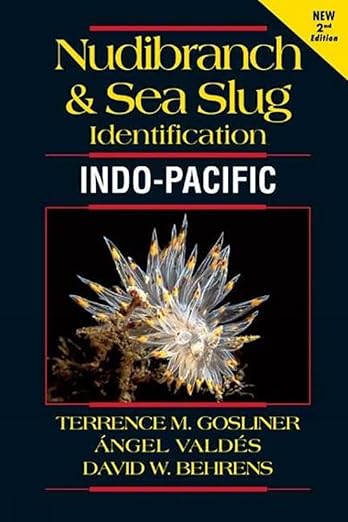
Terrence Gosliner, Ángel Valdés and David Behrens. (2018). Nudibranch and Sea Slug Identification Indo-Pacific 2nd Edition. New World Pubns Inc.
New World Publications
This species, Baeolidia scottjohnsoni, is included in the book.
View on Amazon PR (Amazon Associates)Seasonality
Shooting Locations
Loading shooting locations...
Same Genus Nudibranchs

Similar Colors Nudibranchs

Academic Database
Sea slug observation data is available in international marine biodiversity databases.