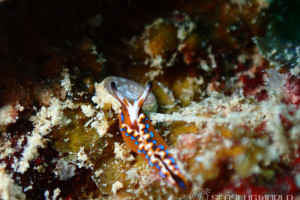
Chelidonura varians Eliot, 1903
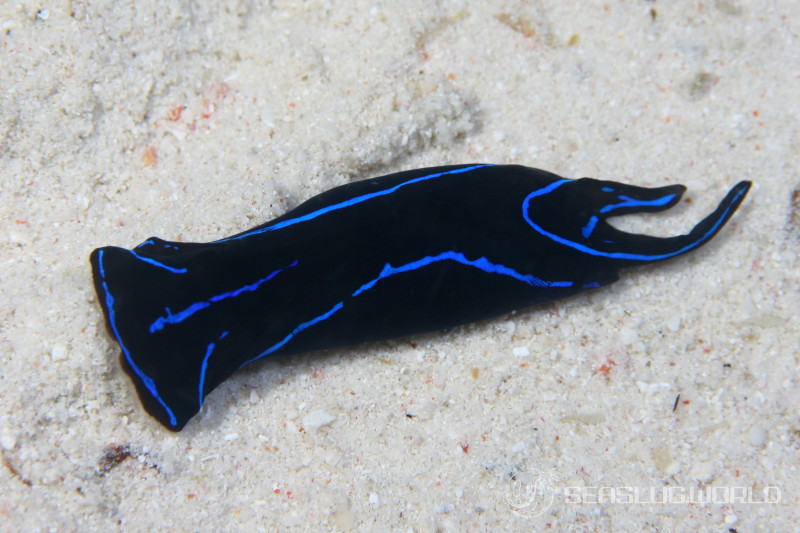
- Location
- Paradise 1, Mabul, Borneo, Malaysia
- Date
- 2011/05/19
- Length
- 50mm
- Depth
- 6.0m
- Water temperature
- 30.0℃
Description
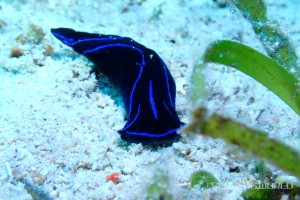
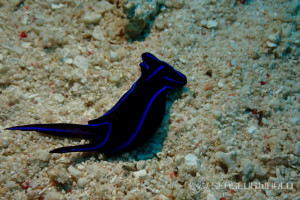
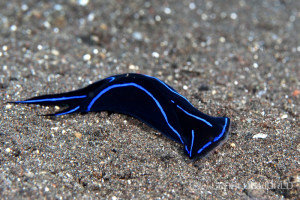
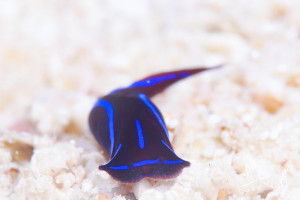
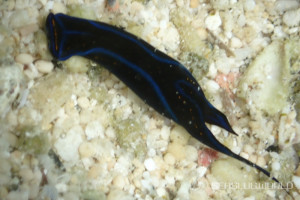
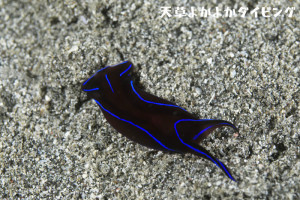
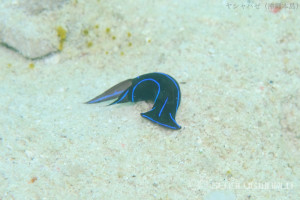
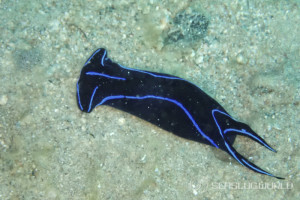
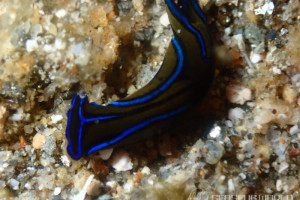
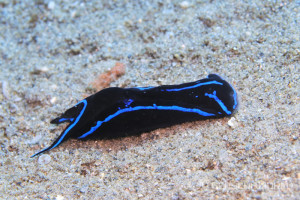
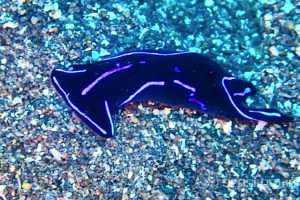
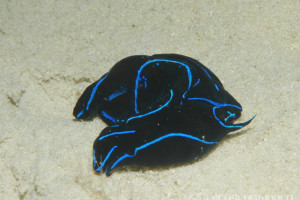
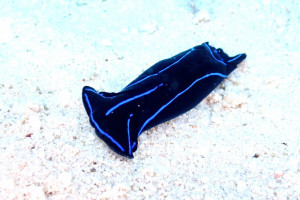
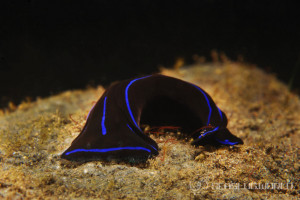
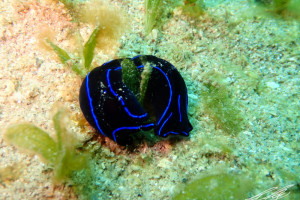
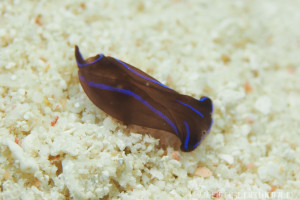
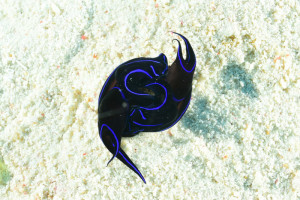
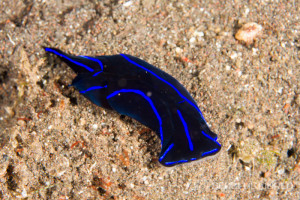
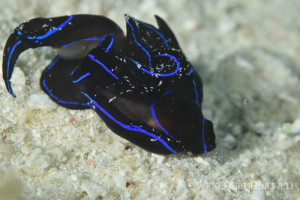
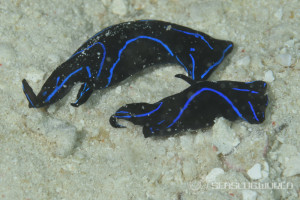
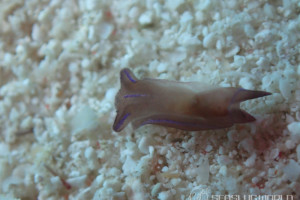
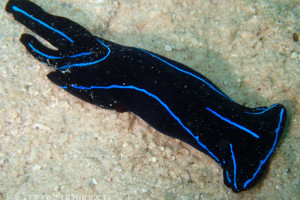
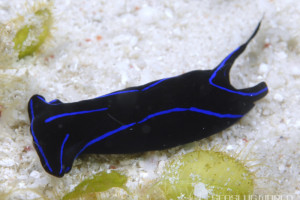
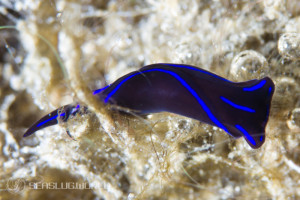
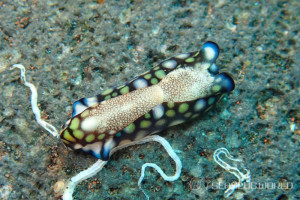
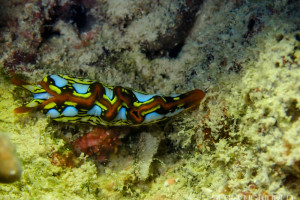
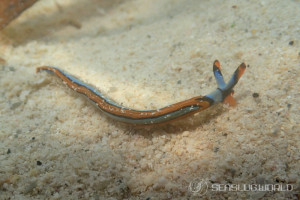
A medium-sized headshield slug with a deep black to dark indigo body that carries a velvety sheen. Vivid electric-blue lines trace the margins of the cephalic shield and parapodia, the median line on the head, the outer edges of the divided tail, and the area between the two tail lobes. The head is broadly expanded with sensory cilia along the anterior edge, used to detect prey. The mantle shield is divided posteriorly into two unequal tail-like lobes, the left one distinctly longer than the right. Reaches about 70 mm in length. The superficially similar Philinopsis gardineri lacks the long tapering tail.Distribution
Widespread across the tropical Indo-West Pacific, from the Red Sea and East African coast through the Maldives, Indonesia, Malaysia, the Philippines, southern Japan, Papua New Guinea, the Solomon Islands, New Caledonia, Fiji and northern Australia, with southern records extending to Lord Howe Island. Inhabits sandy and silty bottoms in shallow lagoons and reef flats, generally to about 30 m depth.Etymology
The specific epithet varians is Latin for "varying" or "variable," although Eliot's original description gives no reason for the name and the species in fact shows little variation in colour pattern.Remarks
A specialist predator of acoel flatworms and other small flatworms. Like most aglajids except Odontoglaja and the eastern-Atlantic radula-bearing Mannesia, members of Chelidonura have lost the radula, but the genus has evolved a rigid, muscular buccal bulb that acts as a suction pump, sucking prey in whole at remarkable speed. The species is widely traded in the marine aquarium hobby under the names "Blue Velvet Headshield Slug" or "Velvet Slug" for biological control of pest planarians, although wild collection raises welfare concerns and captive breeding is not established.The molecular phylogeny of Aglajidae by Zamora-Silva & a 2018 revision reorganised the family into 15 genera, seven of them new — Biuve, Camachoaglaja, Mannesia, Mariaglaja, Niparaya, Spinophallus and Tubulophilinopsis — and confirmed Migaya as a junior synonym of Nakamigawaia. In their tree the historical "Chelidonura" was paraphyletic and split into four lineages; C. varians sits inside the strict Chelidonura clade together with the type species Chelidonura hirundinina and an Indo-West Pacific assemblage including C. amoena, C. alisonae, C. inornata (now Mariaglaja inornata in some samples) and C. livida. The closest relatives recovered in the Bayesian and ML analyses are specimens of C. hirundinina from across the Indo-West Pacific and the Caribbean Chelidonura cubana. The species has therefore not been transferred — unlike many of its former genus-mates — and the original combination Eliot 1903 stands. Chelidonura velutina Bergh, 1905 (and the later Aglaja velutina Bergh, 1908) remain junior synonyms.
The type locality of C. varians is in the western Pacific (Eliot 1903 reported material from the Maldives and from off Loyalty Is.); Zamora-Silva & a 2018 revision sampled C. varians from Lizard Island (NE Australia), Lord Howe Island, Madagascar, the Bahamas, the Philippines (Bohol, Panglao), Papua New Guinea (Uama I.) and Okinawa (Manza, Sand I.) — the broadest molecular sample of the species to date — and recovered all of them as a single, well-supported clade.
References
- Chelidonura varians n.sp., Eliot C.N.E. (1903). Notes on some new or little-known members of the family Doridiidae. Proceedings of the Malacological Society of London. 5(6): 331-336.
- アオスジツバメガイ, 益田一. (1999). 海洋生物ガイドブック. 第2刷. 東海大学出版会.
- ケリドヌラ・ヴァリアンス, 殿塚孝昌. (2003). ウミウシガイドブック〈3〉. TBSブリタニカ.
- ケリドヌラ・ワリアンス, 小野篤司. (2004). 沖縄のウミウシ. ラトルズ.
- ゲンノウツバメガイ(新称), 中野理枝, 今川郁 & 今本淳. (2013). 南西諸島の後鰓類1. 頭楯亜目. ちりぼたん. 43(1-4): 1-22.
- Chelidonura varians, Zamora-Silva A. & Malaquias M.A.E. (2018). Molecular phylogeny of the Aglajidae head-shield sea slugs (Heterobranchia: Cephalaspidea): new evolutionary lineages revealed and proposal of a new classification. Zoological Journal of the Linnean Society. 183(1): 1-51. https://doi.org/10.1093/zoolinnean/zlx064
- ゲンノウツバメガイ, 中野理枝. (2018). 日本のウミウシ. 文一総合出版.
- Chelidonura varians, Terrence Gosliner, Ángel Valdés and David Behrens. (2018). Nudibranch and Sea Slug Identification Indo-Pacific 2nd Edition. New World Pubns Inc.
Featured in this book
Terrence Gosliner, Ángel Valdés and David Behrens. (2018). Nudibranch and Sea Slug Identification Indo-Pacific 2nd Edition. New World Pubns Inc.
New World Publications
This species, Chelidonura varians, is included in the book.
View on Amazon PR (Amazon Associates)Seasonality
Shooting Locations
Loading shooting locations...
Photos of Chelidonura varians
Tag:
























Same Genus Nudibranchs

Similar Colors Nudibranchs

Academic Database
Sea slug observation data is available in international marine biodiversity databases.